Thursday, June 26th 2025

Micron Announces New 2600 NVMe SSD With Adaptive Write Technology and G9 QLC NAND
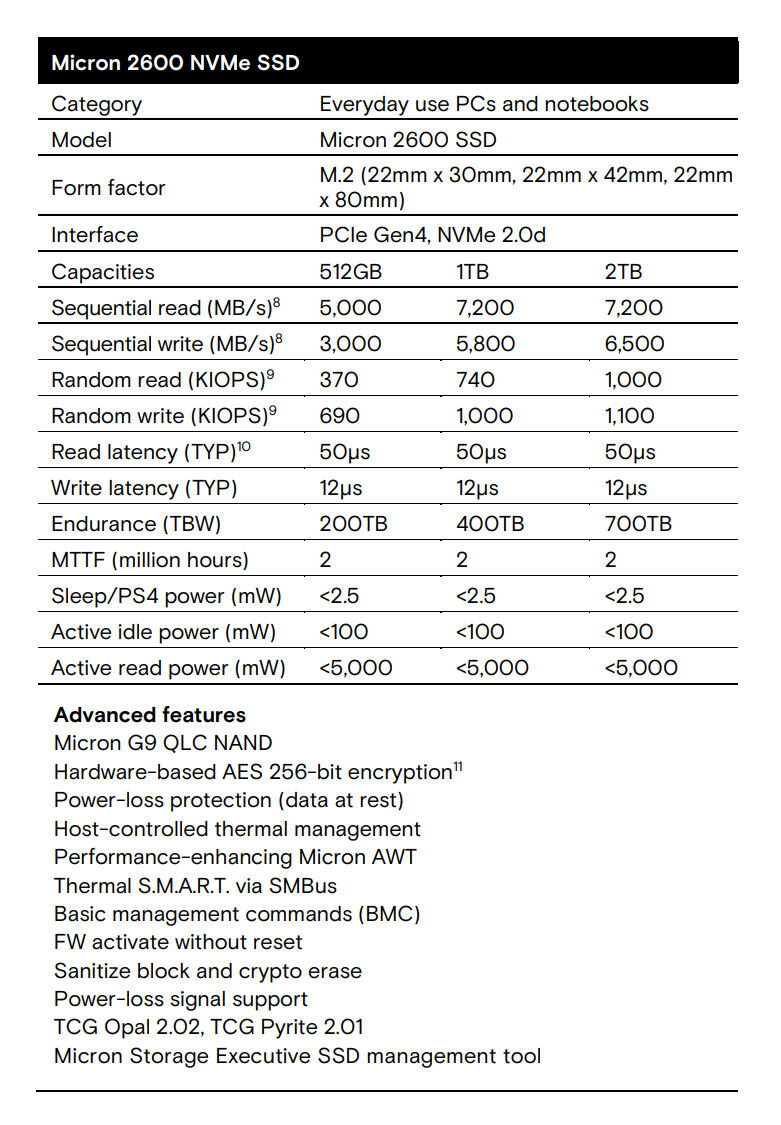
SSDs are vital to enhancing user experience and system performance for PCs and client devices. Micron Technology, Inc. today announced the Micron 2600 NVMe SSD, a value client storage solution designed for OEMs. Built with the industry's first 9th-generation QLC NAND in an SSD, the 2600 SSD features Micron's innovative Adaptive Write Technology (AWT) to deliver exceptional PCIe Gen 4 performance with QLC economics. The Micron 2600 SSD achieves up to 63% faster sequential write and 49% faster random write speeds than competing value QLC and TLC SSDs, offering a best-in-class user experience for demanding client users.
"The Micron 2600 QLC SSD achieves superior performance compared to competitive value TLC drives," said Mark Montierth, corporate vice president and general manager of the Mobile and Client Business Unit at Micron Technology. "Micron's unparalleled combination of high-performance G9 NAND and innovative Adaptive Write Technology unlocks the performance previously only considered possible with TLC drives and is in qualification with Micron's OEM customers. This Micron innovation milestone allows for broader commercial adoption of QLC NAND."
 Optimized QLC NAND performance
Micron AWT improves the write performance of QLC NAND by delivering an industry-first multi-tiered SLC, TLC and QLC dynamic caching architecture to improve sequential write speeds. Improved write performance provides up to four times faster sequential write speeds while continuously writing up to 800 GB of data to a 2 TB SSD.
The cutting-edge six-plane NAND architecture of Micron's 2 Tb G9 QLC NAND allows for higher degrees of parallelism and increases read and write commands issued to the NAND simultaneously to improve performance. With speeds up to 3.6 GB/s, the 2600 SSD offers the fastest NAND I/O rate now shipping in a client SSD.
Storage matters
Powerful PC storage solutions enable improved application productivity and optimized user experience. The Micron 2600 SSD transforms everyday computing experiences, significantly boosting productivity for commonly used applications.

Source:
Micron
"The Micron 2600 QLC SSD achieves superior performance compared to competitive value TLC drives," said Mark Montierth, corporate vice president and general manager of the Mobile and Client Business Unit at Micron Technology. "Micron's unparalleled combination of high-performance G9 NAND and innovative Adaptive Write Technology unlocks the performance previously only considered possible with TLC drives and is in qualification with Micron's OEM customers. This Micron innovation milestone allows for broader commercial adoption of QLC NAND."


Micron AWT improves the write performance of QLC NAND by delivering an industry-first multi-tiered SLC, TLC and QLC dynamic caching architecture to improve sequential write speeds. Improved write performance provides up to four times faster sequential write speeds while continuously writing up to 800 GB of data to a 2 TB SSD.
The cutting-edge six-plane NAND architecture of Micron's 2 Tb G9 QLC NAND allows for higher degrees of parallelism and increases read and write commands issued to the NAND simultaneously to improve performance. With speeds up to 3.6 GB/s, the 2600 SSD offers the fastest NAND I/O rate now shipping in a client SSD.
Storage matters
Powerful PC storage solutions enable improved application productivity and optimized user experience. The Micron 2600 SSD transforms everyday computing experiences, significantly boosting productivity for commonly used applications.
- Enhanced performance: The 2600 SSD accelerates data access, along with read and write speeds, leading to quicker boot times, faster application launch time and enhanced system responsiveness. Reduced OS image installation time ensures more efficient manufacturing process and fast commercial PC drive imaging for IT departments.
- AI PC applications: Storage performance is a key contributor to advancements in AI-driven applications. The 2600 SSD's fast read access allows AI models to be loaded quickly, enabling seamless transitions between tasks.
- User experience: AWT helps ensure active data is optimally stored in the SSD, resulting in smoother performance for content creation, casual gaming and everyday computing. In PCMark 10 testing, the 2600 SSD achieved up to 44% better scoring and 43% better bandwidth versus competitive value TLC SSDs, helping demonstrate the excellent user experience provided by the 2600 SSD.

25 Comments on Micron Announces New 2600 NVMe SSD With Adaptive Write Technology and G9 QLC NAND
I see no issue w/ QLC in a 'Fast Flash Drive' or Games/Storage drive, but would caution using one for a boot drive.
I've got a Sabrent Rocket Q4 1TB that came used as part of a lot. It's still alive today, but is infrequently used as an external storage device.
Regardless, QLC is less reliable and more-susceptible to certain failure modes (thermal- and power- related).
We have 2TB microSD cards now, with 4TB microSD plans to be released later this year or next year, while the nvme SSDs are still stuck on the 2, maximum 4TB sizes???
What gives??
do they really think I will leave an expensive 2TB drive empty? That marketing looks like awesome for a fresh empty drive. I expect worse performance as the budget Crucial P5 Plus 1TB drive.
SSD gave me the impression no performance degradation. I had to use defragmentation on HDDs quite often. It seems we are back as in the hold HDD days, slow performance and software overhead to get a bit of performance back. That does not work with advanced filesystem and / or with encryption and / or other software in between. It is not recommended to mark an encrypted block "in use".
Crucial sold me several different SATA SSDs and DDR4 kits which were high quality. I hope they do not ruin it with a bad product.
Samsung, people advertise for SAMSUNG storage quality, when I saw over the years bug after bug after bug on their storage. The SAMSUNG drives with issues is quite long. Just by reading news sites and forum i see bad samsung drives one after another over the years.
Wether it's external or internal storage, the trend is the same: sharp decline from 2021 to 2023, then fairly steady prices from mid 2023 to 2025.