Thursday, July 10th 2025

AMD Sampling Next-Gen Ryzen Desktop "Medusa Ridge," Sees Incremental IPC Upgrade, New cIOD
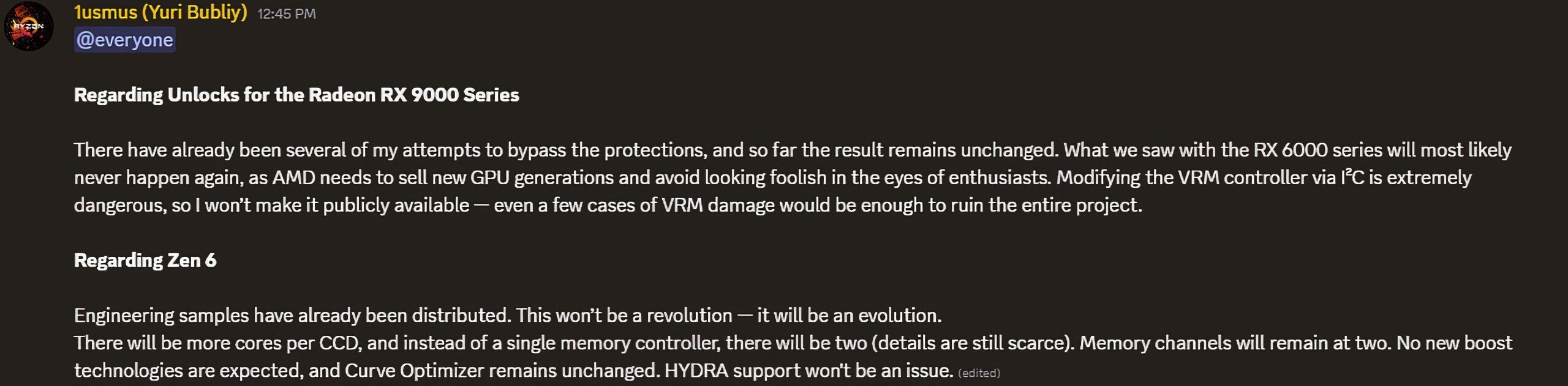
AMD is reportedly sampling its next-generation Ryzen desktop processor powered by the "Zen 6" microarchitecture, codenamed "Medusa Ridge," to close industry partners, such as platform designers and OEMs, says Yuri Bubliy, aka 1usmus, author of the Hydra tuning software, and the now-retired DRAM Calculator for Ryzen. The processor sees AMD update both the CCDs and client I/O die, he says. AMD confirmed that it is building the "Zen 6" CCD on the TSMC N2 (2 nm) node, which entered risk production earlier this year. The node is expected to be ready for mass-production of 2 nm chips later this year. The 2 nm node presents a significant jump in transistor densities from the current TSMC N4P node on which AMD builds its 8-core "Zen 5" CCD, which 1usmus and other sources say, that AMD will use to increase CPU core counts per CCD.
Sources point to the possibility of AMD increasing core counts per CCD to 12, and giving the CCD 48 MB of L3 cache. At this point we don't know if all 12 cores will be arranged in a single CCX with a monolithic slab of 48 MB L3 cache, or if there's a dual-CCX layout with 6 cores per CCX sharing 24 MB of L3 cache, each. The other big upgrade with "Medusa Ridge" is its client I/O die (cIOD). AMD is expected to build its new generation cIOD on a newer EUV node such as 5 nm N5 or 4 nm N4P, a significant upgrade from the current 6 nm N6. 1usmus says that the biggest reason for AMD to update its cIOD is the memory controller architecture. AMD is expected to give "Medusa Point" a new dual memory controller architecture. There are still two DDR5 channels per socket, but this is redesigned for increased memory speeds, letting AMD catch up with Intel in this area. As for the CPU frequency boosting technologies, such as PBO and Curve Optimizer, there are no updates expected, and 1usmus concludes that it Hydra support should be straightforward.

Source:
Wccftech
Sources point to the possibility of AMD increasing core counts per CCD to 12, and giving the CCD 48 MB of L3 cache. At this point we don't know if all 12 cores will be arranged in a single CCX with a monolithic slab of 48 MB L3 cache, or if there's a dual-CCX layout with 6 cores per CCX sharing 24 MB of L3 cache, each. The other big upgrade with "Medusa Ridge" is its client I/O die (cIOD). AMD is expected to build its new generation cIOD on a newer EUV node such as 5 nm N5 or 4 nm N4P, a significant upgrade from the current 6 nm N6. 1usmus says that the biggest reason for AMD to update its cIOD is the memory controller architecture. AMD is expected to give "Medusa Point" a new dual memory controller architecture. There are still two DDR5 channels per socket, but this is redesigned for increased memory speeds, letting AMD catch up with Intel in this area. As for the CPU frequency boosting technologies, such as PBO and Curve Optimizer, there are no updates expected, and 1usmus concludes that it Hydra support should be straightforward.

99 Comments on AMD Sampling Next-Gen Ryzen Desktop "Medusa Ridge," Sees Incremental IPC Upgrade, New cIOD
I doubt there will be changes which are am5 socket related.
DRAM standard is set in stone. I did not claim that. AM4 = DDR4 / AM5 = DDR5
I doubt they increase the CPU cache size. I always wanted that ages ago. Higher cache existed with special cpu cases. Intel had a few (intel 5775c or what they called it), amd had a few processors (x3d cpus).
I would accept zen 4 + zen4c (whatever they called the same cores with less cpu cache but same structure) or similar amd processors.
Note: 8 core - 5000 or 8000 series ryzen processors are kinda cheap
I know it's still dual channel here for Zen6 but COME ON AMD, YOU CAN DO IT, MAKE IT THICKER AND GIVE US QUAD CHANNEL ON ZEN7I mean, does anyone *really* need more ? the problem right now as it is the undoubtely *STUPID* amount of software that runs single-core/single-thread in this day and age
the still-too-few softwares that do run multi-core run fairly well and if you absolutely need more, Threadripper is there (though I'll be the first to admit it's definitely not a wallet friendly option)
though moving from 8 to 12 core CCDs is definitely nice for the mid-high end, as long as the price impact isn't too high...always wondered why there wasn't more things going on backside, mobo mfers experimented putting M.2s backsides a few times but it's not a regular thing (yet ?) and zero cable projects put all the power connectors on the backside of the mobo (obviously), CAMM2 ought to go on the back of mobos, right ?after a putting the cache below the CCD, better IMC, better interconnect, higher clocks across the board, AMD is cooking holy shitwell it's not all there will be to Zen6, I mentioned more of the Zen6 additions/changes above but tbh, I do hope the iGPU gets an upgrade along the IMC rebuild and they manage to sneak in an XDNA2 NPU (or maybe even XDNA3 ? who knows, I haven't heard much about XDNA development...)it used to be an Intel tactic, I hope AMD won't adopt it...I mean, 128 lanes of PCIe5 and quad/hexa/octachannel (I forgot how many are on current gen TRs) ECC memory is also a reason why you'd want such a platform to which Intel has no answer for besides Xeon that is massively expensive since server oriented instead of workstationI mean, they might not increase the cache *per core* but they will likely increase the overall cache along the core count5000 is on Zen3, it's a 2019 design, 6 years later, it's not that relevant anymore, the gap in IPC with Zen5 and soon-to-be Zen6 is huge already
also, 8000 series is a mobile design put in a desktop socket, it's not that surprising that it's cheap since not made to be really all that powerfulthere's a lot of noise (because of a bunch of BIOS update patch notes) about 9000G coming to desktop apparently, maybe that's it ? always wanted to see at least Strix Point come to desktop and bring a thick iGPU (and honestly, a good NPU wouldn't be too bad either)you'd need an IO controller on the CCD itself, kinda redundant tbh, not sure the improvement would be that significant, more interested in the better die interconnect that's also being added to Zen6
All components that are on the "main die" in this image must be made on a single die to ensure the fastest possible communication with each other. If any of these "main die" components were placed on a separate die, latencies go to increase significantly and overall performance go to drop significantly, similar to current Intel CPUs.
Games today tend to be increasingly aggressive in multithreading, including shader compilation and initial installation processes, which are also highly multithreaded.
Lots of games don't care about what are E-cores/Zen 5c cores, they just try to use them and that's it, and it works most of the time.
And if we're going to debate about little cores being useless (E-cores AND Zen 5c cores, because they technically all run at way lower frequencies than main cores), then why is AMD selling us 3 and 4-cores CPUs in €1500 laptops in 2025?
Other thing, haven't you noticed that the highest core count CPUs on mainstream platforms also have the best ST performance? AMD and Intel aren't dumb, they know that mixed workload is important for the mainstream platform. They won't sacrifice ST perf for MT. This isn't the Core 2 Quad era. Even in MT, the 9950x boost higher compared to the 9700x.
Abother thing: even if you personally won't have any use for anything above 8 cores, increasing the core count will make your 8 cores CPU cheaper, so you still win.
Last thing, there's also a strong chance that many apps don't scale that well past 8 cores not because they can't, but because 6-8 cores was probably the most common core configuration for a while. A decades ago many apps also didn't scale that well past 4 cores. Zen 1 was better for productivity only in a few select application. Since that era apps have improved in MT.Ah yes, and getting rid of the thing that made Ryzen so flexible in the first place : being able to use the same compute die and wafers used for Epyc and threadripper, and having to dedicate a whole wafer allocation just for gamers.
It'S time AVX512 will be a hard requirement for the next windows release with all the other newer cpu instructions.
When I want many cores without any cpu instruction sets I can use a arm platform also.
I’m excited to see a potentially faster fabric and higher memory frequencies + cudimm support. I want to chase some higher frequencies for fun, my IMC doesn’t like 8400 unfortunately :(
If you don't want to spend more time arguing, just don't ignore reality when it doesn't suit your narrative and don't call my post misleading by saying that I am quoting second hand prices. I am quoting real pricing here for new parts. You are quoting MSRP prices of products that are released in a market where other products exist. Obviously when AMD, Intel, Nvidia, EVERYBODY has flooded the market with products, they will not price their new line of products in such a way that will make the older products impossible to sell. Are we going to throw logic in the trash just to create a point?
and I doubt TSMC would make the IO die for cheap considering they're very much focused on the bleeding edge nodes and lower value lithography are almost dime a dozen in so many other types of tech, AMD could review a few foundries and pick a few one to make a cheap, effective IO die for the applications described in the picture
There is ZERO benefit to CAMM on desktops, CU-DIMMs match and exceed frequencies of camm modules without changing pcb/motherboard design. They offer nothing.
an NVMe consumes max between 7W (gen4) to 12W (gen5) and you probably can figure out the size of the coolers we can find for those, just make it the same for CAMM2, just less tall and more spread out, even hanging off the module's board, that should be fineI mean, low profile memory displaced to the back that sips power compared to DIMM, I'd buy
plus it would mean zero cooler incompatibilities, more space for bigger air coolers or a bulky water reservoir