Thursday, July 17th 2025

AMD Announces Official Ryzen Threadripper PRO 9000 WX-Series Pricing
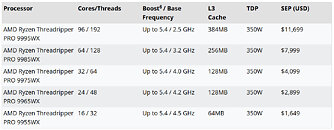
A month ago, AMD launched the Ryzen Threadripper PRO 9000 WX-Series of processors, but at the time, the company didn't provide any pricing. Today, in a blog post, the company revealed the pricing for five of the six new Threadripper processors, skipping the 12-core 9945WX for some reason. As these are workstation chips with up to 96 cores, pricing is accordingly high, with the 16-core 9955WX coming in at US$1,649. The 24-core 9965WX comes in at US$2,899, followed by the 32-core 9975WX at US$4,099. Things start to get really eye watering with the 64-core 9985WX at US$7,999 and finally the 96-core 9995WX at US$11,699.
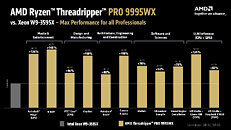
In all fairness, the per core cost actually gets a lot lower with the two high-end parts, but it's pretty clear that these 350 W TDP chips are not intended for consumer use. AMD also added some new benchmark figures, comparing the 9995WX with Intel's Xeon W9-3595X. AMD claims to best it by between 40 and 145 percent, depending on the benchmark in question. It's a bit of an unfair comparison though, as the W9-3595X is only a 60-core CPU that has an MSRP of US$5,889, but Intel doesn't have any higher-end options in its workstation lineup either. It would've made more sense to put the W9-3595X up against the 9985WX though, as the two are closer both in terms of core count and price point.
Source:
AMD
In all fairness, the per core cost actually gets a lot lower with the two high-end parts, but it's pretty clear that these 350 W TDP chips are not intended for consumer use. AMD also added some new benchmark figures, comparing the 9995WX with Intel's Xeon W9-3595X. AMD claims to best it by between 40 and 145 percent, depending on the benchmark in question. It's a bit of an unfair comparison though, as the W9-3595X is only a 60-core CPU that has an MSRP of US$5,889, but Intel doesn't have any higher-end options in its workstation lineup either. It would've made more sense to put the W9-3595X up against the 9985WX though, as the two are closer both in terms of core count and price point.


44 Comments on AMD Announces Official Ryzen Threadripper PRO 9000 WX-Series Pricing
And these aren't HEDT cpu's, they are high end professional workstation cpu's, if you need 96 cores you likely aren't concerned over the price.
It really is just about defending the brand for you isn't it. Of course whoever "needs" 96 cores will happily buy one, regardless of the cost, that's always been the case. $11700 for someone who's working for big budget studios or doing complex simulations for large corporations, the machine's paid off in a week. Even in a forum as large as TPU, there's only one user who comes to mind, and he already has a dual EPYC monster anyway. But this is not the case for the largest majority of people, who could perfectly use something better than a 9950X but don't necessarily need a 96-core processor. That's where they have failed to deliver.
But no, we're stuck in mainstream platforms with 20 miserly PCIe lanes and 2 memory channels because god forbid we have actual expandable desktop platforms anymore.
Your thoughts?
Clockspeeds might be a bit lower, but in the EPYC world you can get the -X chips with large L3 cache.
I
We don't need more gimmicks. Extra L3 cache makes no difference on most productive workloads, especially Threadrippers which have more thermal headroom resulting in less throttling.AVX-512 support is the same on Pro vs. non-Pro. The difference is 8 vs. 4 memory channels, PCIe channels and core count.Anyone who needs lots of memory and/or PCIe bandwidth.
Even more attractive will probably be 9960X (24C, 4-channel DDR5-6400) which will probably be priced at $1500 or less. (judging by retail prices so far)
Workstation CPUs are also more stable, offer more consistent performance under load (thanks to less throttling).
Ryzen 9900X/9950X are borderline "benchmarking CPUs", where those cores don't really come to much real use for productive workloads, the value is made worse thanks to very limited IO. Those who want a "semi-workstation" probably need several fast SSDs and possibly lots of drives, and a AM5 build will probably be very short-lived.Technically Intel's Xeon W starts at $359 BTW.It doesn't sell anything close to what it used to when they offered the real HEDT segment. High-end workstations have always been much more expansive than that.
But ever since Ryzen pushed the core counts too far on mainstream platforms, and the reviews focus on synthetic benchmarks, CPU that offer sustained performance become a hard sell. "Power users" on mainstream platforms upgrade more frequently, and as we all know, there is no one more desperate for an upgrade than a recent AM4/5 buyer. ;)
Just imagine if 12C Threadripper cost $700 and 16C cost $900 with motherboards at $400, they would sell like hot cakes. By comparison, Xeon W isn't that far off price wise, but are only available through server channels and overpriced PC vendors.
Why AMD and Intel, why don't you want to sell the good stuff?
However, the current AMD5, and subsequently, will improve in its capabilities and performance. As I consider this generation of Threadripper, there’s nothing in my mind to suggest that this CPU series will last for another 10 years. If this isn’t the last generation, then the next one will be. The AMD5 does not handle everything out of the box. I see that the generation chips support many more PCI lanes, handle Registered ECC RAM, Advanced Security, and other features. I have a current AMD5 chip; my issues include the lack of PCI lane support and full ECC RAM support (motherboard/Processor), among others. In my own thinking, I considered the AMD4 Epyc, but I believe someone has already mentioned that it has fallen short. I thought it would be the offering that could seamlessly integrate into existing small form factor systems, providing workstation functions, tasks, and stability. Being an offering right above the gaming CPUs, but not the larger format EPYCs, and so on.