Monday, July 28th 2025

NVIDIA to Debut GeForce RTX 50-series SUPER GPUs by Christmas
NVIDIA is planning to update its GeForce RTX 50-series SUPER line of graphics cards by Christmas 2025, says a report by TweakTown. The company will look to bolster the memory sizes of key performance-segment and high-end graphics card SKUs in a bit to boost their performance in higher resolutions, particularly with ray tracing and neural rendering enabled. In particular, NVIDIA is expected to leverage new 24 Gbit density GDDR7 memory chips that allow it to create memory sizes such as 18 GB over a 192-bit wide memory bus, or 24 GB across a 256-bit wide memory bus. Besides the added memory, NVIDIA is expected to marginally increase shader counts and GPU clock speeds.
The TweakTown article also sheds light on possible specs of the RTX 50-series SUPER lineup. Only the RTX 5070 SUPER sees an increase in SM counts over its non-SUPER predecessor, with the card maxing out the "GB205" silicon, enabling all 50 SM, for 6,400 CUDA cores, 200 Tensor cores, and 50 RT cores. The RTX 5070 Ti SUPER sees no increase in SM count over the RTX 5070 Ti despite being based on the "GB203" chip that the two share with the RTX 5080, and there being a rather large gap in SM count between the two (70 vs. 84). The RTX 5080 SUPER, much like the RTX 5080, maxes out the "GB203." What the RTX 5070 Ti SUPER and RTX 5080 SUPER have going for them is a 50% increase in memory size to 24 GB. The RTX 5070 Ti SUPER holds onto the same 28 Gbps memory speed as RTX 5070 Ti, while the RTX 5080 SUPER gets a marginal increase in speed to 32 Gbps. There are fairly good increases in TGP across the board for the RTX 50-series SUPER.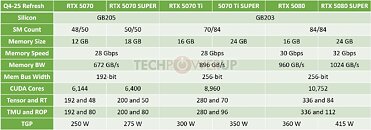
Source:
TweakTown
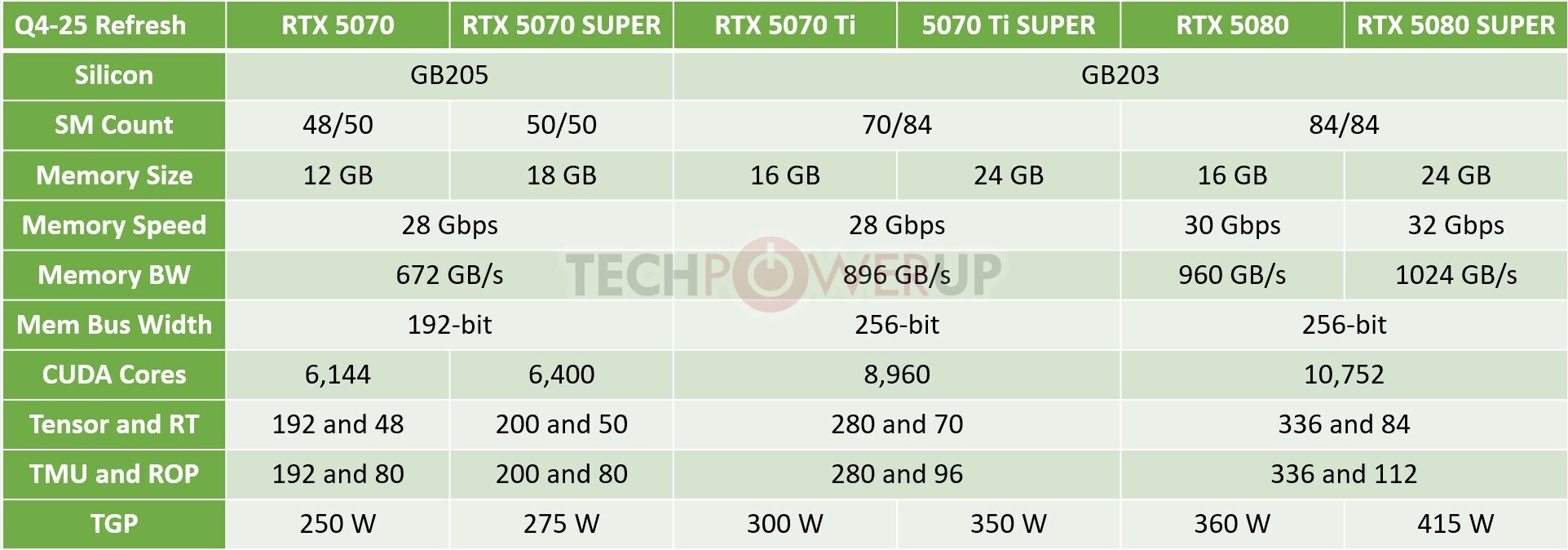
The TweakTown article also sheds light on possible specs of the RTX 50-series SUPER lineup. Only the RTX 5070 SUPER sees an increase in SM counts over its non-SUPER predecessor, with the card maxing out the "GB205" silicon, enabling all 50 SM, for 6,400 CUDA cores, 200 Tensor cores, and 50 RT cores. The RTX 5070 Ti SUPER sees no increase in SM count over the RTX 5070 Ti despite being based on the "GB203" chip that the two share with the RTX 5080, and there being a rather large gap in SM count between the two (70 vs. 84). The RTX 5080 SUPER, much like the RTX 5080, maxes out the "GB203." What the RTX 5070 Ti SUPER and RTX 5080 SUPER have going for them is a 50% increase in memory size to 24 GB. The RTX 5070 Ti SUPER holds onto the same 28 Gbps memory speed as RTX 5070 Ti, while the RTX 5080 SUPER gets a marginal increase in speed to 32 Gbps. There are fairly good increases in TGP across the board for the RTX 50-series SUPER.
112 Comments on NVIDIA to Debut GeForce RTX 50-series SUPER GPUs by Christmas
It doesn't change the very obvious behavior of artificial VRAM scarcity by Nvidia.
To drive people towards higher end model first then release SUPER models in 9 months.
So they can milk us twice.
For an average consumer,
Making a $800 purchase first and then a $950 purchase in 9 months
Is more preferable in their mind, than
Making a $1600 purchase first and use it til the next generation.
It is more preferable for Nvidia too.
They get 2 cash flows from 1 customer for 1 product lifecycle.
The only downside is
The customer purchased twice, spent $1750 dollars
Got 2 products which supersede each other ( Cause Nvidia killed SLI ) so the customer never enjoy the spent $1750 all at once.
Or the customer could get some cash back by selling the old one, maybe $650
Then the combine cost is $150 + $950 = $1100
So at the end,
The customer spent $1100 and only has a product worth of $950 on hand.
Big win for Nvidia, not so happy customer.
You clearly don't understand the market. The Super refresh is not there for people to upgrade twice every cycle. The Super refresh is there to convince people still on older GPUs (RTX 40 or 30) to upgrade by making Blackwell more appealing, once Nvidia has gotten hard sales numbers. They can re-adjust their SKU tiers to better reflect market demand. That's what happened last year with the 4070-Ti, for instance. Nvidia clearly made a mistake putting 12GB on a card of that strength, and they got punished for it with lower sales (still far higher than the entire RX 7000 series, though). After seeing what customers wanted, they re-adjusted the market, slotting in the 4070 Super at $600 with almost the same strength and a major price cut, and the 4070-Ti Super to have 16GB, fill the space under the 4080, and use all the imperfect AD203 chips. And then the 4070 Super became one of the best-selling Ada cards, despite only being there for half the cycle. Pretty good for consumers, if you ask me.
It's also there to provide an option for the casual AI market once gamers are taken care of and the premium customers have gotten the RTX Pro cards. Nvidia intentionally doesn't put as much VRAM on the initial models so AI demand doesn't jack up the price for consumers. If the 5070 launched with 18GB VRAM, for instance, it would be $800 and out of stock due to AI demand. Look at what happened with the 4090 and 5090. Do you want every GPU to be 2x MSRP and sold out for months?
And reviewers will still try to sell us Nvidia's marketing, praising the mediocrity.
No point in being butthurt about Blackwell.
It's a stopgap generation (tick-tock) while nVidia waits for 2nm.
Also for the 3GB VRAM chips. Which will be deployed in the Supers, those will serve as a testing ground and a counter to RDNA4.
nVidia probably could have made us a favor and uplifted the VRAM buffer from the get-go, but then there would have been no Supers/refresh lineup.
The real deal will be the 60 series. More muscle coupled with a larger VRAM buffer (and decreased power draw), if we were to ignore Blackwell and make comparisons with the 40 series then the gains will be significant, however they will be dragged out over a larger time period, larger than between two generations obviously.
Some people simply could not wait for longer, it's weird that they would regret their purchase decision, they weren't forced to buy Blackwell.
It is what it is. nVidia had to buy time with something, it's true that there is less progress from Ada to Blackwell than from RDNA3 to RDNA4.
People moaning that the improvement wasn't as good as from Ampere to Ada need to realise that about half of that improvement was from moving from Samsung
8nm10nm to TSMC 5nm.The fact that the cards have got on average 10-20% (besides 5090, again) faster with an identical node while massively improving AI capabilities and having hardware support for more types of math, for the same prices (despite inflation), purely from architectural improvements, faster VRAM, and minor core count bumps, is decent. It's not as groundbreaking as Ada was, no, but so what? Like others have said, NV is still on top, and they have options at every price bracket.
For the people whinging about VRAM capacity, the 3 Gbit chips were simply not available in the quantities required to put them in consumer tier cards upon release, as has been stated many times, by many people, already. Hence the RTX 6000 Pro being the only card that got them. Come this Super refresh, these chips are in high volume enough that they can be put into consumer cards for the mass market.
Nvidia now steers the USA narrative about what's allowed to be shipped to China, potentially making or loosing billions on AI accelerators, gaming toys are the last thing on their minds. If the Nvidia manages to make a generation with big performance increase, the pricing will mostly follow that.
And there are people defending this end of Moore's Law. Why should we be getting more for our money, just because the time passes? Of course, with this logic price increases following performance increases would bring us midrange cards costing tens of thousands of dollars, if we start in mid 90's Nvidia NV1.
Even if you believe the official "10%" numbers (real inflation based off groceries, prices of items etc, seems to be much higher), that's still in essence a 10% discount for the same tiers of hardware (again, besides 4090-5090), combined with a 10-20% performance increase.
I mean, I can go to Amazon and buy a decent 5070 Ti, which is essentially a RTX 4080S with some more features, for £729 next day delivery. That's a lot better than £1000, or £1100 adjusted for inflation.
Paying $700 for a 5070Ti still isn't a good deal because Nvidia will just double dip with the Super card, when that should've been the x70Ti card in the first place. The 50 series hasn't moved any progress from the 40 series, as mentioned above there wasn't a 50% performance increase from 40 series to 50 series. The praise a refresh gets is amazingly bad, celebrating the company with a near monopoly to sell you the same gen of card twice.
Tell me which computing company has lowered release prices in the past three years for products of the same tier/quality? NVIDIA is no exception, regardless of your own or others opinions on how arguably the world's most successful company could be doing better."Buying a card on release is a bad idea because something better will come a year later." Wow, what a compelling and original argument that definitely couldn't be said for literally any technology product. Is the smartest consumer the one that checks the market every year and decides "I think I'll wait"?
But please, if you can, explain to us all how you would have solved the supply problem of the (at the time) brand new 24 Gbit VRAM chips on Blackwell's release, for the most popular high end card, from the manufacturer with 90% marketshare?
To be clear, new high volume lines of these chips are only just hitting the market, as per this SK Hynix report from last week.
news.skhynix.com/sk-hynix-announces-2q25-financial-results/
You act like you were absent for the last 5 years.
Nvidia did this first time at the 3000 series.
Again in the 4000 series.
Now it is the third time.
I don't "understand" the market, nobody does.
But it is obvious enough to see a trend here, and "It just works".
Many customers fell for it, one way or another.
Most of the customers aren't smart enough or informed enough like the folks here.
They follow the brand, buy what the advertisements says.
And buy until the credit limit runs out.
That's also why they have to make 5060ti 8gb and 16gb (And yes, AMD also guilty)
Less informed customers would look at the hot items...which is the 16gb model.
Buy things based on brand name, the 5060ti
And got a 8gb model at the end, unnoticed.
Logically it is a scam, but legal in terms of law.
Also, stop the insults.
Also, you completely ignore the very real danger of AI demand. More VRAM means a GPU is more valuable for AI. The 4090 and 5090 both instantly sold out at launch and had "street prices" well above MSRP for months to years afterwards, due to their high VRAM capacity. If the 5080 launched with 24GB, it would just be $2000 and sold out everywhere for months. Do you really want that? Same thing with the 5070, if it launched with 18GB, it would probably be at least $1000 due to AI demand.