Monday, July 28th 2025

NVIDIA to Debut GeForce RTX 50-series SUPER GPUs by Christmas
NVIDIA is planning to update its GeForce RTX 50-series SUPER line of graphics cards by Christmas 2025, says a report by TweakTown. The company will look to bolster the memory sizes of key performance-segment and high-end graphics card SKUs in a bit to boost their performance in higher resolutions, particularly with ray tracing and neural rendering enabled. In particular, NVIDIA is expected to leverage new 24 Gbit density GDDR7 memory chips that allow it to create memory sizes such as 18 GB over a 192-bit wide memory bus, or 24 GB across a 256-bit wide memory bus. Besides the added memory, NVIDIA is expected to marginally increase shader counts and GPU clock speeds.
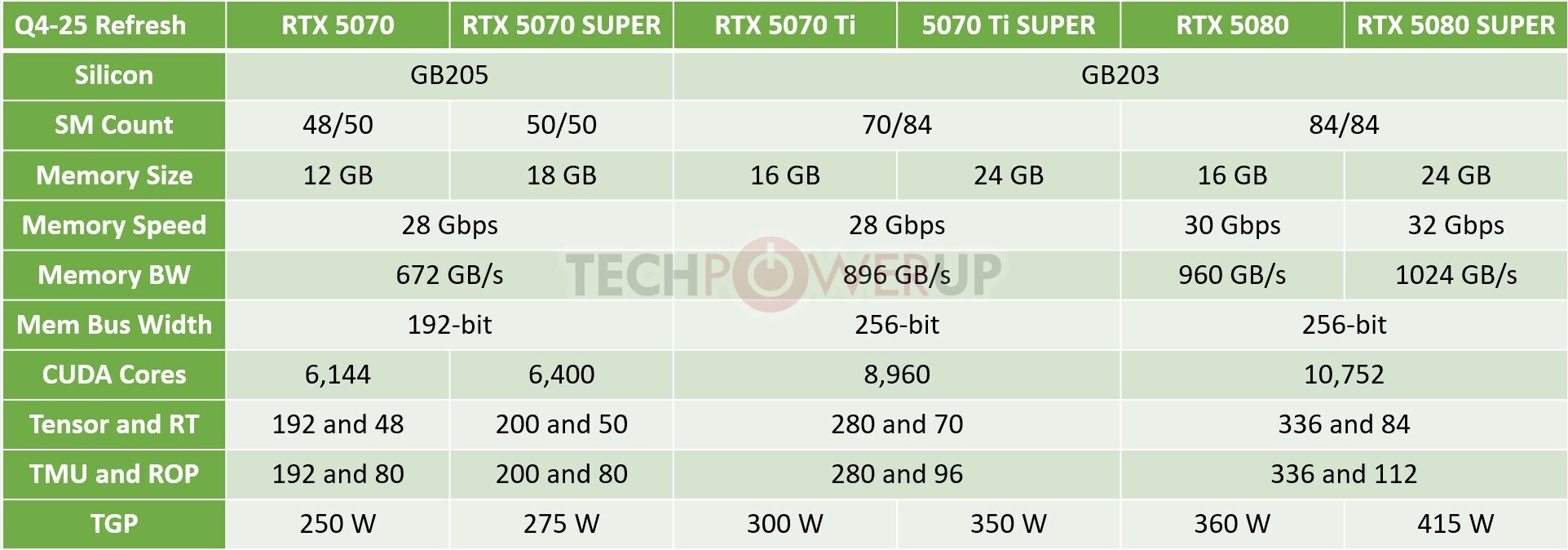
The TweakTown article also sheds light on possible specs of the RTX 50-series SUPER lineup. Only the RTX 5070 SUPER sees an increase in SM counts over its non-SUPER predecessor, with the card maxing out the "GB205" silicon, enabling all 50 SM, for 6,400 CUDA cores, 200 Tensor cores, and 50 RT cores. The RTX 5070 Ti SUPER sees no increase in SM count over the RTX 5070 Ti despite being based on the "GB203" chip that the two share with the RTX 5080, and there being a rather large gap in SM count between the two (70 vs. 84). The RTX 5080 SUPER, much like the RTX 5080, maxes out the "GB203." What the RTX 5070 Ti SUPER and RTX 5080 SUPER have going for them is a 50% increase in memory size to 24 GB. The RTX 5070 Ti SUPER holds onto the same 28 Gbps memory speed as RTX 5070 Ti, while the RTX 5080 SUPER gets a marginal increase in speed to 32 Gbps. There are fairly good increases in TGP across the board for the RTX 50-series SUPER.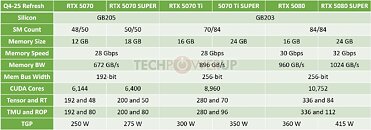
Source:
TweakTown
The TweakTown article also sheds light on possible specs of the RTX 50-series SUPER lineup. Only the RTX 5070 SUPER sees an increase in SM counts over its non-SUPER predecessor, with the card maxing out the "GB205" silicon, enabling all 50 SM, for 6,400 CUDA cores, 200 Tensor cores, and 50 RT cores. The RTX 5070 Ti SUPER sees no increase in SM count over the RTX 5070 Ti despite being based on the "GB203" chip that the two share with the RTX 5080, and there being a rather large gap in SM count between the two (70 vs. 84). The RTX 5080 SUPER, much like the RTX 5080, maxes out the "GB203." What the RTX 5070 Ti SUPER and RTX 5080 SUPER have going for them is a 50% increase in memory size to 24 GB. The RTX 5070 Ti SUPER holds onto the same 28 Gbps memory speed as RTX 5070 Ti, while the RTX 5080 SUPER gets a marginal increase in speed to 32 Gbps. There are fairly good increases in TGP across the board for the RTX 50-series SUPER.
112 Comments on NVIDIA to Debut GeForce RTX 50-series SUPER GPUs by Christmas
Whether a test is GPU limited or not is absolutely relevant for a GPU review. Hence my assertion that for 1080/1440p resolutions, they're of academic interest at the high end. Because even at 1440p in many games with a 5080/5090, the limit in the system is often the CPU, enough so that the results aren't as accurate for pure GPU performance rankings than at higher resolutions. Obviously this is only true for high end cards, for example it wouldn't be fair to use this same logic for $300 8 GB cards, because they could never handle that resolution in the first place. So in this context, knowing whether a resolution is CPU limited or not is absolutely relevant. Hence why 720p testing for CPU reviews used to be useful, not because anyone actually plays at 720p, but because you're minimising the GPU limit as much as possible to see what the CPU is actually capable of. A CPU that can't average 100 FPS at 720 is never going to hit more than that at any higher resolution. The opposite is true for GPU testing. Why make GPU speed inferences from test scenarios where CPU limiting factors are influencing whether the GPU is at 99%+ utilisation or not? So the 4K testing isn't because 4K is the most popular resolution, it's because it's the most demanding on the card, with the least CPU interference. Essentially you're testing the GPU in as close to an isolated GPU only test as you can, without going synthetic. This means the results can be used to determine realistic current and future card performance rankings. E.g. A 3090 that used to comfortably do 4K/60 upon release, can't really do that anymore in the latest AAA games with settings dialled up, but its still a fantastic 1440p card. So the 4K results are a pretty useful metric not just for accurate performance currently, but how well the card will stand the test of time with more common resolutions.
Hence my criticism of using 1080p charts to justify a "less than 10% faster" assertion. It's the same 'logic' as using 4K charts to say a 9800X3D for example is only 5% faster than a 5600X, when the reality is more like 50%.
Edit:
Still a bit pricey..
www.amazon.com/PNY-VCNRTXA200012GB-PB-NVIDIA-A2000-12GB/dp/B09SJ2BZ85