Monday, July 28th 2025

NVIDIA to Debut GeForce RTX 50-series SUPER GPUs by Christmas
NVIDIA is planning to update its GeForce RTX 50-series SUPER line of graphics cards by Christmas 2025, says a report by TweakTown. The company will look to bolster the memory sizes of key performance-segment and high-end graphics card SKUs in a bit to boost their performance in higher resolutions, particularly with ray tracing and neural rendering enabled. In particular, NVIDIA is expected to leverage new 24 Gbit density GDDR7 memory chips that allow it to create memory sizes such as 18 GB over a 192-bit wide memory bus, or 24 GB across a 256-bit wide memory bus. Besides the added memory, NVIDIA is expected to marginally increase shader counts and GPU clock speeds.
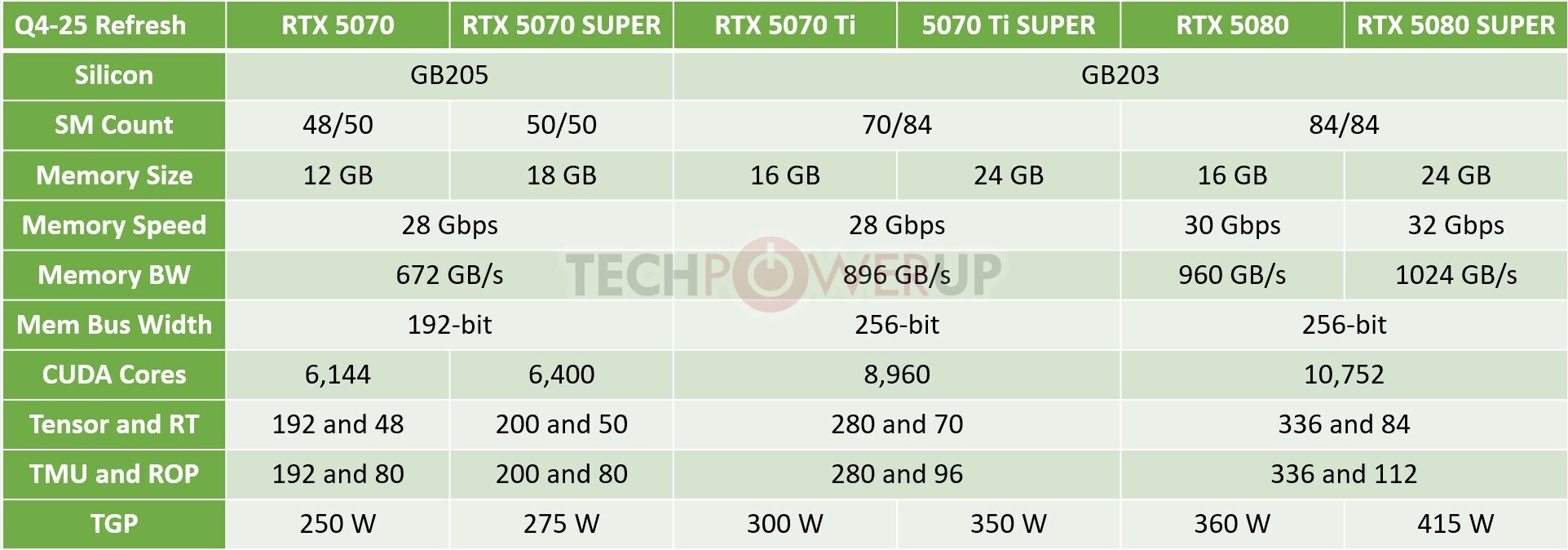
The TweakTown article also sheds light on possible specs of the RTX 50-series SUPER lineup. Only the RTX 5070 SUPER sees an increase in SM counts over its non-SUPER predecessor, with the card maxing out the "GB205" silicon, enabling all 50 SM, for 6,400 CUDA cores, 200 Tensor cores, and 50 RT cores. The RTX 5070 Ti SUPER sees no increase in SM count over the RTX 5070 Ti despite being based on the "GB203" chip that the two share with the RTX 5080, and there being a rather large gap in SM count between the two (70 vs. 84). The RTX 5080 SUPER, much like the RTX 5080, maxes out the "GB203." What the RTX 5070 Ti SUPER and RTX 5080 SUPER have going for them is a 50% increase in memory size to 24 GB. The RTX 5070 Ti SUPER holds onto the same 28 Gbps memory speed as RTX 5070 Ti, while the RTX 5080 SUPER gets a marginal increase in speed to 32 Gbps. There are fairly good increases in TGP across the board for the RTX 50-series SUPER.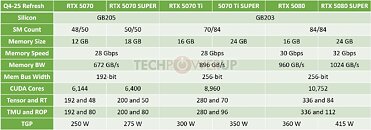
Source:
TweakTown
The TweakTown article also sheds light on possible specs of the RTX 50-series SUPER lineup. Only the RTX 5070 SUPER sees an increase in SM counts over its non-SUPER predecessor, with the card maxing out the "GB205" silicon, enabling all 50 SM, for 6,400 CUDA cores, 200 Tensor cores, and 50 RT cores. The RTX 5070 Ti SUPER sees no increase in SM count over the RTX 5070 Ti despite being based on the "GB203" chip that the two share with the RTX 5080, and there being a rather large gap in SM count between the two (70 vs. 84). The RTX 5080 SUPER, much like the RTX 5080, maxes out the "GB203." What the RTX 5070 Ti SUPER and RTX 5080 SUPER have going for them is a 50% increase in memory size to 24 GB. The RTX 5070 Ti SUPER holds onto the same 28 Gbps memory speed as RTX 5070 Ti, while the RTX 5080 SUPER gets a marginal increase in speed to 32 Gbps. There are fairly good increases in TGP across the board for the RTX 50-series SUPER.
112 Comments on NVIDIA to Debut GeForce RTX 50-series SUPER GPUs by Christmas
In real life those fully working chips come to market in profi rtx 6000 cards for a "little bit more" bucks.
- Base model
- Base model SUPER
- Base model Ti
- Base mode Ti SUPER
Is that right?
Whoops.
1440p is the correct one, either playing native on a 1440p display or using DLSS Quality on a 2160p display.
www.techpowerup.com/review/msi-geforce-rtx-5060-gaming-oc/33.html
Latest review, 8% more at 1440p.
CPU limited resolution 1080p. Because yeah, you buy $1000+ GPUs to play at 1080p, right?
Now go look at the 4K resolution where you are GPU limited, when comparing GPU performance.
SMH. So disingenuous.When comparing GPU performance, you use a GPU limited test. For xx80/90 class you are CPU limited even at 1440p. The 1080/1440 results are used simply so people on those resolutions can see what kind of performance they would get, or for academic interest. What Chromiq is doing is the equivalent of going to a CPU review and picking out the 4K resolution testing, then pretending that's some kind of 'gotcha', since all tested CPUs essentially perform within 15%.It's not cherry picking. You're trying so hard to be disingenuous it's unreal. You do not compare $1k+ GPUs in discussion at 1080p, because the CPU that can drive those cards at that resolution without bottlenecking them does not exist.
Even if you look at W1z specific performance testing vs other cards, he only shows 4K results. Take a moment to think why that might be...
www.techpowerup.com/review/nvidia-geforce-rtx-5080-founders-edition/35.html
It's already at 11%, 4080 and 4080 Super are nearly identical here. The point of Super bringing minimal performance gains stands.
My "quote" was a direct table from W1z 5080 FE review.
Again, try not to be disingenuous (or outright lie).
www.techpowerup.com/review/nvidia-geforce-rtx-5080-founders-edition/34.html
?
12% gen to gen, 1% difference between Supers.
Also:
It's not pre-release estimation. Who's lying now?
Let's stop pretending and misquoting.
Even if the 5080 Super has a similar perf gain (minimal) as the 4080-4080S, that's still going to be 15%, not "at most, 10%".
10% to 15% is a 50% relative difference. And that was "at most" 10%, implying the real number, and thus difference, would be less than that.
If you use "factual" numbers that turn out to not be factual, don't be surprised when you're called out for it on a technical forum.
If your point is true regardless, you shouldn't need to make up numbers to better fit your argument. Doing so is either outright lying, being disingenuous, or being ignorant.
If that's the goal post you're going to shift to, the question becomes, why even bring exact numbers into the conversation at all? Just say "the performance difference will be minimal".The 5070 Ti Super is already rumoured to be coming in this news as a 24 GB variant with a few more cores and higher power limit. As for the 5080 Ti it's very unlikely IMO, since the 203 die is maxed out for the 5080 already, and I strongly doubt NVIDIA is interested in wasting a 202 die on an xx80 Ti class when the competition has nothing faster than the xx70 Ti class.
From what I've seen online a good (not sure if the majority, but significant nonetheless) number of 4090 and 5090 owners say that they use DLSS Quality on 2160p displays. They simply do this so they can get more fps, they could play native and choke the GPUs but the visual improvement would not justify the performance penalty.
Thus with the 5080 yes you could play at 2160p in some titles but why would you if it's not beneficial?
So if people are not using the most brutal settings even if the hardware can take it (well until the next Crysis hits the market), but instead slightly more humane ones because the increase in fps far outweighs the visual downgrade, it means that the review scenario is mostly hypothetical, so for this scenario sure the performance difference between two cards might be 13%, but for the practical scenario that most people are using that difference will be 8%.
It is preferable to always be GPU bound but only when the native fps number is high enough to be playable. If it's a slideshow it's irrelevant, 15 fps is 50% better than 10 fps, but we can agree that in that case it really doesn't matter.I've analyzed the 4080 vs 4080 Super surprisingly low performance difference here, if anyone cares to give it a read (first half of the post).
It's absurd what people are asking for stuff on eBay. For one thing, not enough gen on gen performance for people to upgrade to a new card, and then the price of the new cards is such that the P/P ratio for the old cards doesn't really feel any pressure.
So everything just ends up hovering about $100 less than the equivalent new performance, often around the "fake MSRP" of the new cards rather than the proper deep discount you used to be able to get buying top end but one Gen back.
Say for example someone has a 4K display and a 5080/5090, they run DLSS 4 quality with the transformer model, but without frame generation. Great option, because it's essentially the same/better than native due to better AA, but with no latency issues. They also turn on the eye candy, so high raster settings plus some RT/PT, I mean, why wouldn't you, you've got a 5080/5090.
120/165/240 Hz 4K displays are quite cheap these days, especially for someone willing to pay $1-2k for a 5080/5090. In that case they'll likely be interested in maintaining around 120 FPS, something that even the humble 7600 or 12400F can handle, ruling out being CPU limited. So even if they're running with DLSS Q, as long as they're turning up the settings past a certain point, it's still a GPU limited scenario, because FPS is still going up as resolution goes down. So using raster only unlocked frame rate 1080/1440p testing, with the strongest current gaming CPU, the 9800X3D, to estimate performance is still using a CPU limited method, because the GPU could clearly work harder at those lower resolutions, but isn't, due to the fact these cards are just so powerful. So inferring performance data from those resolutions isn't appropriate for that use case you're describing.
You can see this if you look at max frame rates in the raster testing. For example: Black Myth Wukong. It's basically running at 60-70 FPS whether it's 1080 or 1440, it's not till 4K that it drops to the 30s. Now would you say that data is CPU or GPU limited?
www.techpowerup.com/review/nvidia-geforce-rtx-5080-founders-edition/33.htmlIn this case, 13% perf difference between 5080 and 4080 works out to 97 vs 84 FPS. A "10%" difference would have been 92 FPS. A 5080S with another few % on top of that would be above 100 FPS.
I would agree in your hypothetical situation though that 15 or 10 FPS would both be unplayable.
At 4K Ultra though these 5080 cards are pushing close to 100 FPS. So +/- 5% is meaningful, especially if we're going to maintain at least a pretense of being technically accurate on this technical forum.
Ti Super didn't exist until the 4070-Ti Super.
These days, going off Ada and Blackwell, it does seem like the base xx80 card uses all/almost all the xx 203, and the xx80S uses all of it, plus better clocks/power limit/in the case of the 5080S more VRAM on the same bus. There is no 3080 Ti or 3090 Ti equivalent, those are the Quadro cards. Plus the 3090 Ti was kinda needed because the clamshell GDDR5X ran quite hot and drew a lot of power, eating into the core budget, the fact it got a few extra cores besides the double density VRAM chips eliminating the need for clamshell seems almost an afterthought. The power budget freed up for the core went to good use.
Seems like the only consistent logic is that the Super is going to be faster. As sometimes it's the same die, sometimes it's the next bigger one. Like for example the 4070 Ti vs 4070 Ti Super, to make the Super they had to use the 4080 die. But with 5070 Ti and 5080 they're already both on the same die, and the Supers will be too, just with 24 Gbit VRAM chips instead of 16 Gbit, and with more clocks/higher power limit. In the case of the 5070 Ti Super, a few more cores too, but obviously that's not possible with the 5080 Super.
But only GPU limited is relevant in this discussion, if a GPU upgrade is put on the table it's for GPU limited scenarios.
All of this would mean that resolution per se doesn't necessarily determine whether GPU bound or CPU bound, instead GPU utilization.
If GPU utilization is at 99% it means it's GPU bound regardless of fps number, visual settings or resolution, right?
Games are not constant from start to end, even for games that are generally GPU bound, there are areas which are CPU bound.
I would argue that for GPU tests, regardless of game, the reviewer should test in GPU bound areas. The opposite would be true for CPU tests.
As such weak cards should be GPU bound even at lower resolutions, I doubt that the GPU utilization wouldn't be at max when the fps number is in slideshow territory.
Again, if you're getting satisfactory native fps numbers when being at 99% utilization in a game, if the resolution is 2160p, then you could leave at that, no need to lower the resolution.To be fair it's 77, 60 and 38 respectively. The massive drop at 2160p shows that in this example this resolution is complete fantasy for the 5080.
I know one thing: everyone would choose the lower resolution and the higher fps. Nothing else matters.