Friday, August 22nd 2025

AMD Medusa Halo APU Leak Reveals Up to 24 Cores and 48 RDNA 5 CUs
A fresh leak has shed light on AMD's next-gen Medusa Halo APU that is set to launch in 2027 as the company's top-of-the-line chip (dismissing previous rumors about AMD cancelling Medusa Halo APU). Moore's Law is Dead has shared information suggesting Medusa Halo will pack Zen 6 CPU chiplets made using TSMC's cutting-edge N2P process, with the I/O die will be made using the N3P process. The base Medusa Halo APUs have 12 Zen 6 cores alongside 2 power-efficient Zen 6 LP cores, while high-end versions might include an extra 12-core Zen 6 CCD. This means AMD will provide Medusa Halo APUs with 24 CPU cores (and possible even up to 26 cores).
For graphics, the Medusa Halo APUs will feature 48 compute units (CUs) based on RDNA 5 architecture alongside 20 MB of L2 cache. This represents a significant jump from the 40 CUs in today's Strix Halo APU and should deliver graphics power on par with an NVIDIA GeForce RTX 5070 Ti, a big step forward for built-in GPUs. Memory support is in line for a big boost, with Medusa Halo set to offer either a 384-bit LPDDR6 or 256-bit LPDDR5X memory controller. This will provide high bandwidth to match its upgraded GPU needs.
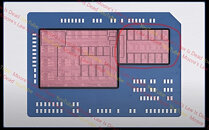
 AMD is also said to be preparing a Medusa Halo Mini variant to be used in notebooks and compact systems. This streamlined model is expected to include 4 Zen 6 cores, 8 Zen 6c cores, and 2 Zen 6 LP cores (14 total), paired with 24 RDNA 5 CUs and 10 MB of L2 cache. It will reportedly use a 128-bit LPDDR5X memory controller, with the possibility of upgrading to 192-bit LPDDR6.
Sources:
IT Home, MooresLawIsDead
For graphics, the Medusa Halo APUs will feature 48 compute units (CUs) based on RDNA 5 architecture alongside 20 MB of L2 cache. This represents a significant jump from the 40 CUs in today's Strix Halo APU and should deliver graphics power on par with an NVIDIA GeForce RTX 5070 Ti, a big step forward for built-in GPUs. Memory support is in line for a big boost, with Medusa Halo set to offer either a 384-bit LPDDR6 or 256-bit LPDDR5X memory controller. This will provide high bandwidth to match its upgraded GPU needs.


45 Comments on AMD Medusa Halo APU Leak Reveals Up to 24 Cores and 48 RDNA 5 CUs
Bandwidth will be probably around 256GB/sec for the "low end" model and 340GB/sec for the "mid range" model. RX 9060XT's bandwidth is at 322GB/sec, so LPDDR5X could do the job.
Don't know if availability and pricing of LPDDR5X over GDDR6 will be enough to justify a swap from GDDR6 that will be offering equivalent bandwidth on a smaller 128bit bus. Not to mention that Nvidia with GDDR7 or whatever comes after that will have a tremendous advantage on memory bandwidth.
Medusa Point (not halo) using chiplets sounds worrying, it may not be the low-power king that's Cezanne and Phoenix. But maybe they managed to get the interconnects close enough so they won't cause an increase in power usage.
On the other hand there was a rumour about a year ago that they are figuring out how to put X3D on the APUs. Chiplets would help out there. Just imagine Medusa Halo with X3D.
If they had not been confident enough with new Infinity Fabric, Strix Halo wouldn't have existed in the first place. Strix Halo is an experimental vehicle for new solutions in Zen6 products. New Infinity Fabric will be at least twice as fast in Zen6 EPYC, as they move to support PCIe 6.0 in server. Traditionally, Infinity Fabric had similar speed per single link to whatever PCIe standard was supported. We will need ro wait and see how new IF is deployed across CPU/APU segments.
I haven't seen any detailed screenshots of Strix Halo power usage (HWMonitor or HWInfo) so I don't know how they fare with this.
RDNA4 is GFX12. RDNA5/UDNA will be GFX13.
The point of "UDNA" is simply that AMD will align compute between their CDNA and RDNA lines so that ROCm will be able to run cleanly up and down the stack the way CUDA does for Nvidia right now. This will require some synchronization between CDNA and RDNA, but it doesn't mean that Instict cards will run off of really big RDNA dies or that consumer facing RDNA cards are going to be shrunk and stripped down Instinct cards.
They are always going to be different lines, but AMD has acknowledged that it needs a top to bottom compute language like Nvidia so there will be some design cross pollination between the Instinct and RX dies (talk about a day late and a dollar short, jeezus, but the guys running the show now aren't the same ones running things when CUDA hit the scene).
Be patient, wait, and you will live to see Medusa Halo with next gen hardware. Some specs can obviously change until final products are ironed out, but there is nothing that sounds "too good". It's next gen hardware and AMD is capable of pushing it across segments.
IF is going to be at least twice as faster on Zen6 CPUs. This is because EPYCs will support PCIe 6.0, so expect significant improvements in speed, latency and idle power draw. It looks like they have matured IF interconnect better than ever before. That's why they are confidently offering more products in chiplet configurations, including dies for new consoles. We will see how this translates into performance next year already.
The APU gfx power doesn't sound entirely unrealistic given the Ryzen AI Max+ 395 has demonstrated some decent gaming chops numbers (pity about the name)
I'd like to see a different take on cores and get more of a FPGA style core for something like transcoding video (or encoding when I stream) that's not a task taken on by the cpu or gpu. I dunno, maybe the efficiency cores could be used for something like that.
For me being a neural diverse lunatic, the idea of an efficiency core handling windows and being able to task the second to to something specific like encoding/transcoding (maybe even video decoding a stream) really appeals to my need for order, then the cpu can just be thrown at a game or rendering task and the gpu the same.
There's probably something I should be looking at to make my 7800X3D's integrated gpu to do these tasks now