Monday, September 8th 2025

Intel 14A Node Expected to Cost More Than 18A, Driven by High-NA EUV
At Citibank's Global 2025 TMT conference, Intel CFO David Zinsner made an appearance and talked about the economics of Intel's next-generation 14A node. According to Zinsner, the "14A [node] is more expensive than 18A. It is not significantly [more expensive] in terms of investment. [But] it is a higher wafer cost, for sure and partly that is because we, we are expecting to use High-NA EUV tools in 14A, which was not the case in 18A." The use of High-NA EUV tools suggests that Intel will install the Twinscan EXE:5200B machine, which costs $380 million. Given the high cost of these tools, Intel will need to raise its wafer prices to break even, assuming the 14A node attracts external customers.
Intel claims its upcoming 14A node will deliver significant efficiency gains, achieving roughly 15-20% better performance per watt, or a 25-35% reduction in power consumption compared to the 18A node. Under the hood, 14A combines several process advances. RibbonFET 2 updates Intel's gate-all-around transistor architecture, while PowerDirect moves the power delivery network to the chip's backside so supply rails can feed transistor sources and drains more directly. The node also introduces Turbo Cells, taller high-drive cells placed within compact standard-cell libraries to shave critical timing paths and lift CPU and GPU frequencies without large area or power penalties. By contrast, scaling 18A will depend on more capable lithography tools with higher resolution, so the node can avoid relying on multi-patterning.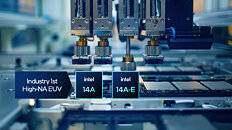
Source:
via Tom's Hardware
Intel claims its upcoming 14A node will deliver significant efficiency gains, achieving roughly 15-20% better performance per watt, or a 25-35% reduction in power consumption compared to the 18A node. Under the hood, 14A combines several process advances. RibbonFET 2 updates Intel's gate-all-around transistor architecture, while PowerDirect moves the power delivery network to the chip's backside so supply rails can feed transistor sources and drains more directly. The node also introduces Turbo Cells, taller high-drive cells placed within compact standard-cell libraries to shave critical timing paths and lift CPU and GPU frequencies without large area or power penalties. By contrast, scaling 18A will depend on more capable lithography tools with higher resolution, so the node can avoid relying on multi-patterning.

13 Comments on Intel 14A Node Expected to Cost More Than 18A, Driven by High-NA EUV
Apple: What is the cost per wafer?
Intel: $10
Apple: TSMC's price is $12 but I know that my chips will be good.
Intel: $8
Apple: I know that they will be performing as expected.
Intel: $6
Apple: With no degradation effects.
Intel: ..............$5?
Apple: Deal.
The new management discards the accomplishments of the old management, because it wasn't theirs.
18A was supposed to be Intel's crown jewel and frankly I see no reason why it still can't be. Who here is running a 2nm CPU? 2nm GPU?
Nope, they don't exist yet. Intel will likely be the first to market with that by 6-9 months, and yet it is already a 'failure'? Why not just focus in on it , get the volume up, and make it better? Maybe if they did that then by this time in 2026 we could have laptop, desktop, and GPUs on Intel 18A while the competition just starts to release some token volume N2 parts for stupid high prices?
But no, that was Geisinger's idea. Can't have that.
from what I can make out of it, you think intel is saying their latest node is bad.
They are not, they are saying the next one will be beter and more expensive.
Anonymous sources should be treated as such, keep it in the back of your head if you need to make a descission about an investment or something. But for all other things treat them like fan fiction you enjoy but don’t bother others with.
We don't see TSMC hyping up their 14A node. They are still working diligently on N2, improving yields, talking up its strengths. Why? Because the next few years is the era of N2, this is their flagship node and for now they'll be investing a lot in it.
What Lip-Bu is doing, is like a car company, say Toyota, coming out with a new Avalon for 2026. Then they say 'Yeah, this is our new 2026 one. It's so-so. But just wait until 2030 when the next gen comes out, that's when the real change happens and it'll be revolutionary!'
There's a reason no manufacturer ever does that.
Lip-Bu is either an idiot or something worse.
Of course, the Osborne effect still applies here and will only suppress current demand for Intel fabs.
I also suspect the new nodes are going to turbocharge the price bellyaching that already goes on. Just wait and see how expensive N2 is. Intel may well have a huge advantage in that respect. I have no interest in seeing a return of the $600 midrange CPU a la the 1990s, but that is what N2 is likely to bring.