Tuesday, September 30th 2025

Snapdragon X2 Elite Extreme Benchmarks Highlight Impressive CPU Performance but Underwhelming GPU
Qualcomm recently unveiled the Snapdragon X2 Elite Extreme SoC as its latest foray into the world of Windows on Arm hardware. It claimed that the new processor would deliver up to 75% higher CPU performance and a 2.3 × improvement in performance per watt. Now, following the post-launch hype, independent benchmarks are starting to appear and show what Qualcomm didn't on-stage. The most recent set of benchmarks comes from ComputerBase, the German-language outlet known for its in-depth hardware testing, and it shows that Qualcomm's claims of CPU performance were surprisingly impressive. Although it also becomes clear why Qualcomm stuck to performance per watt instead of focusing too much on raw GPU performance.
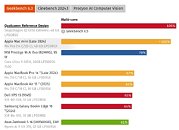
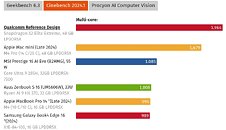
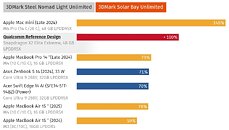
According to the ComputerBase review, the Qualcomm Snapdragon X2 Elite Extreme was able to outperform Apple's best and brightest, the Apple M4 Pro, in both Cinebench 2024 and Geekbench 6.3 multicore benchmarks, scoring 1,964 and 23,693 points, respectively. Results are a little less consistent when it comes to single-core scores, with the Apple M4 Pro pulling ahead of the Snapdragon SoC by 7% in the Cinebench 2024 single-core test but falling behind the X2 Elite Extreme by 7% in Geekbench 6.5. NPU performance was also impressive, with the X2 Elite Extreme's 80 TOP NPU coming out undefeated, at 128% faster than the Intel Core Ultra 9 288V in the ASUS Zenbook S 14. Unfortunately, that seems to be where the good news for Qualcomm ends—mostly. When it comes to GPU tests, the Snapdragon X2 Elite Extreme remains well behind the Apple M4 Pro in both the 3DMark Steel Nomad Light Unlimited and 3DMark Solar Bay Unlimited tests, scoring 5,687 points and 22,946 points, respectively. While that puts the new Arm silicon a solid 37-40% ahead of the nearest competing iGPU, the Apple M4 10-Core, it is still 37-46% behind the Apple M4 Pro in GPU benchmarks. It remains to be seen how this translates to real-world gaming performance and actual CPU workloads, given the translation layer that Arm SoCs currently still rely on for many non-native Windows apps and games, but it's an impressive showing nonetheless.
Source:
ComputerBase
According to the ComputerBase review, the Qualcomm Snapdragon X2 Elite Extreme was able to outperform Apple's best and brightest, the Apple M4 Pro, in both Cinebench 2024 and Geekbench 6.3 multicore benchmarks, scoring 1,964 and 23,693 points, respectively. Results are a little less consistent when it comes to single-core scores, with the Apple M4 Pro pulling ahead of the Snapdragon SoC by 7% in the Cinebench 2024 single-core test but falling behind the X2 Elite Extreme by 7% in Geekbench 6.5. NPU performance was also impressive, with the X2 Elite Extreme's 80 TOP NPU coming out undefeated, at 128% faster than the Intel Core Ultra 9 288V in the ASUS Zenbook S 14. Unfortunately, that seems to be where the good news for Qualcomm ends—mostly. When it comes to GPU tests, the Snapdragon X2 Elite Extreme remains well behind the Apple M4 Pro in both the 3DMark Steel Nomad Light Unlimited and 3DMark Solar Bay Unlimited tests, scoring 5,687 points and 22,946 points, respectively. While that puts the new Arm silicon a solid 37-40% ahead of the nearest competing iGPU, the Apple M4 10-Core, it is still 37-46% behind the Apple M4 Pro in GPU benchmarks. It remains to be seen how this translates to real-world gaming performance and actual CPU workloads, given the translation layer that Arm SoCs currently still rely on for many non-native Windows apps and games, but it's an impressive showing nonetheless.


20 Comments on Snapdragon X2 Elite Extreme Benchmarks Highlight Impressive CPU Performance but Underwhelming GPU
The sooner nvidia gets a SoC out there to compete the better.
Hope Snapdragon isn't trying to cut corners.. Hope its just teething pains with new chips.
I hope it will be as explosive as it looks. We'll have to wait a little longer.
There's also some chinese $2000 mini boxes with questionable build quality, but thats it. Most tech shops are not going to spend $2k+ on a box just ot compare to a snapdragon.
StrixKrackan Point is what you want here.But also, the point still stands.
However, as the comment above pointed out, this is not really a CPU meant for ultrabooks. Those are devices with totally different markets and power targets.
And let's be real, this thing has a TDP of 80W, that's encroaching on the 120W of Strix Halo. The difference isn't that large that I'm accepting that as a reasonable argument.
My local reviewer was also missing it.
tweakers.net/reviews/13834/qualcomm-snapdragon-x2-elite-moeten-amd-en-intel-zich-zorgen-maken.html
And after they got told by the community they apologized and added it.
They just straight up forgot and that's it... Right?
Now multiple other outlets have also forgot to mention it. Oh my, it appears that everyone forgot...
You see my point?
This is why nVidia needs to get their laptop arm SOC out already, their drivers will blow Qualcomm's out of the water and force them to shape up.
I can't find the article if they did.
I'd like to see some more real life productivity benchmarks on those systems. Synthetics are kinda useless if there is little software that is optimized for the platform.
IMO, it's not worth buying a phone at launch, especially a Pixel as they go on sale a few months later.
I think the problem with Snapdragon laptops is software support, WoA support is still mediocre, and pricing of these laptops. A faster CPU and GPU doesn't matter much if apps in emulation mode are still slow and these overpriced laptops don't sell.Not even remotely true, Pixels are the only Android phones to support GrapheneOS.
However iphone users sure make some interesting assumptions, Pixel performance is fine when not simply looking at synthetic benchmarks, real word performance has reached a point where even a midrange phone is just fine for what most people do with them.
You claim I'm wrong, and then you proceed to "correct" me by... saying exactly the same thing I did? They are modification-friendly. Flashing a third-party binary is a "modification". The Pixel line is known to be very well supported for this purpose, as a reference device of sorts.
And it's not that I'm an "iPhone user", and although I won't deny the thinly veiled accusation (I will openly admit that I do not have a high opinion of Android), I never brought the iPhone into this at all.