Wednesday, October 1st 2025

Apple M5 SoC Brings 35% GPU Gain and 10-15% CPU Boost vs. M4

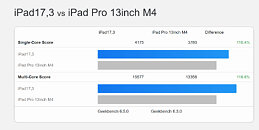
Apple's M-series of SoCs continues with generational performance improvements, and the upcoming M5 SoC will be no exception. A Russian YouTuber Wylsacom obtained an unreleased iPad Pro based on the M5 SoC and published benchmark data for it. As a reminder, the same source correctly previewed last year's M4 MacBook Pro. The early numbers suggest that Apple's next-generation tablet silicon focuses more on graphics than on a raw CPU jump. A single-core CPU IPC performance improves by roughly 12% relative to frequency, and multi-core performance improves by approximately 15% over the standard M4 in iPad Pro. Meanwhile, GPU performance shows significantly larger gains in some tests, reaching as much as 35% in graphics workloads. That kind of uplift won't transform every task, but it could deliver noticeably smoother frame rates in games and more sophisticated visual effects in creative apps.

Given Apple's habit of carrying phone-class architecture into its M-series chips, the M5's strengths align with improvements first seen in the family's A-class parts, where advances in neural and graphics subsystems have increasingly been used to augment traditional rendering pipelines. Digging into the sample that surfaced, the leaked iPad Pro is listed as a 256 GB model with 12 GB of RAM, which is a step up from last year's comparable 8 GB configuration. It is reasonable to expect Apple to reserve 16 GB or higher for larger storage tiers as it has in past launches. If the M5 really pairs modest CPU boosts with a substantial GPU jump, the benefits would extend beyond the iPad form factor, with thinner MacBook Air and Pro models that receive the chip also seeing improved CPU and GPU data scores, thanks to bigger cooling capacity. Especially with active cooling, Apple could push these chips way past this point, and again claim the performance crown.
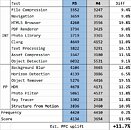
Sources: @lafaiel on X, Geekbench v6
Add your own comment

41 Comments on Apple M5 SoC Brings 35% GPU Gain and 10-15% CPU Boost vs. M4

#26
cvaldes
Darmok N JaladThose are pretty solid gains, even on the CPU front. These days, 10% is a lot of improvement in that segment.
The purported benchmark results of this purported M5 are actually believable.

The single core CPU improvement of 10% is appears to be a combination of process node upgrade and improved thread scheduling (following the A19 Pro), likely with a few other minor factors.

The larger multi core CPU improvement is due to Apple introducing a new architecture for the four efficiency cores. I believe the A19 Pro's efficiency cores have a larger cache too.

The GPU improvement is tied to the introduction of "neural accelerators" in the GPU cores that are separate from the Neural Engine ML cores. In last month's iPhone announcement, the Apple presenter explicitly called out the A19 Pro's "desktop class GPU" which makes it (the A19 Pro not the M5) a likely candidate for the next generation entry level Apple MacBook.
Posted on Reply
#27
R0H1T
Onasifor desktop applications under Windows it was around 5% faster
Right but that wasn't the whole picture was it? It's like Apple not advertising their pretty GB scores, even if implicitly. There's a reason manufacturers include a bunch of applications to make their chips look good/better & YMWV as always.
Posted on Reply
#28
TheinsanegamerN
IntelJustDieI'm not sure either, but to be honest I feel like Intel will disappear before any APX implementation (P.S: Maybe I'm wrong, but for now the things for Intel seems to be very bad).
Intel is losing money but also still has a huge market, billions in income, and tons of fat left to cut, along with the only US owned fabs.

They'll be around a long, long time. AMD screwed up and went into serious debt and it took almost a decade for them to go nearly bankrupt.
DeathtoGnomesill remind you of the time before Ryzen.
Irrelevant to the conversation. Single digit gains are not only the domain of Intel.
R0H1TRight but that wasn't the whole picture was it? It's like Apple not advertising their pretty GB scores, even if implicitly. There's a reason manufacturers include a bunch of applications to make their chips look good/better & YMWV as always.
It was the majority of the picture. Zen 5 had great gains for AVX 512 and AVX2. If yo use Windows, unless you use specific apps, there was no improvement. Linux saw more benefit because more software on Linux uses said AVX extensions, but outside of said software there was again little improvement, and your average user doesnt use said software.

The only exception to this is RCPS3.
Posted on Reply
#29
igormp
TheinsanegamerNIntel is losing money but also still has a huge market, billions in income, and tons of fat left to cut, along with the only US owned fabs.
Look at the username of the person you quoted. They are clearly biased and made lots of almost trolling posts in many different threads.
TheinsanegamerNIt was the majority of the picture. Zen 5 had great gains for AVX 512 and AVX2. If yo use Windows, unless you use specific apps, there was no improvement. Linux saw more benefit because more software on Linux uses said AVX extensions, but outside of said software there was again little improvement, and your average user doesnt use said software.
Zen 5 was clearly made with the focus of servers in mind, where it's got lots of success. Epyc Turin is a beast, and lots of hyperscalers rushed to deploy it.
For regular Windows users it was indeed meh. The saving grace was that the x3D chips brought some nice uplifts due to the higher clocks, and also the whole ARL disappointment.
TheinsanegamerNThe only exception to this is RCPS3.
Not really, it benefits from AVX-512 due to the instructions itself, but it does not benefit much from the increased datapath that Zen 5 brought (256-bit -> 512-bit).
Posted on Reply
#31
cvaldes
igormpLook at the username of the person you quoted. They are clearly biased and made lots of almost trolling posts in many different threads.
Probably a short seller.

And yes, the anti-Intel rhetoric is a common occurrence from that particular TPU community member and often times their arguments have zero logic.

It would be great if Intel could release silicon that competes with Apple's phantom M5 SoC on a performance-per-watt metric. Same with AMD.

It's unsurprising that Apple kicked Intel to the curb five years ago and went to an in-house solution. Intel sells the majority of CPUs for notebook PCs though. They just lost Apple as a customer in 2020.
Posted on Reply
#32
LastDudeALive
cvaldesIt would be great if Intel could release silicon that competes with Apple's phantom M5 SoC on a performance-per-watt metric. Same with AMD.
The problem is Intel's (and AMD's) CPUs have to run everything. They have to run modern games and legacy 32-bit applications, and practically every piece of software ever. And they also have to run Windows, which is equally bloated from the same requirements. Finally, they have to develop for desktop and server systems at the same time, or at least have their architecture improvements be useful for both to avoid duplicating R&D.

Apple only has to develop for iOS/MacOS, which they have total control over and are moving towards unifying. If they want a new feature in the next iPhone/Mac, they can implement it in hardware as efficiently as possible. If they don't think a feature or program is worth having on their platform, they just don't support it. They're even developing their own network adapters to further streamline and maximize efficiency.

This has allowed Apple to achieve domination in the smartphone, consumer laptop, and niche multimedia markets. But it also means they will never, ever threaten Intel/AMD in the vastly more lucrative SMB, enterprise, or server markets.
Posted on Reply
#33
dgianstefani
TPU Proofreader
LastDudeALiveThe problem is Intel's (and AMD's) CPUs have to run everything. They have to run modern games and legacy 32-bit applications, and practically every piece of software ever. And they also have to run Windows, which is equally bloated from the same requirements. Finally, they have to develop for desktop and server systems at the same time, or at least have their architecture improvements be useful for both to avoid duplicating R&D.

Apple only has to develop for iOS/MacOS, which they have total control over and are moving towards unifying. If they want a new feature in the next iPhone/Mac, they can implement it in hardware as efficiently as possible. If they don't think a feature or program is worth having on their platform, they just don't support it. They're even developing their own network adapters to further streamline and maximize efficiency.

This has allowed Apple to achieve domination in the smartphone, consumer laptop, and niche multimedia markets. But it also means they will never, ever threaten Intel/AMD in the vastly more lucrative SMB, enterprise, or server markets.
x86S would have been great. Shame it was killed.
Posted on Reply
#34
Hecate91
TheinsanegamerNIntel is losing money but also still has a huge market, billions in income, and tons of fat left to cut, along with the only US owned fabs.

They'll be around a long, long time. AMD screwed up and went into serious debt and it took almost a decade for them to go nearly bankrupt.
Intel isn't going anywhere either, as long as the US owns a stake in the company.
And Intel screwed AMD up during the P4 era with anti-competitive tactics, it hurt their progress for years until Ryzen.
TheinsanegamerNIrrelevant to the conversation. Single digit gains are not only the domain of Intel.
Intel had single digit gains for years, they're the worst at it by far. A 10-15% CPU gain here isn't anything exciting, mostly from going to a more advanced node.
Posted on Reply
#35
qcmadness
dgianstefanix86S would have been great. Shame it was killed.
Without AMD's support, Intel could never get x86S happening.
Posted on Reply
#36
LastDudeALive
qcmadnessWithout AMD's support, Intel could never get x86S happening.
They wouldn't necessarily need AMD's support. Either one can develop extensions or modifications to the x86 and x86-64 instruction sets. It just means the other one gets to use it.
Posted on Reply
#37
NC37
Hecate91Intel isn't going anywhere either, as long as the US owns a stake in the company.
And Intel screwed AMD up during the P4 era with anti-competitive tactics, it hurt their progress for years until Ryzen.

Intel had single digit gains for years, they're the worst at it by far. A 10-15% CPU gain here isn't anything exciting, mostly from going to a more advanced node.
Intel definitely screwed a lot of folks but AMD also shot themselves in the foot with Bulldozer. There was ways they could have made it work and delivered on their promises but they just couldn't do it. It was like they were purposely gimping it. Console designs from that era showed AMD knew how to improve the shortfalls. They just never implemented them for desktops.
Posted on Reply
#38
ypsylon
Biggest problem of M-silicone right now is that Apple has no high core CPUs to compete. Every "new" iteration of M add few GPU cores, but basically nothing in CPU departament. Because of that a lot of work which could be done on a Mac coming from Windows gets shafted without CUDA support and CPUs are puny.

Was doing recently rendering exercises between M4 (10 cores), TRX40 and WRX90 Threadrippers - not exceeded the RAM limitation of M4 on TRs. Because Apple silicone cores scale linearly, M4 needs basically 5 or 6 M4s to achieve same result as, old by now, 3960x. That's between 260-320W (M4 pegged uses between 53-55W) of Macs to do a work which old 3960x does on 280W. TRPro 9965WX obliterates this totally by offering 50% time reduction vs 3960x, which basically = 10 -12 M4s to do same job.

Sorry but Apple is nowhere on heavy duty front if software is not utilizing Metal.
Posted on Reply
#39
dgianstefani
TPU Proofreader
ypsylonBiggest problem of M-silicone right now is that Apple has no high core CPUs to compete. Every "new" iteration of M add few GPU cores, but basically nothing in CPU departament. Because of that a lot of work which could be done on a Mac coming from Windows gets shafted without CUDA support and CPUs are puny.

Was doing recently rendering exercises between M4 (10 cores), TRX40 and WRX90 Threadrippers - not exceeded the RAM limitation of M4 on TRs. Because Apple silicone cores scale linearly, M4 needs basically 5 or 6 M4s to achieve same result as, old by now, 3960x. That's between 260-320W (M4 pegged uses between 53-55W) of Macs to do a work which old 3960x does on 280W. TRPro 9965WX obliterates this totally by offering 50% time reduction vs 3960x, which basically = 10 -12 M4s to do same job.

Sorry but Apple is nowhere on heavy duty front if software is not utilizing Metal.
You know M series Max/Ultra variants exist right? They have 16/32 cores.
Posted on Reply
#40
trparky
Most people running a Mac don’t need that kind of computing horsepower and for those that do, there’s the Mac Pros that, as dgianstefani alluded to, has that kind of power.
Posted on Reply
#41
LastDudeALive
ypsylonBiggest problem of M-silicone right now is that Apple has no high core CPUs to compete. Every "new" iteration of M add few GPU cores, but basically nothing in CPU departament. Because of that a lot of work which could be done on a Mac coming from Windows gets shafted without CUDA support and CPUs are puny.

Was doing recently rendering exercises between M4 (10 cores), TRX40 and WRX90 Threadrippers - not exceeded the RAM limitation of M4 on TRs. Because Apple silicone cores scale linearly, M4 needs basically 5 or 6 M4s to achieve same result as, old by now, 3960x. That's between 260-320W (M4 pegged uses between 53-55W) of Macs to do a work which old 3960x does on 280W. TRPro 9965WX obliterates this totally by offering 50% time reduction vs 3960x, which basically = 10 -12 M4s to do same job.

Sorry but Apple is nowhere on heavy duty front if software is not utilizing Metal.
That's awesome, where can I buy a Threadripper laptop to do some silent rendering? Or a Threadripper micro-PC I can stick on the back of a monitor mount?

Also, performance absolutely does not just scale by CPU cores. A major component of Apple's power is the memory bandwidth, which goes up with chip tier. That's why an M4 Max (16c/16t) can match a Ryzen 9 7945HX (16c/32t) in CPU rendering.

And as for the 3960X specifically, the comparable CPU is the M2 Ultra, which achieves a similar score in Blender CPU rendering with half the threads.
Posted on Reply
Add your own comment
Nov 22nd, 2026 18:03 CST change timezone

New Forum Posts

Popular Reviews

TPU on YouTube

Controversial News Posts