Monday, October 20th 2025

Zotac Boards Powerful Mini PC Hype Train With NVIDIA RTX 5060 Ti-Powered ZBOX MAGNUS
In light of the recent flood of AI-ready mini PCs coming from the likes of Framework and GMKtec, Zotac has announced its own competitor, this time opting for a slightly different approach than the hyped AMD Ryzen AI Max+ 395 APU. Instead, the component company known for its mini PCs and discrete NVIDIA GPUs has equipped the Zbox Magnus (stylized as ZBOX MAGNUS) with an NVIDIA GeForce RTX 5070 Ti and up to a 20-core (8 performance, 12 efficiency cores) Intel Core Ultra 7 255HX CPU paired with dual memory slots for up to 96 GB of DDR5-6400 CSODIMM or DDR5-5600 SODIMM RAM—all in a mere 2.65-liter chassis. By default, however, the Magnus doesn't ship with RAM or storage, with a barebones variant currently listed on the company's Chinese site at a converted price of around $1,966 (13,9999 Yuan).
The product page lists the cooling solution as a heatsink and fan, but it's unclear whether there are separate heatsinks and fans for the CPU and GPU, raising questions about potential thermal throttling, given the tiny chassis. Zotac says that the Zbox Magnus is the first mini PC of its size to offer a desktop-class GeForce RTX 5060 Ti 16 GB GPU in a chassis that small, with the chassis measuring in at just 210 × 203 × 62.2 mm. That small chassis comes with the caveats that the Zbox Magnus needs a 330 W external AC-DC adapter, and that it features a soldered laptop-class CPU. Despite the small chassis, the Zbox Magnus has a decent selection of ports, with five USB Type-A ports, dual front USB Type-C ports, and dual Ethernet ports. It also comes with wall mount hardware and Wi-Fi antennae in the box.
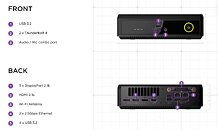 Zotac Zbox Magnus ports selection:
Front
Source:
Zotac
The product page lists the cooling solution as a heatsink and fan, but it's unclear whether there are separate heatsinks and fans for the CPU and GPU, raising questions about potential thermal throttling, given the tiny chassis. Zotac says that the Zbox Magnus is the first mini PC of its size to offer a desktop-class GeForce RTX 5060 Ti 16 GB GPU in a chassis that small, with the chassis measuring in at just 210 × 203 × 62.2 mm. That small chassis comes with the caveats that the Zbox Magnus needs a 330 W external AC-DC adapter, and that it features a soldered laptop-class CPU. Despite the small chassis, the Zbox Magnus has a decent selection of ports, with five USB Type-A ports, dual front USB Type-C ports, and dual Ethernet ports. It also comes with wall mount hardware and Wi-Fi antennae in the box.


Front
- 1× USB 3.2 Gen 2 Type-A
- 2× Thunderbolt 4
- 1× 3.5 mm audio combo jack
- 4× USB 3.2 Gen 2 Type-A
- 2× 2.5 Gbps Ethernet
- 3× DisplayPort 2.1b
- 1× HDMI 2.1b
14 Comments on Zotac Boards Powerful Mini PC Hype Train With NVIDIA RTX 5060 Ti-Powered ZBOX MAGNUS
Our big computers will be a thing of the past at some point in the nearish future I think..
At least the HX255 isnt a step down in hardware config, its effectively an ultra 7 265. You can get a 265k for about $300 or so, but we've seen it go on sale repeatedly for as low as $230. Realistically with the TDP limits this will be more along the lines of a normal 265 at best, and those have gone as low as $220 IIRC.
Add in a power supply and a case. Since this doesnt come with memory or storage, you are paying charitably ~$800 for the proprietary design, likely closer to $900. Given these are not upgradeable, use loud laptop like cage fans, and this new model has significantly cut down on I/O (no SD card slot, fewer USB ports, no 10Gbps Ethernet option) that's a steep ask, IMO.
Oh yeah, dont forget this likely will be power limited. Previous Magnus designs used GPUs power limited to ~110 watt or so. So this "desktop class 5060ti" will most likely be power limited to closer to 5060 performance. I look forward to benching this against my 4060 LP build, to see how much is sacrificed for that 2.65L case capacity.
If this came with a desktop class 5070ti without power limits, it would be a better value proposition.Not so long as DIY hardware has such a price advantage. Mini PCs like this have long been niche sales wise. I'd bet good money, based on how hard previous ones are to find, that single models of the 5060ti, like the MSI venus, have outsold the entirety of the Magnus line for any given generation.
This design could catch on, if there were some changes. Mainly, the return of MXM with a standard GPU design so we could reuse heatsinks, along with socketed mobile processors. So long as these are soldered boxes they'll remain a curiosity for the wealthy.
EDIT: I'd like to clarify I'm not opposed to a mini PC future. I love the idea of an upgradeable alienware alpha sized box.
I think what holds back a lot of very small form factor builds is there are very few worthwhile flex atx psu, and dc-dc or pico psu are pretty much a Wild West.
There are also ITX cases which can get fairly small yet still fit 5090s into them, though yeah not 2.65L small
www.techspot.com/review/3042-battlefield-6-benchmark/#Preset-png
Me I'd kinda over powerful high end PCs, I like mine but even the 9070xt was a tempting enough offer to upgrade. The next generation will see mid rangers more powerful then my 6800xt, and after 10 years my 5800x3d will likely get replaced by a much smaller PC.
If the GPU was upgradeable, even with TDP limits I'd jump on one of these things. The 255HX here is basically a 265k and will be plenty for the next decade of usage.Well, for pico PSU mini-box has a great selection, and for DC-DC HDPLEX has you covered.
I like the deskmeet more than the mini since it can host a GPU, but a mini with a 5080 mobile/5070 desktop chip would be very interesting.
A desktop 5060 ti is 180W, a 255HX is 55W, that's 235W to dissipate with very limited surface, which is not realistic. So probably a tuned down mobile version with 50W TDP.
Also the article says " (stylized as ZBOX MAGNUS) with an NVIDIA GeForce RTX 5070 Ti" which is probably a typo, should be 5060 ti right? Or did i not understand properly?
Intune did not like that at all! Lot's of problems when installing and software deployment. We're sending them all for recycling and hope to get some $ for them!
Efficiency has never justified the price, unless you are using a machine 8+ hour sa day at full power, every day, 365 days a year, at which point you are either making money on said PC, in which case you go for max performance, not efficiency, or you need to seriously readjust your life.
At $0.50 per kWh, the difference between a 5060ti and a 5080 would be 178w vs 343w with raytracing. That's a difference of 165 watts, or 0.165kW, or $0.0825 per hour of usage. So assuming you did 8 hours of usage, at that power, per day, 365 days a year, your annual power difference would be.....$240.90 per year. At 8 hours per day, 5 days per week, this falls to $171.60. The average I could find is 7-10 hours per week spent gaming, which at the high end would mean you save a whopping $42.90 per year of operation.
For comparison, Germany has the 5th highest residential electric cost in the world, at $0.38 per kwh. If you put that many hours into working a job that pays out $15 per hour, you would make $43,800 per year before taxes or overtime rates.
If $40 a year is bank breaking, you shouldn't be buying a $1200 GPU OR a $450 GPU. You should go work one extra shift at McDonalds to cover the cost.We can also look at performance per watt compared to previous generations. The arrow lake series consumes a mere fraction the power Alder lake did. A 265 and a 5060ti will have far better performance per watt then a 12600 and a 3060ti would.
Nobody is forcing you to use the 5090. The 5090 isnt even the highest we've had. The old dual GPUs blow that thing out of the water. GTX 590s, the insane AMD 295x2, both of those cards drew insane power as well, especially overclocked.
I'd bet good money that this box significantly outperforms the previous iterations at the same power usage.That's totally unrealistic. Nobody, not even zotac, is running a desktop 5060ti at 50 watts.
Previous iterations ran cards with upt o a 115 watt TDP, plus 25 watt of shared boost TDP. So 115+25+55 brings us to 195 watts. Not too far from the 235w an unrestricted desktop 5060ti would need.
Oh yeah, and it IS a desktop 5060ti. There is no 16GB mobile 5060ti...........It should be 5060ti. No 5070ti has been confirmed yet.
Far greater variety of Flex-psu cases, but again little to no reviews. the few really well known ones are super pricey for what you get with them.
The Deskmeet is good, but I dislike the layout. There is also the Deskmate x600, Deskmix X600 and Deskmax X600.
Deskmix supports 200MM half-height GPU and 70MM height CPU-cooler, with 1U PSU.
Deskmax supports 200MM full-height GPU and 140MM height CPU-cooler, with ATX PSU.
The Deskmate x600 had an exposed PCI-E slot you could use for an external gpu, provided you had some way of powering it.
The Deskmini recently got a USB4 / Thunderbolt upgrade, though an Occulink would still be the dream for it. I think some custom cases allow for you to use the bottom nvme slot to convert to occulink for an EGPU setup as well.
Honestly I just wish we had more options for barebones apu setups. Minisforum and Asrock seem to have th eonly two major players in that arena. Also more mobile on desktop stuff would be nice. I adore some of the laptop APU's and would love to throw them in a SFF case, but there are very few ITX boards out there sporting them, nd even then they tend to be engineering sample style chips.
www.bee-link.com/products/beelink-ex-docking-station
"First, the YouTuber ran Cyberpunk 2077 at 1440p with ray tracing set to the ultra settings, and the game stayed above 60 FPS.
Next, ETA Prime tested Ghost of Tsushima at 1440p with "very high" graphics settings and without frame generation turned on. The eGPU setup could keep the game around 100 FPS. Then, the YouTuber ran the built-in benchmark of Shadow of the Tomb Raider at 1440p with the highest preset, and the average FPS was 175.
Another notable game tested on the Beelink EX eGPU dock with GTi14 Ultra setup is Forza Horizon 5. The game was tested at the "extreme" visual settings at 1440p, and the FPS stayed over 160. "
or Google eGPU for the Thunderbolt approach... but it's much less good for gaming...