Tuesday, November 4th 2025

AMD Reports Record Q3 2025 Revenue of $9.2 Billion
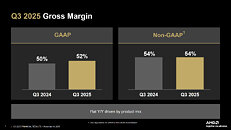
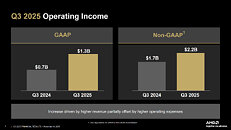
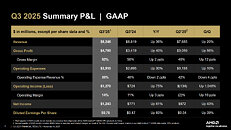
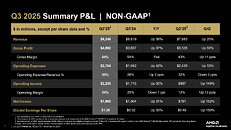
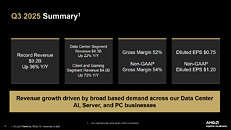
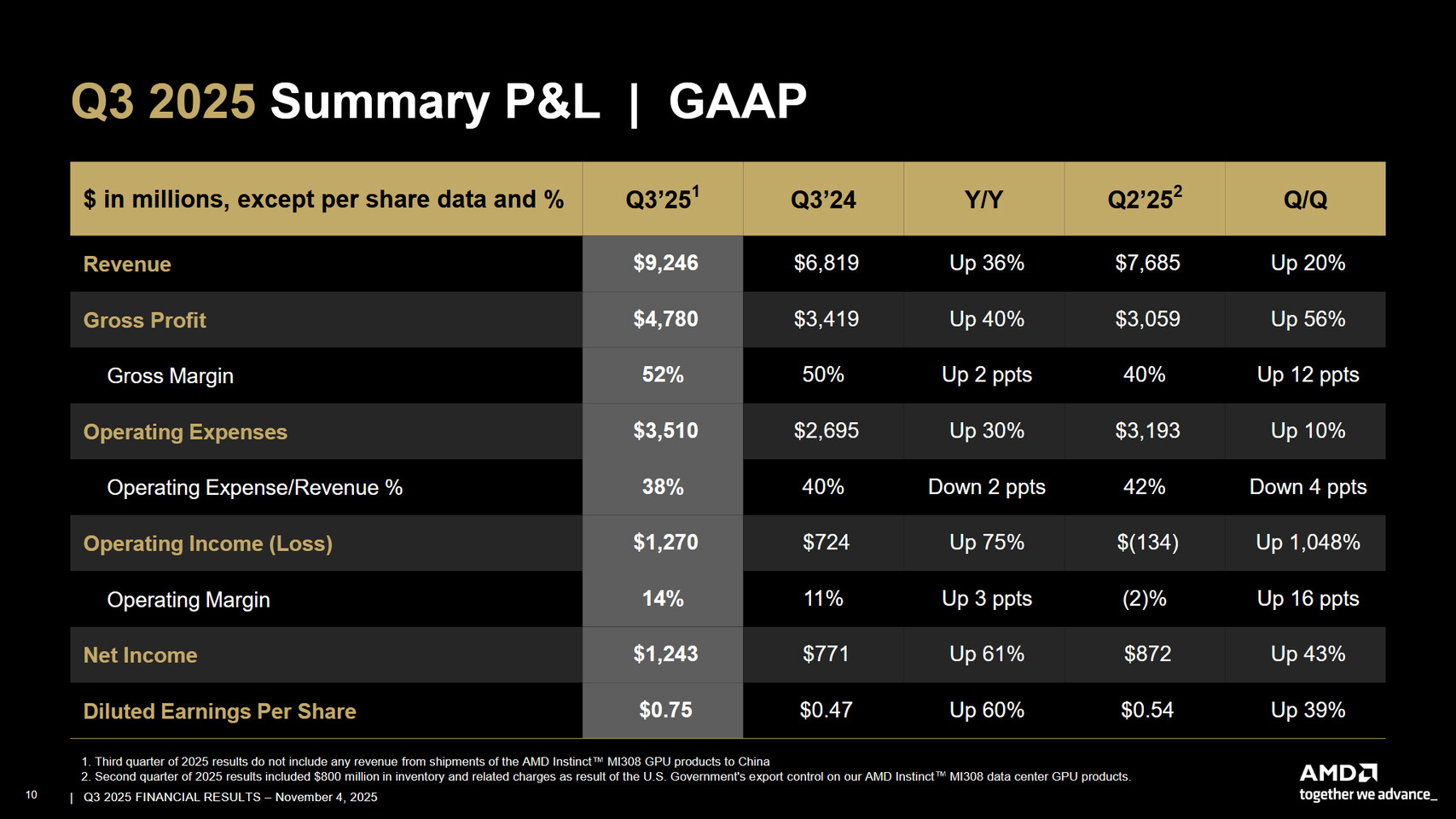
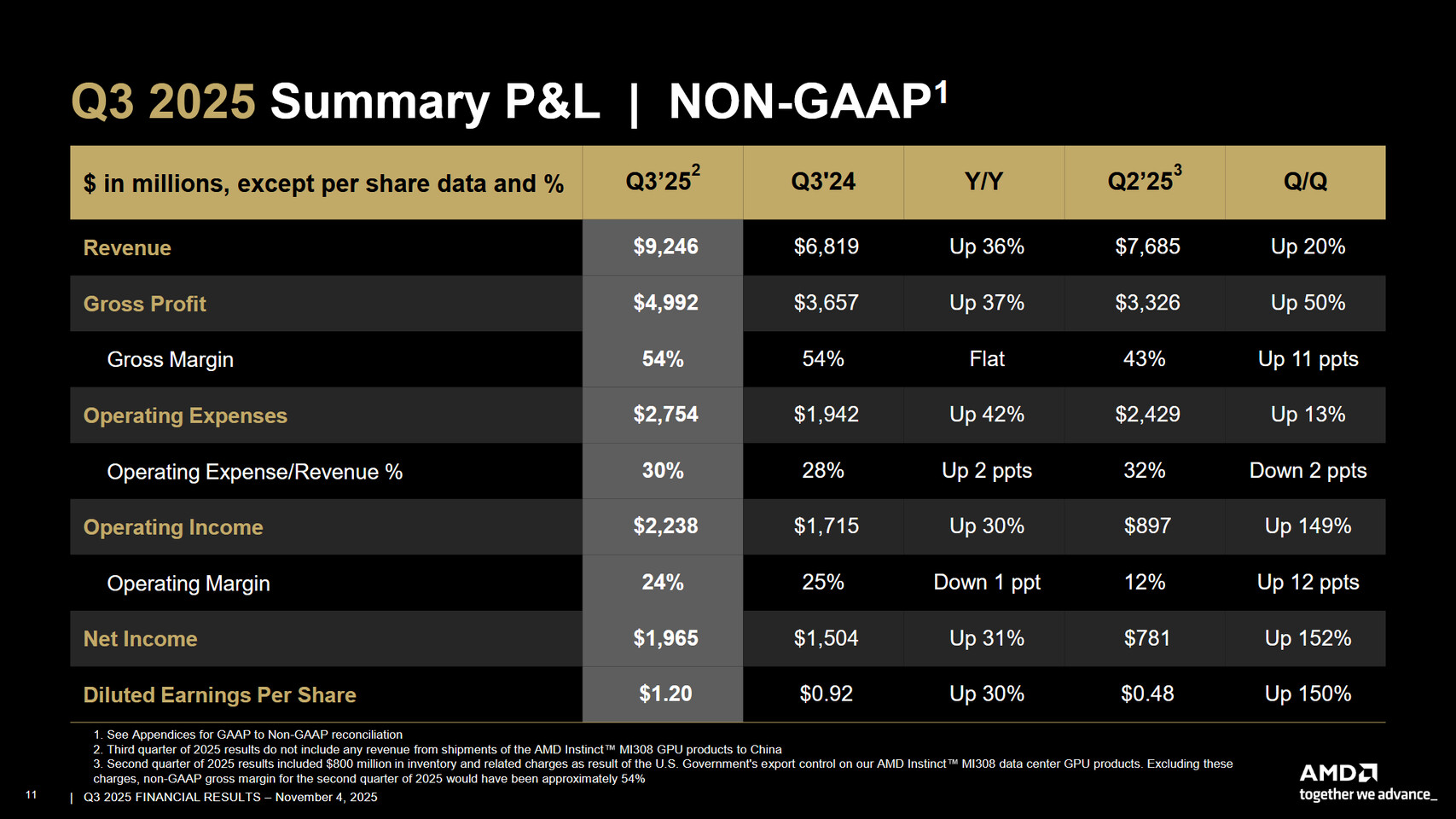
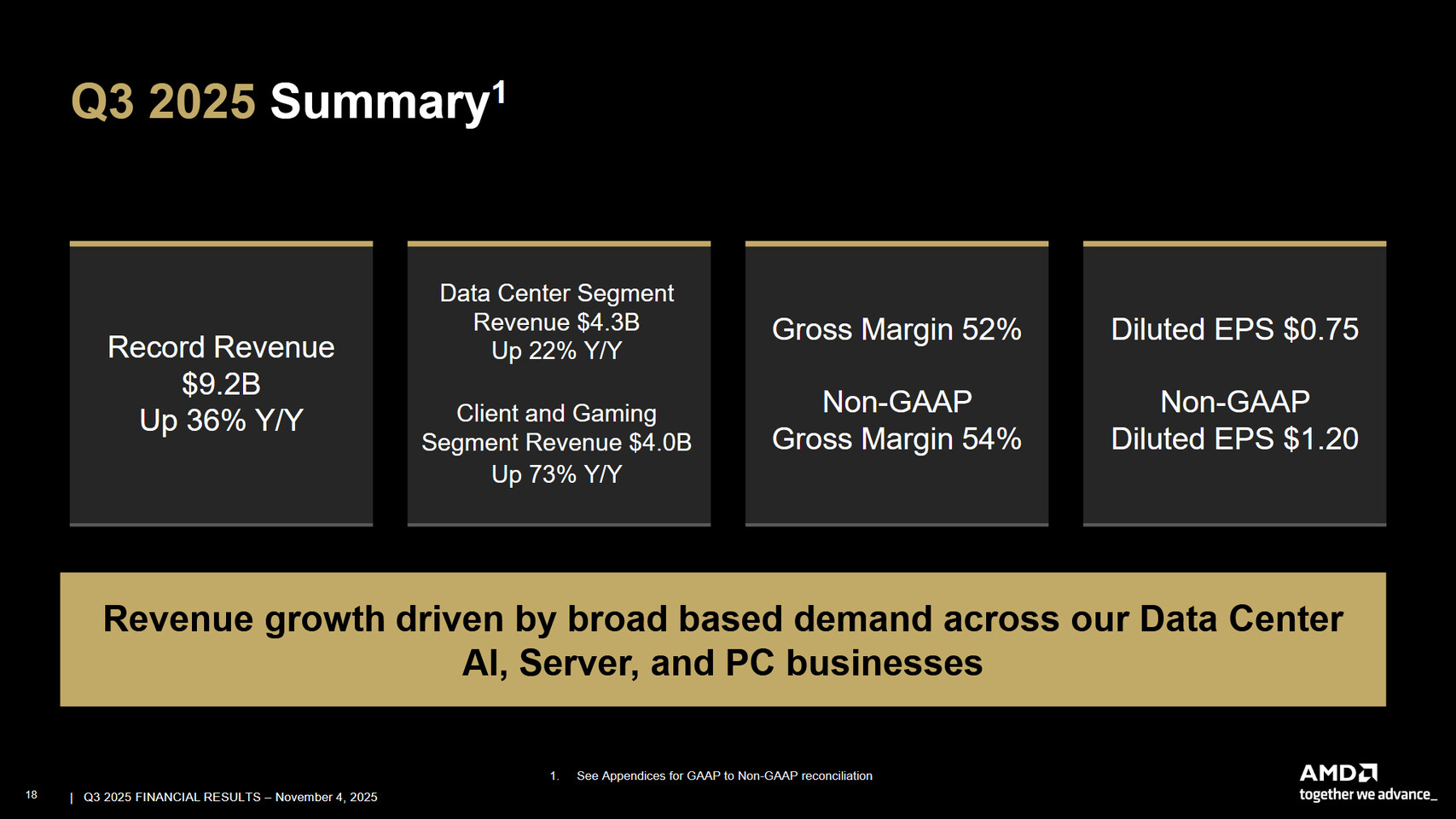
AMD (NASDAQ:AMD) today announced financial results for the third quarter of 2025. Third quarter revenue was a record $9.2 billion, gross margin was 52%, operating income was $1.3 billion, net income was $1.2 billion and diluted earnings per share was $0.75. On a non-GAAP basis, gross margin was 54%, operating income was $2.2 billion, net income was $2 billion and diluted earnings per share was $1.20. Our third quarter results did not include any revenue from shipments of AMD Instinct MI308 GPU products to China.
"We delivered an outstanding quarter, with record revenue and profitability reflecting broad based demand for our high-performance EPYC and Ryzen processors and Instinct AI accelerators," said Dr. Lisa Su, AMD chair and CEO. "Our record third quarter performance and strong fourth quarter guidance marks a clear step up in our growth trajectory as our expanding compute franchise and rapidly scaling data center AI business drive significant revenue and earnings growth."
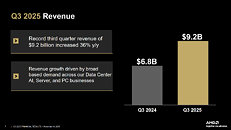
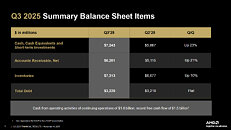
 "We delivered record quarterly revenue of $9.2 billion, up 36% year-over-year, and generated record free cash flow, reflecting the strength of our leadership portfolio and disciplined execution," said Jean Hu, AMD executive vice president, chief financial officer and treasurer. "Our continued investments in AI and high-performance computing are driving significant growth and position AMD to deliver long-term value creation."
Segment Summary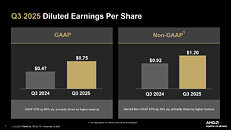
 Recent PR Highlights
 Current Outlook
AMD's outlook statements are based on current expectations. The following statements are forward-looking and actual results could differ materially depending on market conditions and the factors set forth under "Cautionary Statement" below.
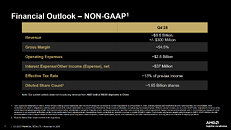
For the fourth quarter of 2025, AMD expects revenue to be approximately $9.6 billion, plus or minus $300 million. At the mid-point of the revenue range, this represents year-over-year growth of approximately 25% and sequential growth of approximately 4%. Non-GAAP gross margin is expected to be approximately 54.5%. Our current outlook does not include any revenue from AMD Instinct MI308 shipments to China.
Source:
AMD Investor Relations
"We delivered an outstanding quarter, with record revenue and profitability reflecting broad based demand for our high-performance EPYC and Ryzen processors and Instinct AI accelerators," said Dr. Lisa Su, AMD chair and CEO. "Our record third quarter performance and strong fourth quarter guidance marks a clear step up in our growth trajectory as our expanding compute franchise and rapidly scaling data center AI business drive significant revenue and earnings growth."


Segment Summary
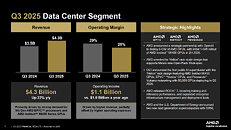
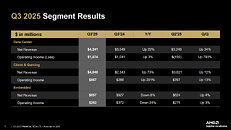
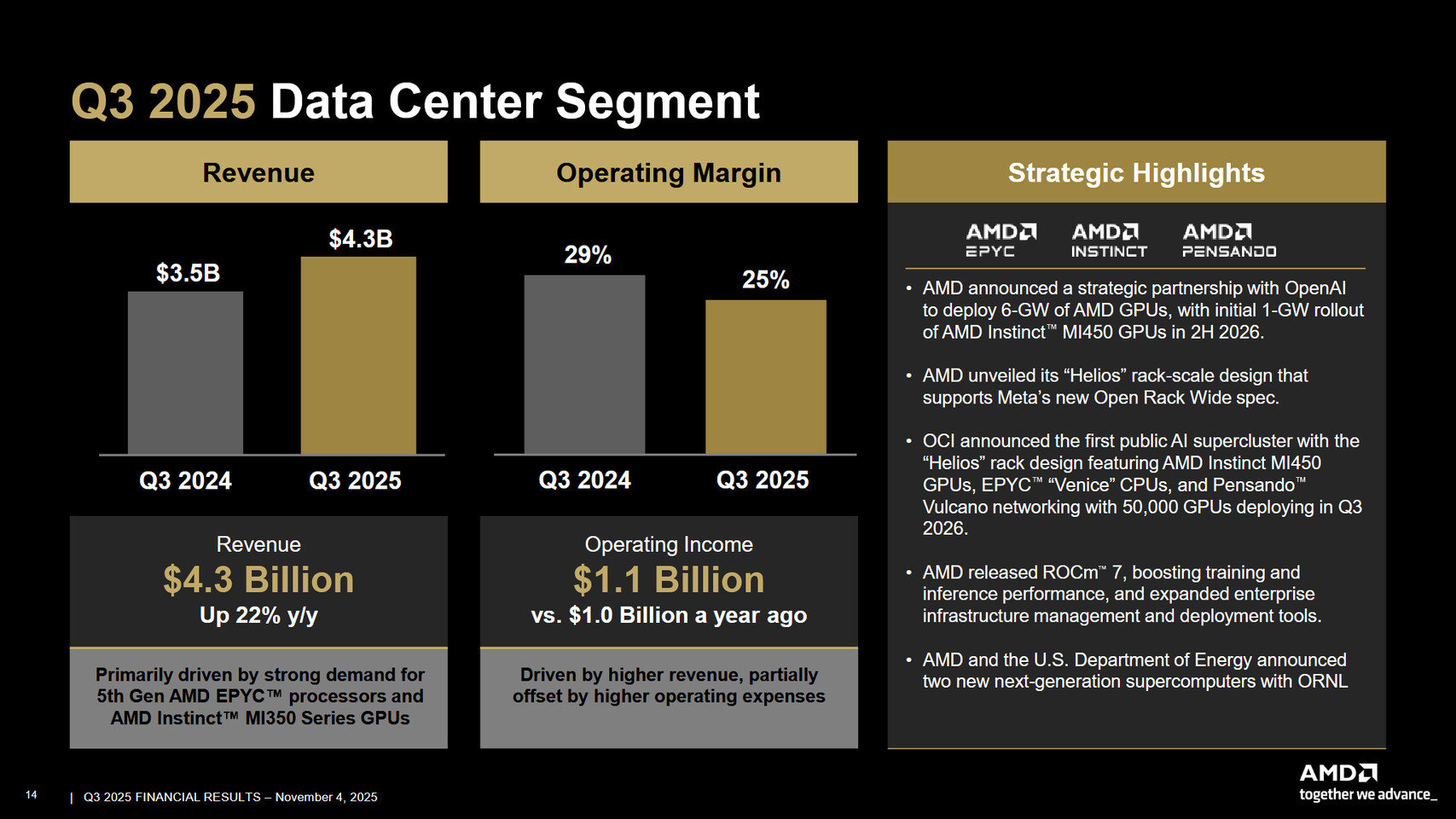
- Data Center segment revenue was $4.3 billion, up 22% year-over-year primarily driven by strong demand for 5th Gen AMD EPYC processors and AMD Instinct MI350 Series GPUs.
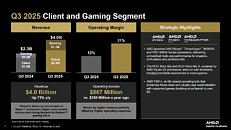
- Client and Gaming segment revenue was $4 billion, up 73% year-over-year. Client revenue was a record $2.8 billion, up 46% year-over-year primarily driven by record sales of Ryzen processors and a richer product mix. Gaming revenue was $1.3 billion, up 181% year-over-year driven by higher semi-custom revenue and strong demand for Radeon gaming GPUs.
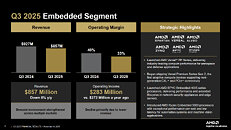
- Embedded segment revenue was $857 million, down 8% year-over-year.



- Customer momentum for AMD AI platforms is accelerating:
- OpenAI and AMD announced a strategic partnership where AMD will be a core preferred partner to deploy 6 gigawatts of AMD GPUs to power OpenAI's next generation AI infrastructure, with the first 1-gigawatt deployment of AMD Instinct MI450 GPUs set to begin in the second half of 2026.
- Oracle and AMD announced that Oracle Cloud Infrastructure (OCI) will offer the first publicly available AI supercluster powered by the AMD "Helios" rack design with
- AMD Instinct MI450 GPUs, EPYC "Venice" CPUs and Pensando "Vulcano" networking, with an initial deployment of 50,000 GPUs starting in Q3 2026.
- AMD unveiled its "Helios" rack scale design that supports the new Open Rack Wide specification introduced by Meta at Open Compute Project Global Summit.
- Cisco and AMD announced an expanded collaboration with G42 to deploy a large-scale AI cluster powered by AMD Instinct MI355X GPUs to advance secure AI infrastructure across UAE.
- IBM and AMD announced a multi-year collaboration to provide Zyphra with advanced AI infrastructure, leveraging a large cluster of AMD Instinct MI350X GPUs to power next-generation multimodal AI models.
- Cohere and AMD expanded their collaboration, bringing AMD Instinct GPU-powered infrastructure to Cohere's full suite of enterprise AI offerings.
- Vultr announced the global availability of AMD Instinct MI355X GPUs across its cloud platform.
- DigitalOcean expanded its AMD-based cloud offerings to support a broader range of AI workloads with AMD Instinct MI325X GPUs available now and AMD Instinct MI350X GPUs available later this year.
- AMD and Tech Mahindra announced a collaboration to bring AMD Instinct GPUs and AMD EPYC processors to the Cloud BlazeTech enterprise AI solution.
- AMD and the U.S. Department of Energy announced two new next-generation supercomputers:
- The Lux AI supercomputer, powered by AMD Instinct MI355X GPUs, AMD EPYC CPUs and AMD Pensando advanced networking technologies, will be the first U.S. AI factory supercomputer.
- The Discovery supercomputer, expected to be delivered in 2028, will be based on next-gen AMD EPYC CPUs, codenamed "Venice," and AMD Instinct MI430X GPUs, a new MI400 Series accelerator designed for sovereign AI and scientific computing.
- AMD released ROCm 7 software, boosting training and inference performance and expanding enterprise tools for infrastructure management and deployment.
- AMD announced the completion of the divestiture of the ZT Systems data center infrastructure manufacturing business to Sanmina.
- AMD partners expanded their cloud offerings based on AMD EPYC processors to meet growing compute demand for enterprise and AI workloads:
- AWS announced the availability of Amazon EC2 M8a general-purpose instance powered by 5th Gen AMD EPYC processors, delivering up to 30% higher performance than the previous generation.
- Oracle announced next-gen Compute Cloud@Customer X11 and Private Cloud Appliance X11 platforms powered by 5th Gen AMD EPYC processors.
- IBM and AMD announced plans to combine quantum computers and high-performance compute to drive scalable, open-source next-generation computing architectures.
- AMD delivered new capabilities for the most demanding PC and gaming workloads, including:
- The AMD Ryzen Threadripper 9000WX and Ryzen Threadripper PRO 9000X Series processors, delivering unmatched multicore performance and platform capabilities for creators, enthusiasts and professionals.
- AMD FSR 4, a ML-based upscaling technology that enhances frame rates and visuals, saw rapid adoption with supported games doubling since launch to over 85.
- AMD expanded its x86 embedded processor portfolio, including:
- The AMD EPYC Embedded 4005 series processors, built to deliver performance, optimized system costs and extended deployment lifecycles in network security appliances and entry-level industrial edge servers.
- The AMD Ryzen Embedded 9000 processors delivering exceptional performance-per-watt, low latency, and the long-term stability for industrial PCs, automation systems and machine vision applications.


AMD's outlook statements are based on current expectations. The following statements are forward-looking and actual results could differ materially depending on market conditions and the factors set forth under "Cautionary Statement" below.
For the fourth quarter of 2025, AMD expects revenue to be approximately $9.6 billion, plus or minus $300 million. At the mid-point of the revenue range, this represents year-over-year growth of approximately 25% and sequential growth of approximately 4%. Non-GAAP gross margin is expected to be approximately 54.5%. Our current outlook does not include any revenue from AMD Instinct MI308 shipments to China.
30 Comments on AMD Reports Record Q3 2025 Revenue of $9.2 Billion
Margin on DC down. I guess that'll hurt Intel too.
So I just imagine a server that you cannot stress workload for the life of ya, but comes out with the result faster than you think, not in the way you know (debugging, I mean) and with a witty comeback.
It says a lot that they explicitly name the Rog Ally products and other "semi-custom revenue" as drivers of growth, but group all Radeon GPUs together. The Steam Survey has shown that RDNA 3 adoption has skyrocketed in the last quarter, but RDNA 4 adoption has been lackluster, with no RX 9000 GPU appearing in the top 100 GPUs. FSR 4 gets a shoutout, but only with game support, not number of users (which would reveal RDNA 4 adoption).
I'm on AMD CPU's since the Socket 7 and on Radeon since the 9600XT. Always believed in the brand, the value it gave for the money but also the support it has been given.
They deserved it - they worked hard out of a near bankrupt situation to where they are now.
no pun intendedmuch before that.There was one blip a few months ago where the Chinese market was obviously over-sampled. Other than that, the month-to-month and long-term trends are both extremely stable and intuitive. The slow decline of Intel's CPU share is what you'd expect from AMD's increasingly competitive offerings, for instance.
For instance, Nvidia's Q2 report said this:It's that sort of explicit shout-out that indicates confidence in a product. Third-party sources like the Hardware Survey indicate that RDNA 3 has sold much better than RDNA 4 this quarter, and AMD's lack of confidence in RX 9000 confirms that.Yes, that's exactly what I'm saying as well. We agree on this. RX 9000 has not sold well this last quarter, RX 7000 has. That's what the hardware survey indicates, and AMD's language in the quarterly report leans that way as well.
The sales figures are in bars and tell their own story. They mentioned RDNA4 cards in previous quarterly reports. No point in mentioning the same thing again. If they did this, then people would be complaining that they have nothing new to say and that they are repetitive...
You need to nitpick in a more logical and consistent way, otherwise any narrative you wish to portray makes little sense.It's not surprising that 7000 cards still sell, as there are way more models and discounts. No one should be surprised about this. It's not any news.
Q2:Q1:They've never said "RDNA 4 is selling well" or anything that could imply that. Growth is always attributed to semi-custom revenue (which I totally understand, it is AMD's strong suite at the moment) and overall Radeon sales (i.e. lots of revenue clearing out RDNA 2 and 3 inventory).
These quarterly announcements are nitpicked to death by in-house lawyers before they're published, because any misrepresentation or exaggeration whatsoever can easily form the basis for a class-action lawsuit from stockholders. That's why it's so notable that Nvidia is confident enough to say the 5060 sold well, and AMD cannot say RDNA 4 is selling well. The most they can say is "we released this" and "Radeon GPUs are providing lots of revenue" (with no mention of which GPUs, or what profit AMD is making on them, because it's mostly clearing out old inventory at barely any profit, or even a slight loss).
According to AMD initial RDNA4 sales were very good. The hardware survey also lists 9000 series in the Linux section, something is up with how Valve is polling RDNA4.
But hey, maybe Lisa Su is lying to shareholders and the sales figures are fake.
Regular user gets to participate in survey maybe once per 2 or 3 years. How's that gonna tell you something relevant about sales per quarters?
For Steam survey to have some sort of meaning, the sample size should be always equally large and also equally large per each participating country.
(If sample size per country is uneven, then results must be normalized, otherwise data for countries will have difference in their statistical weight.
That means 50% market share in China is totally different amount of machines than 50% market share in San Marino.
Percentage might be the same, but it does not represent the same amount of machines, thus different statistical weight.)
I haven't been asked to participate in Steam survey since I switched to AM5 8 months ago. Now imagine they asked me today to participate.
Steam survey will have -1 participant for AM4 CPU and +1 participant for AM5 CPU. This change will be interpreted as differences between quarters.
Now tell me what's the accuracy and relevancy of this report like? (I switched 3 quarters ago and they'd report it as last quarter change.)
Steam hardware survey should be taken anonymously, globally and to have highest possible accuracy and relevancy, machines should participate in repeated period (monthly).
Also, +160% (compared Q3'24 vs. Q3'25) revenue in gaming segement comes not mainly from RX 9000 series, but rather RX 7000?
RX 7800 XT and RX 7090 XT(X) was selling better when you could already get noticeable performance uplift with no or just minor price extra? Are users that dumb?
Who would buy 7800 XT for 550 € or 7090 XT for 670 € when at the same time they could get RX 9070 for 600 € and RX 9070 XT for 720 €?
Valve clearly doesn't want to put more money into improving the polling methodology, unless many tech journalists and community members put pressure on them to do so to improve the validity of data.
;)