Thursday, November 13th 2025

Intel Officially Confirms AVX10.2 and APX Support in "Nova Lake"
Intel published its 60th Architecture Instruction Set Extensions and Future Features manual, confirming that the AVX-512 subset and its AVX10.2 superset will be supported on the next-generation "Nova Lake" processors. This puts an end to months of rumors circulating online that Nova Lake will not support AVX10.2 and APX, leaving only AMD with 512-bit vector acceleration. However, we will now have two x86 CPU vendors with a proper 512-bit processing in the desktop PC market. This is important as the regular CPU becomes a universal base platform, fulfilling its intended role with enhanced observability. Software can now be accelerated for any market from desktop to server.
Since AVX10.2 mandates both P-cores and E-cores to support AVX-512 acceleration, this is a sign that "Coyote Cove" P-cores and "Arctic Wolf" E-cores for Nova Lake will be running advanced vector processing, greatly accelerating what the CPU can do. Especially since Nova Lake is supposed to be a 52-core design, having a massive set of cores processing AVX-512 will finally give Intel a possible advantage in the desktop CPU feature set. In comparison, AMD introduced full AVX-512 support with its "Zen 5" cores across its product lineup, enhancing performance in optimized applications for both desktop and server CPUs. This marked the first time AMD implemented native 512-bit AVX support, eliminating the need to split 512-bit data into two 256-bit units for processing in two cycles. AMD will continue with AVX-512 and other features in "Zen 6," making this a start of year-long competition of advanced features in the desktop sector.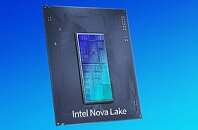
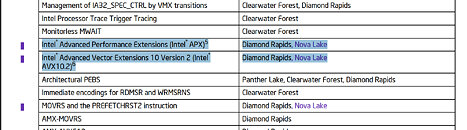
Source:
@InstLatX64 on X
Since AVX10.2 mandates both P-cores and E-cores to support AVX-512 acceleration, this is a sign that "Coyote Cove" P-cores and "Arctic Wolf" E-cores for Nova Lake will be running advanced vector processing, greatly accelerating what the CPU can do. Especially since Nova Lake is supposed to be a 52-core design, having a massive set of cores processing AVX-512 will finally give Intel a possible advantage in the desktop CPU feature set. In comparison, AMD introduced full AVX-512 support with its "Zen 5" cores across its product lineup, enhancing performance in optimized applications for both desktop and server CPUs. This marked the first time AMD implemented native 512-bit AVX support, eliminating the need to split 512-bit data into two 256-bit units for processing in two cycles. AMD will continue with AVX-512 and other features in "Zen 6," making this a start of year-long competition of advanced features in the desktop sector.


91 Comments on Intel Officially Confirms AVX10.2 and APX Support in "Nova Lake"
Sadly your arguments do nothing to help Intels degraded image, and rest assured that depriving the customer of CHOICE won't help either.
Yes, it is nice to have the option but there's bound to be tradeoffs involved. For example: my 7900 XTX must run at PCIe 3.0 x16 even if I use a 5700X3D (and both my M.2 SSD's also running at older spec). Reason? My X470 motherboard. In real-life usage, though? Performance penalty is near negligible.
Gaming benchmarks look awful when everyone is comparing a 285K (9950x competitor) to a 9800X3D (no Intel competitor). Degraded and bent cpus also don't look too good
OK. Lol.
DIY obviously is AMD-favored, but it's a tiny portion of the market. AMD's also made up some ground in the prebuilt market thanks to the strength of X3D, but the vast majority of prebuilts are still Intel, lots of LGA1700 CPUs still being pumped out for those.
Also see the Steam hardware survey, Intel CPU market share has been going down there, some of the top selling CPU's have been AMD, while Intel has trouble selling their latest chips and decided to raise prices on their 12th,13th, and 14th gen cpu's.
I can understand if someone keeps the same system for 5-10 years not caring about socket longevity, however since AM4, the market has responded to not needing to buy a new board with every new generation. Getting a 20-30% performance uplift without needing to drop $200 on a new board is a nice option to have, IMO.
Take a chill pill.
P.s.: Contraty to what some people claim on this thread, 200 dollars for a new mobo, for every new CPU gen, is not a small sum. Not everyone lives in the US. And yes, Z890 is a high end chipset, marketed as such by Intel itself, regardless of cost.
These people are not your friend, and never will be.
AMD isn't any different despite lasting longer with sockets.
We are not the majority of the market. And yes EVEN IN DIY the vast majority of not upgrade. Go look at the ryzen 5000 owners club, tell me what percentage are using 3/400 series boards vs 500 series.
It is an objective waste of money. People spent $1000+ going from a 1700x to a 2700, 3700, then a 5800, all to get the same performance they could have had for $350 5 years earlier with coffee lake.
The only time it truly made sense was the 5800x3d which was a monumental leap for gaming over everything else that came out, and which Intel still cannot match on 1 percent lows and cache heavy games.
Intel has the resources and R&D to figure out how to make a socket last more than 1 gen and a refresh, we sort of got that with LGA 1700 if you count a refresh of a refresh as getting any socket longevity.I don't upgrade every generation but I value the option of having it if the next gen offers a significant upgrade without having to spend more than I would otherwise have to, for example someone could go from a 7800X3D to whatever Zen 6 is going to be.
I keep voting with my wallet, for products that are the most cost effective in my country. I just feel glad not having to spend "the not high end" amount of 200 dollars for a new MB, whenenver I decide to upgrade.Still the same gen. Imagine having to buy a new MB for a refresh.
B860s start at $120 in the US if $200 seems high end to youYou don't need a new MB for a refresh... You would also be insane to upgrade to a refresh
Though I believe Hecate91 meant how LGA1700 had Alder Lake and Raptor Lake, two distinct generations
As for prebuilts, casuls do buy new GPU and CPU every 3-5 years. A lot cheaper to upgrade one part then the whole PC, so they go for it. It's super easy, and it only takes a little encouragement, and that is looking at costs. It's becoming more popular ever year and the amount of product range, many new brands, etc., are the proof the PC parts market is booming. I am not even talking about PC builder level, just upgrading GPU or CPU, a new mobo or DDR kit, some RGB lights maybe.I think Zen 6 will be pretty impressive though, it will be twice the density of Zen 5, even smaller gaps between CCDs, and more cores (rumored/leaks). I think Zen 5 vs Zen 6 will be a bigger gain than Zen 4 vs Zen 5, and Zen 7 probably something similar to Zen 4 vs Zen 5 (20%-ish) as I think it will be also 2nm as Zen 6. However, Zen 7 will likely be the first AM6, and we will probably see DDR6 (and maybe PCIe 6.0).
Like really only now are we seeing actual gains that could make them viable for some people.
www.techpowerup.com/review/phison-e28-es/18.html
Compare that with the top tier Gen4 ones.
You're telling me that for someone having a 2022 platform and using a good Gen4 drive somehow that is the weakest link, the bottleneck in the whole system? And for that they would need to upgrade to Gen5 but lo and behold evil greedy Intel didn't allow the connector on the mobo?
Try harder, it doesn't stick.
The lane switching shitshow on AM5 boards is ridiculous, either it's bifurcation with the GPU slot or the USB4 gets axed, all so you get unnecessary Gen5 M.2s for the secondary slots. Who the hell uses secondary Gen5 M2s???
I have a Z890 Tomahawk, yes the chipset is high-end but price wise it's midrange.
Guess what, I have zero lane switching/bifurcation on it.
It has Gen5 M.2 primary and the rest are Gen4, more than enough for me, does it look like I feel bad for not having Gen5 secondary M.2s?
I'm only using Gen4 drives, I mean price wise it's almost 4TB Gen4 vs 2TB Gen5 so it's an easy choice for me.
Besides Intel made sure Gen5 is gimped on Arrow Lake so I'm definitely not interested in Gen5 drives. :roll:I agree it's nice having the option, but you also have to agree that for the "upgrade path" argument to be viable a reasonably good motherboard has to be purchased initially.
Buying a cheap crappy motherboard that inevitably is lacking some features/connectivity (otherwise it wouldn't be cheap) but also might have some skinny heatsinks for the VRMs and the M.2s (assuming it has heatsinks for the secondary M.2s) is not a good idea when aiming for longevity and pairing that with a much stronger CPU after 2 gens let's say.
With this approach it's very likely that the motherboard will be the bottleneck so to speak, you can't add many M.2s, the secondary ones might need to be the version with heatsink, the thermal pads on the VRMs might need changing (because you can't upgrade the heatsinks) etc.
Not only that choosing AMD for the upgrade path, even though at the moment you're making the choice it's not objectively the best one, forces you to upgrade later. If you don't upgrade you're missing out and you have to use for long term a system which could be slightly inferior to the Intel one you turned down initially.
That's what @Harun8 did, price wise he had a choice between 9600X and 245K (which is really an adversary for the 9700X).
I told him as well that going with AMD for the upgrade path is not wrong but kind of forces him to upgrade later otherwise if he uses the 9600X for a long period he will be using an inferior CPU (inferior in other stuff than gaming, but some people do more than gaming obviously) for all that duration.
Can you really say he made a bad choice in this scenario?