Thursday, November 13th 2025

Intel Officially Confirms AVX10.2 and APX Support in "Nova Lake"

Intel published its 60th Architecture Instruction Set Extensions and Future Features manual, confirming that the AVX-512 subset and its AVX10.2 superset will be supported on the next-generation "Nova Lake" processors. This puts an end to months of rumors circulating online that Nova Lake will not support AVX10.2 and APX, leaving only AMD with 512-bit vector acceleration. However, we will now have two x86 CPU vendors with a proper 512-bit processing in the desktop PC market. This is important as the regular CPU becomes a universal base platform, fulfilling its intended role with enhanced observability. Software can now be accelerated for any market from desktop to server.

Since AVX10.2 mandates both P-cores and E-cores to support AVX-512 acceleration, this is a sign that "Coyote Cove" P-cores and "Arctic Wolf" E-cores for Nova Lake will be running advanced vector processing, greatly accelerating what the CPU can do. Especially since Nova Lake is supposed to be a 52-core design, having a massive set of cores processing AVX-512 will finally give Intel a possible advantage in the desktop CPU feature set. In comparison, AMD introduced full AVX-512 support with its "Zen 5" cores across its product lineup, enhancing performance in optimized applications for both desktop and server CPUs. This marked the first time AMD implemented native 512-bit AVX support, eliminating the need to split 512-bit data into two 256-bit units for processing in two cycles. AMD will continue with AVX-512 and other features in "Zen 6," making this a start of year-long competition of advanced features in the desktop sector.
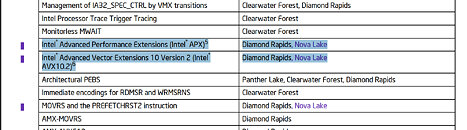
Source: @InstLatX64 on X
Add your own comment

91 Comments on Intel Officially Confirms AVX10.2 and APX Support in "Nova Lake"

#1
_roman_
Lovely.

A revision from a revision from a revison of AVX 512.

Now it'S another mess. AVX 10 subrevision 2. I see it as Intel/AVX.10-r2

They are not able to define a simple cpu instruction for themselves. Basic maths can not put into basic cpu instructions. how comes so many people could do that in the old days? Feel free to look up any assembler instruction from the old days. Simple, well defined.

Hint: Intel Core are outdated as they lack AVX512 and AVX 10 and AVX 10 Revision 2= AVX 10.2 (seems like it for myself. Future will tell facts )
Posted on Reply
#2
kondamin
_roman_Lovely.

A revision from a revision from a revison of AVX 512.

Now it'S another mess. AVX 10 subrevision 2. I see it as Intel/AVX.10-r2

They are not able to define a simple cpu instruction for themselves. Basic maths can not put into basic cpu instructions. how comes so many people could do that in the old days? Feel free to look up any assembler instruction from the old days. Simple, well defined.

Hint: Intel Core are outdated as they lack AVX512 and AVX 10 and AVX 10 Revision 2= AVX 10.2 (seems like it for myself. Future will tell facts )
It's a number of new instructions and they managed to get them to work on e-cores, this is a thing.
Posted on Reply
#3
Waweq
AAAAAAAAAAAAAAAAAAAAAAAAAAAAAAAAAAND


NEWWWWWWWWWWWWWWWWWWWWWWWW

MOTHERBOARD REQUIREDDDDDDDDDDDDDDDDDDDDDDDDDDDDDDDDDDDDDDDDDDDDDDDDDDDDDDDDDDDDDDDDDDDDDDD
Posted on Reply
#4
Nathaaab
WaweqAAAAAAAAAAAAAAAAAAAAAAAAAAAAAAAAAAND


NEWWWWWWWWWWWWWWWWWWWWWWWW

MOTHERBOARD REQUIREDDDDDDDDDDDDDDDDDDDDDDDDDDDDDDDDDDDDDDDDDDDDDDDDDDDDDDDDDDDDDDDDDDDDDDD
We knew this... not everyone changes CPUs every gen anyways
Posted on Reply
#5
dgianstefani
TPU Proofreader
NathaaabWe knew this... not everyone changes CPUs every gen anyways
Most people don't, in fact the vast majority of people don't even upgrade their PC at all, perhaps a little more RAM/storage or a GPU replacement after a few years. Enthusiast forums can be a bit of an echo chamber in that regard.
Posted on Reply
#6
RejZoR
NathaaabWe knew this... not everyone changes CPUs every gen anyways
It's also stupid to change motherboard for every CPU upgrade as well. How the F can AMD release several generations of dramatically enhanced CPU's on same socket but Intel somehow can't because they always move 1 pin for whatever reason just so they force people to buy new motherboards every time. Especially now that motherboards are more expensive than ever.
Posted on Reply
#7
dgianstefani
TPU Proofreader
RejZoRIt's also stupid to change motherboard for every CPU upgrade as well. How the F can AMD release several generations of dramatically enhanced CPU's on same socket but Intel somehow can't because they always move 1 pin for whatever reason just so they force people to buy new motherboards every time. Especially now that motherboards are more expensive than ever.
Compare Arrow Lake platform (x8 DMI twice that of AM5, more/faster PCIe lanes, better networking integrated into CPU/platform, Thunderbolt 4, more/faster USB) to 800 series 600 series boards they tacked USB4 onto, and you might see why a platform change every two generations makes more sense than keeping the same platform for four or five years and advertising the latest CPUs, especially when most people don't ever upgrade.

Even with AM4, there were huge differences between X370, X470 and X570 in terms of what they offered, and at first AMD wasn't even going to offer Zen 3 on first gen boards.
Posted on Reply
#8
lemonadesoda
So e cores can execute AVX512. But can each core and each thread have it’s own AVX registers and execute independently and in parallel, or is there just one AVX register instruction processor, and therefore even though e and p cores have their own virtual set of registers and operators, execution stalls until the AVX processor is free? What an absolute thread scheduler mess
Posted on Reply
#9
Hecate91
RejZoRIt's also stupid to change motherboard for every CPU upgrade as well. How the F can AMD release several generations of dramatically enhanced CPU's on same socket but Intel somehow can't because they always move 1 pin for whatever reason just so they force people to buy new motherboards every time. Especially now that motherboards are more expensive than ever.
Because AMD is a lot less greedy with socket changes, and well they don't have the marketshare to be pushing a new socket on users every generation, or the enthusiasts defending it with "but most don't" nonsense. We're enthusiasts here, obviously we upgrade more often than most people do using a PC until it breaks or Microsoft forcing people to upgrade.

Having some socket longevity is nice for not having to spend another $200-300 on a new board to get more cores and better IPC. And IMO, feature upgrades should be from pci-e cards, but if only motherboard manufacturers weren't loading up boards with m.2 slots and RGB crap so you only get 2 pci-e slots.
Posted on Reply
#10
Rulumi
Nice news for everyone and hopefully it doesn't take much time for AMD to implement AVX10.2 and APX in future products.

As for the people criticizing this as a mess, I really can't see the problem with this, the real mess is the lack of any standarization of any AVX-512 subsets outside of AVX512F (foundational) in general, which AVX10.1 fixes and 10.2 adds some extra instructions and flexibility to it while in both cases normal AVX-512 compatibility is still kept fully in the processor. Add this with APX support and this is good going forward for both Intel and AMD.
Posted on Reply
#11
Six_Times
What series nomenclature will these be released under, 4 or 5?
Posted on Reply
#12
ncrs
@AleksandarK: please stop posting the old image about AVX10 versions. 512-bit is no longer optional. This image contradicts what you wrote in the news-piece itself.
Posted on Reply
#13
CornyOC
Nobody cares about Intel CPU at this point, until they release a generation that factually beats X3D processors by a significant amount, which won't happen.
Posted on Reply
#14
ncrs
lemonadesodaSo e cores can execute AVX512. But can each core and each thread have it’s own AVX registers and execute independently and in parallel, or is there just one AVX register instruction processor, and therefore even though e and p cores have their own virtual set of registers and operators, execution stalls until the AVX processor is free? What an absolute thread scheduler mess
No, each core has its own register resources (far more than what's architecturally defined due to register files) and execution resources. Threads with AVX10.2 don't differ significantly from "classical" AMD64 ones in this regard.
RulumiNice news for everyone and hopefully it doesn't take much time for AMD to implement AVX10.2 and APX in future products.
It's been confirmed that AVX10 comes with Zen 7. As for APX it's unknown.
RulumiAs for the people criticizing this as a mess, I really can't see the problem with this, the real mess is the lack of any standarization of any AVX-512 subsets outside of AVX512F (foundational) in general, which AVX10.1 fixes and 10.2 adds some extra instructions and flexibility to it while in both cases normal AVX-512 compatibility is still kept fully in the processor. Add this with APX support and this is good going forward for both Intel and AMD.
Indeed, AVX10 is fixing the AVX-512 mess, not exacerbating it.
Posted on Reply
#15
TheDeeGee
NathaaabWe knew this... not everyone changes CPUs every gen anyways
Indeed, it's only a problem if you make it a problem.
Posted on Reply
#16
MufasaV
Intel E cores will basically achieve feature parity on client devices. IPC remains the main difference, although its unlikely to be bigger than the current 15% between Skymont and Lion Cove. So far, the difference has been shrinking, but Darkmont and Cougar Cove already had the exact same architecture differences compared to previous gen when looking at Pantherlake, maybe Intel has long since blended the teams together. I doubt the IPC differences will continue to shrink. Possibly P cores will get more XTORs proportionally as E cores just get feature parity while P cores push for more resources.

In return, Arctic Wolf would likely be less of an E core and more of a smaller P core like Zen C. P cores are still far better at scaling performance with more extreme clocks unlike E cores, that's why the C cores are more comparison point. Maybe even the scale may reduce so that a P core is maybe only 2.5X larger than E core. Doubly so now that P cores now share L2 cache in a cluster.

Having APX and AVX is unlikely to move the average IPC difference much seeing how Zen 5 performed, it will be interesting to compare the performance and loads between Intel and AMD here.

Also with new FP8 support, and more extensions, are NPUs going to remain relevant? Or am I missing something? Is AI with AVX and APX the reason why the CPU was justified to be given such a large cache pool?
Posted on Reply
#17
ThomasK
TheDeeGeeIndeed, it's only a problem if you make it a problem.
Sure, it's not a problem for a small company like Intel, that doesn't have a social/environmental responsability. The ESG corporate bullshit goes out the window.

Intel always had the money and the engineering prowess to design a socket that lasts longer than a generation, but it sadly also has always opted to be anti consumer, and pile cash on top of its MB partners.

Regardless if 'most people' don't change CPUs every gen, consumer perception has already shifted, and marketshare reflects exactly that.
Posted on Reply
#18
LastDudeALive
MufasaVAlso with new FP8 support, and more extensions, are NPUs going to remain relevant? Or am I missing something? Is AI with AVX and APX the reason why the CPU was justified to be given such a large cache pool?
Only for mobile chips, where power efficiency matters.
Posted on Reply
#19
Harun8
ThomasKSure, it's not a problem for a small company like Intel, that doesn't have a social/environmental responsability
Old platforms can be reused. Just because a motherboard doesn't work for the latest gen cpu doesn't mean you should be throwing it out. I assume you don't throw out your old cpu when you upgrade it within the same motherboard
Posted on Reply
#20
melkor_unlimited
dgianstefaniCompare Arrow Lake platform (x8 DMI twice that of AM5, more/faster PCIe lanes, better networking integrated into CPU/platform, Thunderbolt 4, more/faster USB) to 800 series 600 series boards they tacked USB4 onto, and you might see why a platform change every two generations makes more sense than keeping the same platform for four or five years and advertising the latest CPUs, especially when most people don't ever upgrade.

Even with AM4, there were huge differences between X370, X470 and X570 in terms of what they offered, and at first AMD wasn't even going to offer Zen 3 on first gen boards.
Please show me mainboard for Intel CPU from 2022 which can run together PCIe v.5 x16 and at least one PCIe v.5 x4.
AM5 boards with X670/X670E chipset can do that.
Two PCIe v.5 x4 or one and 2x USB4.

If x670 or x870 is not enough, there are x670E and x870E. And even if that is not enough, boards for ThreadRippers are there. 4 memory channels or even 8.
Plese show me one non-server mainboard for Intel CPU with more than 2 memory channels.
Posted on Reply
#21
LastDudeALive
melkor_unlimitedPlease show me mainboard for Intel CPU from 2022 which can run together PCIe v.5 x16 and at least one PCIe v.5 x4.
The CPUs didn't have that capability, so obviously the motherboards didn't either.
melkor_unlimitedAM5 boards with X670/X670E chipset can do that.
Two PCIe v.5 x4 or one and 2x USB4.

If x670 or x870 is not enough, there are x670E and x870E. And even if that is not enough, boards for ThreadRippers are there. 4 memory channels or even 8.
Plese show me one non-server mainboard for Intel CPU with more than 2 memory channels.
Don't throw red herrings, Threadrippers are irrelevant.

The point is that AMD is severely limited by the need to support the same socket for 3+ generations. The connectivity of a Ryzen 5000 CPU is severely limited on a 300 series mobo. The connectivity of a Zen 6 CPU will be severely limited on a 600 series mobo. There's no way for AMD to increase the PCIe lane count with Zen 6, for instance, because 80% of the customer base will have motherboards that can't use more PCIe lanes.

Sure, Intel's changing of sockets every generation or two is frustrating for DIY enthusiasts like us. But it's important to remember that at least 90% of Intel's desktop sales come from the prebuilt/OEM market, where that's not a factor at all. Those customers won't be upgrading the CPU, they'll just be getting a new computer in 3-5 years.
Posted on Reply
#22
efikkan
MufasaVIntel E cores will basically achieve feature parity on client devices. IPC remains the main difference, although its unlikely to be bigger than the current 15% between Skymont and Lion Cove…
Such comparisons are very misleading as the sharing of L2 cache for E-cores makes them perform very differently in a latency sensitive (logic heavy) workload (e.g. a user-interactive application or game), while async batch loads will scale much better.
MufasaVHaving APX and AVX is unlikely to move the average IPC difference much seeing how Zen 5 performed, it will be interesting to compare the performance and loads between Intel and AMD here.

Also with new FP8 support, and more extensions, are NPUs going to remain relevant? Or am I missing something? Is AI with AVX and APX the reason why the CPU was justified to be given such a large cache pool?
I assume you mean performance per clock, not IPC (which are not the same), as comparing IPC isn't useful when the instructions change. While APX may result in more instructions per clock overall, it more importantly eliminates a lot of branching and results in fewer pipeline stalls, so the performance per clock gain will be higher than the count of instructions per clock gain.

APX will also allow for better saturation of execution ports, as CPU designs go wider and wider. AMD's Zen 5 got marginal gains from increasing its ALU count from 4 to 6, and their design may even achieve larger gains than Intel with APX. But more importantly, it will allow to scale even further in the future.

APX isn't an "AI" feature, and should not be confused with SIMD like AVX and AMX, and will be mostly useful where SIMD isn't; games, user interfaces, web browsing, etc. It will require recompilation though, but unlike SIMD this optimization should be "entirely" automatic. But I don't think the compilers are near maturity yet (GCC has some "support"), so don't expect to see the real gains until a couple of years from now.
Posted on Reply
#23
ThomasK
Harun8Old platforms can be reused. Just because a motherboard doesn't work for the latest gen cpu doesn't mean you should be throwing it out. I assume you don't throw out your old cpu when you upgrade it within the same motherboard
What about old platforms that support new products? Ever heard of that? Probably not, since you bought Arrow Lake.

Yall should quit blaming the customer for a choice made by a billion dollar company, that benefits itself and everyone else, EXCEPT the customer.
Posted on Reply
#24
Harun8
ThomasKWhat about old platforms that support new products? Ever heard of that? Probably not, since you bought Arrow Lake.

Yall should quit blaming the customer for a choice made by a billion dollar company, that benefits itself and everyone else, EXCEPT the customer.
I've heard of them, and I think they're irrelevant for people like me. I bought a Z490 5 years ago and a Z890 this month. If I bought into AM4 instead of Z490 5 years ago, I would have replaced my motherboard anyway. I am not upgrading my cpu/gpu until I can at least double my performance. The e-waste argument only applies when you're buying the new thing every generation, which not enough people do to matter in terms of e-waste when considering socket longevity
Posted on Reply
#25
Waweq
NathaaabWe knew this... not everyone changes CPUs every gen anyways
What we don't know is: when will Intel learn that nobody buys a new motherboard every year


no wonder their sales are low
Posted on Reply
Add your own comment
Nov 22nd, 2026 15:49 CST change timezone

New Forum Posts

Popular Reviews

TPU on YouTube

Controversial News Posts