Friday, November 21st 2025
AMD Rebrands "FidelityFX Super Resolution" to Its "FSR" Acronym
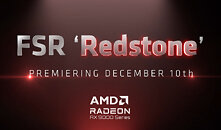
AMD has rebranded its most advanced graphics technology—previously known as FidelityFX Super Resolution—to simply "FSR." This change was noted in AMD's official product page, which states that FSR stands for "formerly AMD FidelityFX Super Resolution." However, AMD has not made any formal announcements regarding this rebranding. All of this is happening ahead of the official FSR "Redstone" product demo scheduled for December 10, which will include technical details about FSR Redstone, as well as games that will implement it.
This sudden and unusual change in product naming by AMD is likely intended to make the shorter acronym resonate better with the gaming audience. It's similar to AMD's own name, which some might not realize stands for Advanced Micro Devices. As a reminder, on December 10, we expect to see AMD's latest FRS "Redstone" platform, which builds on the AI and machine learning super resolution introduced with FSR 4 and introduces three key innovations. The first is neural radiance caching, followed by AI and ML-based Ray Regeneration, and AI and ML-based Frame Generation. Neural Radiance Caching uses a machine learning model that continuously learns how light interacts within a scene to predict and store indirect lighting, reducing the performance cost of ray tracing.
 AMD is likely aiming to capture the gamer's imagination with its FSR rebranding, especially since many gamers associate features like NVIDIA's DLSS with AI advancements in gaming. To add to the intrigue, AMD's FSR "Redstone" Ray Regeneration functions similarly to NVIDIA's DLSS 3.5 Ray Reconstruction. It uses a neural network to regenerate pixels that couldn't be accurately path-traced, significantly enhancing reflection quality when super resolution is applied. The new AI and machine learning-based Frame Generation model represents a major advancement from the interpolation technology AMD introduced with FSR 3.
Sources:
AMD, via VideoCardz
This sudden and unusual change in product naming by AMD is likely intended to make the shorter acronym resonate better with the gaming audience. It's similar to AMD's own name, which some might not realize stands for Advanced Micro Devices. As a reminder, on December 10, we expect to see AMD's latest FRS "Redstone" platform, which builds on the AI and machine learning super resolution introduced with FSR 4 and introduces three key innovations. The first is neural radiance caching, followed by AI and ML-based Ray Regeneration, and AI and ML-based Frame Generation. Neural Radiance Caching uses a machine learning model that continuously learns how light interacts within a scene to predict and store indirect lighting, reducing the performance cost of ray tracing.


26 Comments on AMD Rebrands "FidelityFX Super Resolution" to Its "FSR" Acronym
You know, FidelityFX Super Resolution Super Resolution.
Like how I'm a CAD Designer.
"AMD Fluid Motion for Blu-rays: if your computer's graphics card and driver supports AMD™ Fluid Motion, this option will be available. Select it to enable smoother Blu-ray playback."
a shame AMD has not kept this feature for newer cards. I wonder if Nvidia has an equivalent
Interesting it seems like alot of people dislike watching shows and movies at 60fps, thinking about it, i don't see how that's even possible, but people see things differently.
Well you can tell the difference between 30fps or 60fps. There's videos about it on Youtube and elsewhere. Me personally i have no intention on using any gpus but Vega forever. I do have a 6600 and 5500 gpus, but i might use the 6600 on my secondary computer i plan on building early next year. But my main always vega gpus.
Might play around with that movie again later tonight with the MPV player see if I like it better or not
MPV is somewhat difficult to use, though I suppose you'll pick up quick if you're familiar with Linux terminal commands. There used to be a fork for Windows with a frontend I used to use, but it hasn't been updated in some time. Probably worth checking out
github.com/mpvnet-player/mpv.netThey are not "going to" make FSR fully proprietary, arguably, by vendor-locking it and requiring their latest architecture, they already have. In any case, feast your eyes on the documentation they've finally published, after almost a year of delay. Special attention to the "Limitations" section:
gpuopen.com/manuals/fidelityfx_sdk2/techniques/super-resolution-ml/
Besides, all research on FSR 4 and getting it working on other architectures unofficially come from that source code leak "oopsie" of theirs back in August. And for the nth time, I do not hate AMD. The difference is that I am willing to acknowledge they're a corporation and place their business interests first. If you cannot see it for what it is, then you have simply elected not to.
Gaming profiles are still not applied.
How to reproduce: Close the running Game. Restart game and wait for the useless advertising at the game start. Success hear the graphic card fans now blowing constantly at 50%. Straight line 50% fan "curve" without zero fan. See gpu temps dropping from 52 or 54°C to 48°C over the time.
Plenty of pre RT/TAA reliant AA games to go back and enjoy though, and they're comparatively easy to run.
Personally I'm enamoured with the Perfect Dark PC port, which runs on the smell of a wet fart. I get get 1080p144fps flat line w/4xMSAA on an N100/UHD 730 using 10w or less for the whole soc, or use gratuitous AA and/or super sampling on anything newer (like 2880x1800 120hz w/8xMSAA on a 1050Ti being 30-50% utilised), and the beauty is it's perhaps one of the greats FPS games of all times. The actual gameplay / richness of content is what I find the most lacking these days, not the visuals.