Thursday, December 11th 2025

Just Launched OpenAI GPT-5.2 Trained & Deployed on NVIDIA Infrastructure
Unveiling what it describes as the most capable model series yet for professional knowledge work, OpenAI launched GPT-5.2 today. The model was trained and deployed on NVIDIA infrastructure, including NVIDIA Hopper and GB200 NVL72 systems. It's the latest example of how leading AI builders train and deploy at scale on NVIDIA's full-stack AI infrastructure.
Pretraining: The Bedrock of Intelligence
AI models are getting more capable thanks to three scaling laws: pretraining, post-training and test-time scaling. Reasoning models, which apply compute during inference to tackle complex queries, using multiple networks working together, are now everywhere. But pre-training and post-training remain the bedrock of intelligence. They're core to making reasoning models smarter and more useful. And getting there takes scale. Training frontier models from scratch isn't a small job. It takes tens of thousands, even hundreds of thousands, of GPUs working together effectively. That level of scale demands excellence across many dimensions. It requires world-class accelerators, advanced networking across scale-up, scale-out and increasingly scale-across architectures, plus a fully optimized software stack. In short, a purpose-built infrastructure platform built to deliver performance at scale.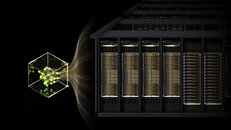
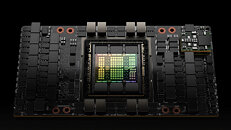
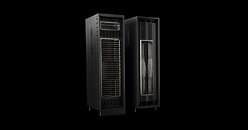 Compared with the NVIDIA Hopper architecture, NVIDIA GB200 NVL72 systems delivered 3x faster training performance on the largest model tested in the latest MLPerf Training industry benchmarks, and nearly 2x better performance per dollar. And NVIDIA GB300 NVL72 delivers a more than 4x speedup compared with NVIDIA Hopper. These performance gains help AI developers shorten development cycles and deploy new models more quickly.
Proof in the Models Across Every Modality
The majority of today's leading large language models were trained on NVIDIA platforms.
AI isn't just about text.
NVIDIA supports AI development across multiple modalities, including speech, image and video generation, as well as emerging areas like biology and robotics.
For example, models like Evo 2 decode genetic sequences, OpenFold3 predicts 3D protein structures and Boltz-2 simulates drug interactions, helping researchers identify promising candidates faster. On the clinical side, NVIDIA Clara synthesis models generate realistic medical images to advance screening and diagnosis without exposing patient data.
Companies like Runway and Inworld train on NVIDIA infrastructure.
Runway last week announced Gen-4.5, a new frontier video generation model that's the current top-rated video model in the world, according to the Artificial Analysis leaderboard.
Now optimized for NVIDIA Blackwell, Gen-4.5 was developed entirely on NVIDIA GPUs across initial research and development, pre-training, post-training and inference.
Runway also announced GWM-1, a state-of-the-art general world model trained on NVIDIA Blackwell that's built to simulate reality in real time. It's interactive, controllable and general-purpose, with applications in video games, education, science, entertainment and robotics.
Benchmarks show why.
MLPerf is the industry-standard benchmark for training performance. In the latest round, NVIDIA submitted results across all seven MLPerf Training 5.1 benchmarks, showing strong performance and versatility. It was the only platform to submit in every category. NVIDIA's ability to support diverse AI workloads helps data centers use resources more efficiently.
That's why AI labs such as Black Forest Labs, Cohere, Mistral, OpenAI, Reflection and Thinking Machines Lab and are all training on the NVIDIA Blackwell platform.
NVIDIA Blackwell Across Clouds and Data Centers
NVIDIA Blackwell is widely available from leading cloud service providers, neo-clouds and server makers. And NVIDIA Blackwell Ultra, offering additional compute, memory and architecture improvements, is now rolling out from server makers and cloud service providers. Major cloud service providers and NVIDIA Cloud Partners, including Amazon Web Services, CoreWeave, Google Cloud, Lambda, Microsoft Azure, Nebius, Oracle Cloud Infrastructure and Together AI, to name a few, already offer instances powered by NVIDIA Blackwell, ensuring scalable performance as pretraining scaling continues.
From frontier models to everyday AI, the future is being built on NVIDIA.
Sources:
NVIDIA Blog, OpenAI
Pretraining: The Bedrock of Intelligence
AI models are getting more capable thanks to three scaling laws: pretraining, post-training and test-time scaling. Reasoning models, which apply compute during inference to tackle complex queries, using multiple networks working together, are now everywhere. But pre-training and post-training remain the bedrock of intelligence. They're core to making reasoning models smarter and more useful. And getting there takes scale. Training frontier models from scratch isn't a small job. It takes tens of thousands, even hundreds of thousands, of GPUs working together effectively. That level of scale demands excellence across many dimensions. It requires world-class accelerators, advanced networking across scale-up, scale-out and increasingly scale-across architectures, plus a fully optimized software stack. In short, a purpose-built infrastructure platform built to deliver performance at scale.


Proof in the Models Across Every Modality
The majority of today's leading large language models were trained on NVIDIA platforms.
AI isn't just about text.
NVIDIA supports AI development across multiple modalities, including speech, image and video generation, as well as emerging areas like biology and robotics.
For example, models like Evo 2 decode genetic sequences, OpenFold3 predicts 3D protein structures and Boltz-2 simulates drug interactions, helping researchers identify promising candidates faster. On the clinical side, NVIDIA Clara synthesis models generate realistic medical images to advance screening and diagnosis without exposing patient data.
Companies like Runway and Inworld train on NVIDIA infrastructure.
Runway last week announced Gen-4.5, a new frontier video generation model that's the current top-rated video model in the world, according to the Artificial Analysis leaderboard.
Now optimized for NVIDIA Blackwell, Gen-4.5 was developed entirely on NVIDIA GPUs across initial research and development, pre-training, post-training and inference.
Runway also announced GWM-1, a state-of-the-art general world model trained on NVIDIA Blackwell that's built to simulate reality in real time. It's interactive, controllable and general-purpose, with applications in video games, education, science, entertainment and robotics.
Benchmarks show why.
MLPerf is the industry-standard benchmark for training performance. In the latest round, NVIDIA submitted results across all seven MLPerf Training 5.1 benchmarks, showing strong performance and versatility. It was the only platform to submit in every category. NVIDIA's ability to support diverse AI workloads helps data centers use resources more efficiently.
That's why AI labs such as Black Forest Labs, Cohere, Mistral, OpenAI, Reflection and Thinking Machines Lab and are all training on the NVIDIA Blackwell platform.
NVIDIA Blackwell Across Clouds and Data Centers
NVIDIA Blackwell is widely available from leading cloud service providers, neo-clouds and server makers. And NVIDIA Blackwell Ultra, offering additional compute, memory and architecture improvements, is now rolling out from server makers and cloud service providers.

From frontier models to everyday AI, the future is being built on NVIDIA.
12 Comments on Just Launched OpenAI GPT-5.2 Trained & Deployed on NVIDIA Infrastructure
They're sort of just coasting and providing nothing updates while everyone surpasses them. Now whenever I use them for anything work related or technical it has become super painful, often wrong, and just somewhat weird all around - like random "I can't help with that" for valid tasks.
Whowouldathunkit.
And we wonder why the West is losing its tech lead, as more and more money gets stuck to the top 1%.
not because someone actually said it.
so if this happened with things "being enough" to be some national news, how many times does it happen for smaller cases.
"Grandpa, do you remember the time before the 7 Great Strong AI Regions, where we had 50 States that all had their own laws? How was life in the 1900s?? They say your phones were wired to the wall and no one had tracker chips!?!"
In all seriousness though - this happens to almost all initial leader/first mover companies - Coca Cola wasn't the first soda company etc. Xerox invented the GUI, Nokia and phones, Kodak and digital camera etc. It's the First Mover curse - they almost always get disrupted by others - Im actually surprised they werent able to patent it in any way / lock it down before this point. Open AI needed to grab those lawyers that locked up the Nemesis system with WB - that's still off limits lol.