Thursday, January 8th 2026

Carbice Shows Off Ice Pad, a High-Performance Carbon Nanotube Thermal Pad
Carbice is a new entrant at CES, and we caught their revolutionary new product, called simply Ice Pad. This is a high-performance, sold-state thermal pad based on carbon nanotubes, a technology more advanced than graphite-based thermal pads from, say, Hitachi. Graphite based pads tend to offer much higher thermal conductivity than regular polymer-based ones, but carbon nanotube (CNT) based ones tend to offer even higher axial thermal conductivity. The Ice Pad offers in-plane thermal conductivity of 200 W/mK, and outlasts a conventional TIM application by years. In fact Carbice claims that the conductivity improves over time. A single pad application can last the entire age of the system.
The Carbice Ice Pad is available in sheets measuring 33 mm x 33 mm, or about the size of the IHS of a processor. It's available in various other sizes, and can be cut down. Among the applications shown at the Carbice booth include CPU and GPU. The GPU application sees you get rid of the copious amounts of thermal paste VGA manufacturers tend to apply. Carbice scored its first major OEM design win with CyberPowerPC, which offers Ice Pad as a premium TIM option for its gaming desktops.

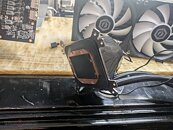

The Carbice Ice Pad is available in sheets measuring 33 mm x 33 mm, or about the size of the IHS of a processor. It's available in various other sizes, and can be cut down. Among the applications shown at the Carbice booth include CPU and GPU. The GPU application sees you get rid of the copious amounts of thermal paste VGA manufacturers tend to apply. Carbice scored its first major OEM design win with CyberPowerPC, which offers Ice Pad as a premium TIM option for its gaming desktops.


7 Comments on Carbice Shows Off Ice Pad, a High-Performance Carbon Nanotube Thermal Pad
and I'd love to test this. Igor's lab should also get a sample!
It will be VERY intersting to test this thing and compare with current graphite stuff.
Would be interested to see real measurements of those pads.