Friday, January 16th 2026

Interesting AMD FCH-on-a-Stick Addon Card Gives the Appearance of Intel CPU on AMD Chipset

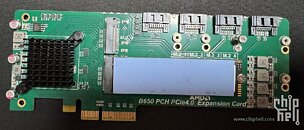
AMD creates the top X670E and X870E chipsets by joining two AMD "Promontory 21" FCH chips at the hip. Each of these takes in a PCI-Express 4.0 x4 connection, and puts out 8 PCIe 4.0 lanes and four SATA 6 Gbps ports that can be re-configured as four additional Gen 3 lanes. The X870E/X670E chipset hence has a total of 12 PCIe 4.0 lanes and up to eight SATA 6 Gbps ports on the platform. A company decided to put one of these chips on an add-on card, so you could upgrade your single-FCH platform, such as B650, B850, or X870, with more PCIe lanes wired out as additional M.2 slots, and some SATA ports.

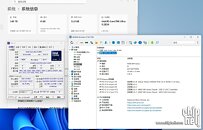
PC enthusiasts in China decided to install this card on an Intel motherboard to hilarious results—utilities such as AIDA64 are confused, thinking these Promontory 21 chips are the platform's main chipset. This gives the appearance of an Intel processor on an AMD chipset motherboard. The card has four M.2 slots, two on each side, and four SATA 6 Gbps ports. At least two of these are Gen 4 x4, while the others could be Gen 3 x4 and M.2-SATA, used when none of the SATA 6 Gbps ports is connected. There's no word on how to get one of these cards.
Sources: ChipHell Forums, HXL (Twitter)
Add your own comment

44 Comments on Interesting AMD FCH-on-a-Stick Addon Card Gives the Appearance of Intel CPU on AMD Chipset

#1
R-T-B
btarunrThere's no word on how to get one of these cards.
More like theres no word on how to source the Promontory chips... the cards layouts are freely downloadable and you can send them to the PCB maker of your choice.
Posted on Reply
#2
Chaitanya
R-T-BMore like theres no word on how to source the Promontory chips... the cards layouts are freely downloadable and you can send them to the PCB maker of your choice.
Give it some time you will find it for sale on Aliexpress.
Posted on Reply
#3
qcmadness
R-T-BMore like theres no word on how to source the Promontory chips... the cards layouts are freely downloadable and you can send them to the PCB maker of your choice.
From previous information, the most difficult step is to get a firmware for the chipset. Otherwise it would refuse to work.
Posted on Reply
#4
_roman_
Surprise: PCIE slot is connected to a x670 chip. This is just mechanically different as the use case on motherboards. Electrically basically the same.

I see the issue more in the possible need for firmware. I do not own datasheets. And I am already serching without results datasheets for my motherboard, various chips.

This post maybe shows how overpriced motherboards are. You could put the io on expansion cards. Less chips wasted for stuff which may never get utilised.
Posted on Reply
#5
TheinsanegamerN
_roman_Surprise: PCIE slot is connected to a x670 chip. This is just mechanically different as the use case on motherboards. Electrically basically the same.

I see the issue more in the possible need for firmware. I do not own datasheets. And I am already serching without results datasheets for my motherboard, various chips.

This post maybe shows how overpriced motherboards are. You could put the io on expansion cards. Less chips wasted for stuff which may never get utilised.
Yeah, then you'll never have enough room for the stuff you do want to use once you get beyong basic input.

There's a reason we abandoned that idea with BabyAT back in the 90s.
Posted on Reply
#6
LabRat 891
btarunrPC enthusiasts in China decided to install this card on an Intel motherboard to hilarious results—utilities such as AIDA64 are confused, thinking these Promontory 21 chips are the platform's main chipset. This gives the appearance of an Intel processor on an AMD chipset motherboard. The card has four M.2 slots, two on each side, and four SATA 6 Gbps ports. At least two of these are Gen 4 x4, while the others could be Gen 3 x4 and M.2-SATA, used when none of the SATA 6 Gbps ports is connected. There's no word on how to get one of these cards.
😍 I live for this stuff.

Screw your vendor lockout, I'll build my own expansion fanout; with blackjack, and hookers!
Posted on Reply
#7
TheLostSwede
News Editor
_roman_Surprise: PCIE slot is connected to a x670 chip. This is just mechanically different as the use case on motherboards. Electrically basically the same.

I see the issue more in the possible need for firmware. I do not own datasheets. And I am already serching without results datasheets for my motherboard, various chips.
Datasheets are one of those things you get when your company works with another company that makes the chips you want to use...

Even though I'm good friends with one of the VP's at ASMedia, I doubt he'd give me access to the datasheet for the AMD chipsets, even less so access to the firmware.
Posted on Reply
#8
Chrispy_
I still don't understand these, the same way I don't really understand X670/X870.

You get more PCIe lanes, but they're not getting any more bandwidth to the CPU unless you plug them into one of the two 4-lane M.2 slots that hang off the CPU. Connecting a second chipset to a PCIe slot already hanging off the chipset just makes the horrible contention for lanes to the CPU even worse.
Posted on Reply
#9
A Computer Guy
Bandwith issues to the CPU aside I like the out of the box thinking with this. It seems you can never have enough SATA or root USB hubs and this looks like a great way to do that.
Posted on Reply
#10
_roman_
Its just a hub, like a usb hub. You share the total bandwidth for all devices.
The idea is, that you never need all devices at full bandwidth. #

Some stuff will always be the bottleneck, x670 chipset, cpu bus, cpu itself, dram, storage, network...
Posted on Reply
#11
zenlessyank
_roman_Its just a hub, like a usb hub. You share the total bandwidth for all devices.
The idea is, that you never need all devices at full bandwidth. #

Some stuff will always be the bottleneck, x670 chipset, cpu bus, cpu itself, dram, storage, network...
Yes, but it keeps me from having to take stuff apart to play. That 'A' in my pic ain't for asshole (although it probably should be).

I see several useful things about this device now that I have pondered it more. See, I really want USB 4 on my AM4 rig. This might be a pathway. More brain processing required.

Hats off to creative minds.
Posted on Reply
#12
Punkenjoy
Chrispy_I still don't understand these, the same way I don't really understand X670/X870.

You get more PCIe lanes, but they're not getting any more bandwidth to the CPU unless you plug them into one of the two 4-lane M.2 slots that hang off the CPU. Connecting a second chipset to a PCIe slot already hanging off the chipset just makes the horrible contention for lanes to the CPU even worse.
It's true, but for the contention part, this is only the case if you need to use all port at full bandwidth at the same time. But in many scenario, this is not something that happen frequently. We are talking about consumer/DIY stuff. Indeed, for servers, you want dedicated lanes and the CPU will provide it.

In reality, this is pretty niche, but there are some niche usecase that make sense.
Posted on Reply
#13
r00tcz
Very cool, I would love to see version with 4 PCIe slots instead of M.2
Posted on Reply
#14
TheLostSwede
News Editor
Chrispy_I still don't understand these, the same way I don't really understand X670/X870.

You get more PCIe lanes, but they're not getting any more bandwidth to the CPU unless you plug them into one of the two 4-lane M.2 slots that hang off the CPU. Connecting a second chipset to a PCIe slot already hanging off the chipset just makes the horrible contention for lanes to the CPU even worse.
Remember the old PLX PCIe switches? This kind of works in the same way.
You have limited upstreams bandwidth, but since you rarely use all your connected devices at the same time, plus with the help of DMA, not everything has to go via the CPU.
It's unlikely to cause a ton of contention to the CPU thanks to DMA, as anything that doesn't have to go to the CPU, won't go that far up the chain.
_roman_Its just a hub, like a usb hub. You share the total bandwidth for all devices.
The idea is, that you never need all devices at full bandwidth. #

Some stuff will always be the bottleneck, x670 chipset, cpu bus, cpu itself, dram, storage, network...
No, it's actually quite different, as prior to USB4, USB didn't have DMA for the part after the host controller, so a USB hub doesn't have DMA.
With PCIe, you have DMA, so if you have two NVMe devices that you copy data between, that never goes via the CPU, but if you were to connect those two NVMe devices using an NVMe to USB 3.2 Gen 2x2 bridge, you'd have to go via the CPU, as I'm not aware of any USB 3.x host controllers that do any meaning full CPU offloading.
The only DMA interaction with USB would be if you have two devices on different USB host controllers that need to communicate with each other, but it's still not going to be as good as over PCIe.
Posted on Reply
#15
evernessince
Makes you wonder if AMD could just offer a chipset slot for their top SKU motherboard instead of dual chipsets and let the user choose which extra IO they want.
Posted on Reply
#16
TheLostSwede
News Editor
zenlessyankI see several useful things about this device now that I have pondered it more. See, I really want USB 4 on my AM4 rig. This might be a pathway. More brain processing required.
No it won't be. USB4/Thunderbolt needs some kind SPI/GPIO/DMA/whatever interface with the CPU, plus support in the UEFI. It's a lot more complex than it appears at first.
Posted on Reply
#17
zenlessyank
TheLostSwedeNo it won't be. USB4/Thunderbolt needs some kind SPI/GPIO/DMA/whatever interface with the CPU, plus support in the UEFI. It's a lot more complex than it appears at first.
Sad face. O well, await Zen 6 I will.
Posted on Reply
#18
TheLostSwede
News Editor
zenlessyankSad face. O well, await Zen 6 I will.
You can thank Intel for that, as they apparently decided that Thunderbolt needed more than just PCIe.
If you look at all the add-in cards, they come with an internal USB 2.0 cable (as Thunderbolt doesn't support USB 2.0 natively) and a second, proprietary cable that differs between manufacturers. It might be possible to get Thunderbolt/USB4 working without that cable, but things like sleep and hot-swapping won't work and you could end up crashing your system if you try to hot-swap.
Posted on Reply
#19
zenlessyank
TheLostSwedeYou can thank Intel for that, as they apparently decided that Thunderbolt needed more than just PCIe.
If you look at all the add-in cards, they come with an internal USB 2.0 cable (as Thunderbolt doesn't support USB 2.0 natively) and a second, proprietary cable that differs between manufacturers. It might be possible to get Thunderbolt/USB4 working without that cable, but things like sleep and hot-swapping won't work and you could end up crashing your system if you try to hot-swap.
Yea, I have been looking for a USB 4 add-in card for my rig and they just aren't out there. Unless you have AM5 you are SOL. And it doesn't look like that will change. And this is why I detest proprietary tech. Of all people, Intel should know better and be better about it. Reeks of Itanium & Thunderbolt. Although I am aware that USB4 has some kinda of Thunderbolt tech in it.
Posted on Reply
#20
TheLostSwede
News Editor
zenlessyankYea, I have been looking for a USB 4 add-in card for my rig and they just aren't out there. Unless you have AM5 you are SOL. And it doesn't look like that will change. And this is why I detest proprietary tech. Of all people, Intel should know better and be better about it. Reeks of Itanium & Thunderbolt. Although I am aware that USB4 has some kinda of Thunderbolt tech in it.
I'm sort of SOL and I'm on AM5, as Gigabyte never made USB4 add-in card. Ok, I could get a Thunderbolt 4 card, but it would be performing worse than the ASM4242 based USB4 cards.
USB4 is based on Intel's "gifted" Thunderbolt 3, but Intel kindly left out a lot of things from the specs it "gave" to the USB-IF. Having talked with people in the industry about it and initially it was very hard for them to work out the spec and to get their products certified. Guess why USB4 was delayed for as long as it was?

Edit: Gigabyte seem to claim that it's GC-Titan Ridge add-in card works with some AM4 boards, assuming they have the extra pin-header.
www.gigabyte.com/PC-Accessory/GC-TITAN-RIDGE-rev-20
Posted on Reply
#21
zenlessyank
TheLostSwedeI'm sort of SOL and I'm on AM5, as Gigabyte never made USB4 add-in card. Ok, I could get a Thunderbolt 4 card, but it would be performing worse than the ASM4242 based USB4 cards.
USB4 is based on Intel's "gifted" Thunderbolt 3, but Intel kindly left out a lot of things from the specs it "gave" to the USB-IF. Having talked with people in the industry about it and initially it was very hard for them to work out the spec and to get their products certified. Guess why USB4 was delayed for as long as it was?

Edit: Gigabyte seem to claim that it's GC-Titan Ridge add-in card works with some AM4 boards, assuming they have the extra pin-header.
www.gigabyte.com/PC-Accessory/GC-TITAN-RIDGE-rev-20
MSI has one but it doesn't work on any am4. That is cool Gigabyte makes one. Maybe I won't be so judgemental against them. lol
Posted on Reply
#22
hkpolice2
TheLostSwedeRemember the old PLX PCIe switches? This kind of works in the same way.
You have limited upstreams bandwidth, but since you rarely use all your connected devices at the same time, plus with the help of DMA, not everything has to go via the CPU.
It's unlikely to cause a ton of contention to the CPU thanks to DMA, as anything that doesn't have to go to the CPU, won't go that far up the chain.


No, it's actually quite different, as prior to USB4, USB didn't have DMA for the part after the host controller, so a USB hub doesn't have DMA.
With PCIe, you have DMA, so if you have two NVMe devices that you copy data between, that never goes via the CPU, but if you were to connect those two NVMe devices using an NVMe to USB 3.2 Gen 2x2 bridge, you'd have to go via the CPU, as I'm not aware of any USB 3.x host controllers that do any meaning full CPU offloading.
The only DMA interaction with USB would be if you have two devices on different USB host controllers that need to communicate with each other, but it's still not going to be as good as over PCIe.
This is news to me, can you please confirm if I understand it correctly?

For example if I have 2x PCIe4 nvme SSDs connected to x870e chipset, they can copy files to each other @ max speed without any data going upstream to CPU? What if the data is encrypted with something like bitblocker?

Nevermind, just figured out that data still has to go upstream to memory controller, but it doesn't require any CPU cycles. So I'm guessing the main PCIe4x4 uplink to CPU is still a bottleneck if transferring more than 8GB/s like moving files from SSD to SSD while copying data from pcie5 SSD to sata
Posted on Reply
#23
TheLostSwede
News Editor
hkpolice2Nevermind, just figured out that data still has to go upstream to memory controller, but it doesn't require any CPU cycles. So I'm guessing the main PCIe4x4 uplink to CPU is still a bottleneck if transferring more than 8GB/s like moving files from SSD to SSD while copying data from pcie5 SSD to sata
Well, you're always going to be running into a bottleneck somewhere, as that's how all computers are designed, most likely on purpose to keep the costs manageble.
DMA is obviously not a new thing, but it has become more and more important, as modern computers are using increasingly higher amounts of bandwidth.
I don't really see the issue in your scenario, but I guess it depends on how the board maker has wired things up, since the CPU supports a pair of SATA ports, but potentially, there could be an issue if the SATA ports goes via the chipset. I haven't tested this kind of a scenario myself, but most people aren't going to run into these types of hypothetical issues.
Admittedly Intel moved its DMI bus (the one between the CPU and chipset) to eight lanes worth of PCIe 4.0 equivalent bandwidth, on higher-end chipsets, but I haven't seen anyone do any tests where they compare the performance between AMD and Intel when it comes to copying data between internal storage devices.
Posted on Reply
#24
EsaT
A Computer GuyBandwith issues to the CPU aside I like the out of the box thinking with this. It seems you can never have enough SATA or root USB hubs and this looks like a great way to do that.
And more importantly since SATA seems to be on its way to neglect in consumer SSDs and worser prices per capacity, this kind cards would be great option for being able to add more M.2/NVMe drives to mainstream motherboard with few M.2 slots,
Now you need electrically x16 slot or at least x8 slot, of which there are no spares in mainstream motherboard, for multi-slot adapter.
(well, there are x1 slot adapters...)

For home user four PCIe lane connection upstream wouldn't be much of issue, because most usages wouldn't hammer multiple drives simultaneous.
And even if all four drives were hammered with sequential transfers, available bandwidth per drive would be still higher than on SATA drives.
TheLostSwedeWell, you're always going to be running into a bottleneck somewhere, as that's how all computers are designed, most likely on purpose to keep the costs manageble.
There's also power consumption cost for adding circuitry to offer more I/O lanes and bandwidth.
Which is accepted in server hardware really needing that bandwidth.

Though in power efficiency Intel's Z-serie boards are significantly ahead of AMD.
Current "double chipset" approach of X670/870 just isn't power efficient with traffic between chips propably going through SERDESes (and then going through another SERDES to get to PCIe lanes offered by chip) unless also internal communication of Promontory chip uses PCIe.
Posted on Reply
#25
Chrispy_
hkpolice2For example if I have 2x PCIe4 nvme SSDs connected to x870e chipset, they can copy files to each other @ max speed without any data going upstream to CPU? What if the data is encrypted with something like bitblocker?
This is why I treat x670/x870 as pointless. Everything has to go via RAM in most scenarios. DirectStorage is the only technology I know of that allows a device to bypass the CPU/RAM process and that's a barely-used scenario even though it's been around for a few years now. As for DMA, it's irrelevant to the puny four-lane bottleneck between the chipset and the CPU - it literally means direct memory access so anything using DMA must be going over those four lanes to the CPU's memory controller.

If you have a B650/B850 with eight dedicated lanes for two M.2 drives hanging off the CPU, you can move data between those two drives at their full speed, and you still have four chipset lanes for a third drive that is sharing its lanes with audio, USB, network etc but for most workloads that's barely going to impact the third drive. It's a reasonably common video-editing workflow where you have high bandwidth needs on three drives at once (raw source drive, final output destination, scratch disk for proxies+cache). That three-drive limitation is the limit of the AM5 processor, not the motherboard. Adding a more PCIe lanes to that system using three drives achieves nothing because all four chipset lanes are saturated by the third drive.

For single-tasking consumer workloads, that 28-lane limit s a sensible stopping point; Scenarios that need more lanes really do imply professional multitasking. If your system is running as a host for multiple VMs, those could suffer but you wouldn't really be seriously complaining if your production VM host was running on a consumer platform.

The additional FCH chip does give you more USB, more SATA, more actual raw connectivity. If you are one of those people who needs an additional 4-6 SATA ports, or a bazillion USB drives, then yeah, the extra physical ports that allows might be useful and that's why this FCH on a stick is interesting - but it's for edge-case weirdo scenarios, potentially in the sort of system that isn't even using a GPU so there are an extra 16 lanes to the CPU going spare anyway. The FCH-on-a-stick makes far more sense to me than the existence of x670/x870 since the kind of high-end gaming or workstation build that is likely to buy x670/x870 won't be an edge-case consumer scenario like a VM host, hosting a huge soft-RAID array of several SATA drives, or acting as some kind of USB-device farm.
Posted on Reply
Add your own comment
Nov 28th, 2026 08:34 CST change timezone

New Forum Posts

Popular Reviews

TPU on YouTube

Controversial News Posts