Tuesday, January 27th 2026
KIOXIA Introduces QLC UFS 4.1 Embedded Flash Memory Devices for High-Capacity Mobile Storage
KIOXIA America, Inc. today announced that it has begun sampling new Universal Flash Storage (UFS) Ver. 4.1 embedded memory devices with 4-bit-per-cell, quadruple-level cell (QLC) technology. Designed for read-intensive applications and high-capacity storage needs, the new devices are powered by KIOXIA's 8th generation BiCS FLASH 3D flash memory technology.
QLC UFS offers a higher bit density than traditional TLC UFS, making it suitable for mobile applications that require higher storage capacities. Advancements in controller technology and error correction have enabled QLC technology to achieve this while maintaining competitive performance.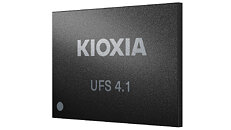 Building on these advancements, the new Kioxia devices achieve substantial performance increases. KIOXIA's QLC UFS boosts sequential write speeds by 25%, random read speeds by 90%, and random write speeds by 95% compared to the previous generation (UFS 4.0/BiCS6 QLC UFS). Write Amplification Factor (WAF) is also improved by up to 3.5x (with WriteBooster disabled).
Well-suited for smartphones and tablets, KIOXIA QLC UFS also supports emerging product categories that demand higher capacity and performance, including PCs, networking, AR/VR, IoT, and AI-enabled devices.
Available in 512-gigabyte (GB) and 1-terabyte (TB) capacities, the new UFS 4.1 devices combine KIOXIA's advanced BiCS FLASH 3D flash memory and an integrated controller in a JEDEC -standard package. KIOXIA's 8th generation BiCS FLASH 3D flash memory introduces CBA (CMOS directly Bonded to Array) technology - an architectural innovation that marks a step-change in flash memory design.
Key features include:
Source:
KIOXIA
QLC UFS offers a higher bit density than traditional TLC UFS, making it suitable for mobile applications that require higher storage capacities. Advancements in controller technology and error correction have enabled QLC technology to achieve this while maintaining competitive performance.

Well-suited for smartphones and tablets, KIOXIA QLC UFS also supports emerging product categories that demand higher capacity and performance, including PCs, networking, AR/VR, IoT, and AI-enabled devices.
Available in 512-gigabyte (GB) and 1-terabyte (TB) capacities, the new UFS 4.1 devices combine KIOXIA's advanced BiCS FLASH 3D flash memory and an integrated controller in a JEDEC -standard package. KIOXIA's 8th generation BiCS FLASH 3D flash memory introduces CBA (CMOS directly Bonded to Array) technology - an architectural innovation that marks a step-change in flash memory design.
Key features include:
- Compliant with the UFS 4.1 specification. UFS 4.1 is backward-compatible with UFS 4.0 and UFS 3.1.
- KIOXIA BiCS FLASH generation 8 3D flash memory
- WriteBooster support for significantly faster write speeds
- Reduced package size compared to the previous QLC UFS: 11×13 mm to 9×13 mm
2 Comments on KIOXIA Introduces QLC UFS 4.1 Embedded Flash Memory Devices for High-Capacity Mobile Storage
In 2026, informing consumers about the shift to
QLC (Quad-Level Cell) in high-end devices like the potential Pixel 11 Pro is a necessary counter-narrative to the "AI-optimized" marketing. The industry is currently facing a massive squeeze, and "capacity inflation" is being used to hide "endurance deflation."
If you are looking to provide people with the raw, non-marketing facts about why UFS 4.1 QLC is a compromise, here are the three critical points to highlight for the 2026 landscape:
1. The 7-Year Update Trap
Google and Samsung now promise 7 years of OS updates. However, if they use Kioxia’s QLC (rated at ~600–1,000 P/E cycles) to save costs on 512GB/1TB models, the hardware may physically wear out before the software support ends.
- The Math: A power user recording 4K/8K video or using "On-Device AI" (which involves constant swapping and caching) can easily exceed the write limits of QLC NAND within 4–5 years, leading to "read-only" lockups or total device failure.
2. Performance "Thermal Throttling"Marketing focuses on the 4,200 MB/s read speeds of UFS 4.1. They rarely mention that once the small SLC (Single-Level Cell) cache is full, QLC write speeds can tank to lower than UFS 2.1 speeds (sometimes below 100-200 MB/s).
- The Reality: Moving a large 50GB file or installing a massive game update on a QLC-based Pixel will start fast but become a crawl as the drive fills up.
3. The "Capacity over Quality" Shell GameIn 2026, memory prices have risen by 30-40%due to AI server demand. Manufacturers are using QLC to avoid raising phone prices, but they are doing so by swapping out "industrial-grade" TLC for "consumer-grade" QLC.
- The Comparison: A 256GB TLC chip (Samsung/Micron) is objectively a better, longer-lasting piece of hardware than a 512GB QLC chip (Kioxia), even though the average buyer thinks "higher number equals better."
Summary for 2026 BuyersTo avoid "planned obsolescence e-waste," consumers should be advised to check teardowns and technical sheets for:
- Micron (G9 TLC) or Samsung (V-NAND TLC): Found in premium flagship configurations.
- SK Hynix (321-layer TLC): The current gold standard for the "ZUFS" (Zoned UFS) used in high-performance AI phones.
- Kioxia (BiCS QLC): The "red flag" for longevity, often hidden in the highest-capacity tiers of "value-focused" Pro phones.
By exposing the voltage-level instability and limited P/E cycles inherent to QLC, you are helping users choose hardware that actually survives its own software support window.