Wednesday, February 4th 2026
Western Digital Unveils New Hard Drive Solutions on its Innovation Day
At its Innovation Day 2026, Western Digital today unveiled a new customer-centric storage roadmap that reinvents the hard drive for AI needs, reinforcing its position as a strategic storage infrastructure partner for the AI-driven data economy. The announcements reflect how WD's fundamental business transformation has enabled a new generation of storage technologies spanning scalable capacity, breakthrough performance optimizations, power efficiency innovations and an intelligent platform API with cost-effective economics.
As AI generates massive amounts of data, it has spurred intense demand for data storage. To meet the moment, WD has focused deeply on customer needs, particularly capacity with proven reliability and economics, performance, power efficiency, and faster qualifications without customer business disruptions. During its Innovation Day, WD showcased technologies that address these essential customer requirements and will deliver them at scale.


 Today's announcements represent a new era for WD, building on the strategic moves the company completed over the past year: shifting to long-term customer partnerships based on multi-year commitments; achieving operational excellence through disciplined execution that more than doubled gross profit year-over-year; and cultural transformation through leadership renewal that accelerated decision-making. All of this drove WD's success and inclusion in the Nasdaq 100 and ranking among top S&P 500 performers in 2025. In addition, a new financial model was shared to reflect the company's refreshed view for the next 3 to 5 years. The new model is available at investor.wdc.com.
As a capstone to this momentum, the company, now known as WD, also unveiled updated branding that visually references the data center and reflects its transformation into a company that provides essential storage infrastructure for the AI-driven data economy.



 Capacity Innovation: Clear Path to 100 TB+
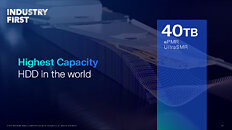
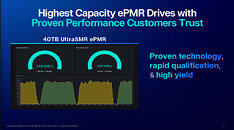
Reinforcing its dual ePMR and HAMR technology leadership approach, WD announced that the world's highest capacity 40 TB UltraSMR ePMR HDD is in qualification with two hyperscale customers with volume production planned for the second half of 2026. WD HAMR HDD qualifications are also underway with two hyperscale customers with ramp production in 2027.
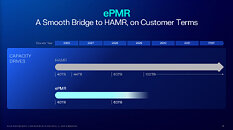
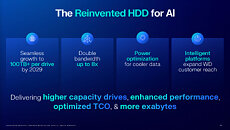
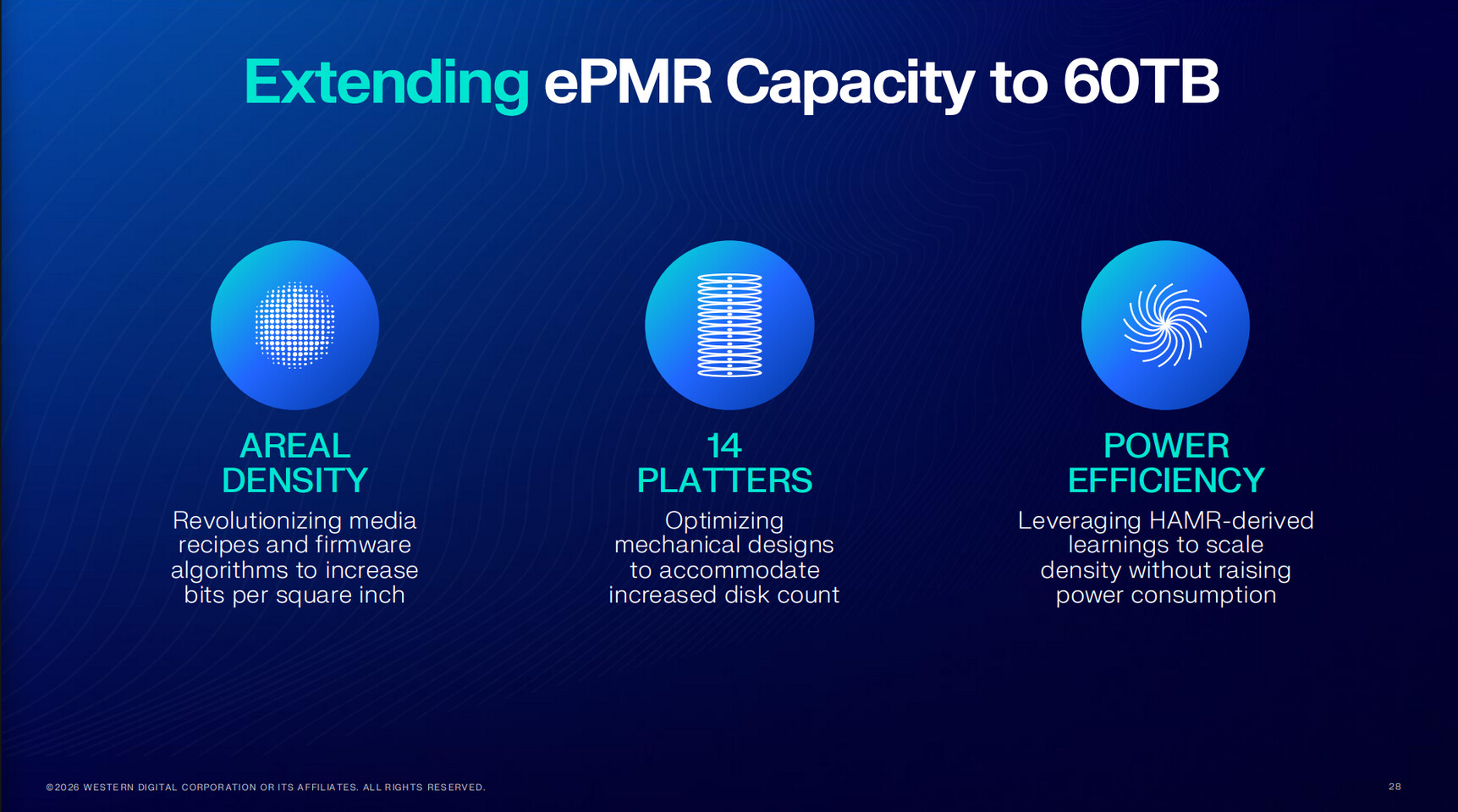
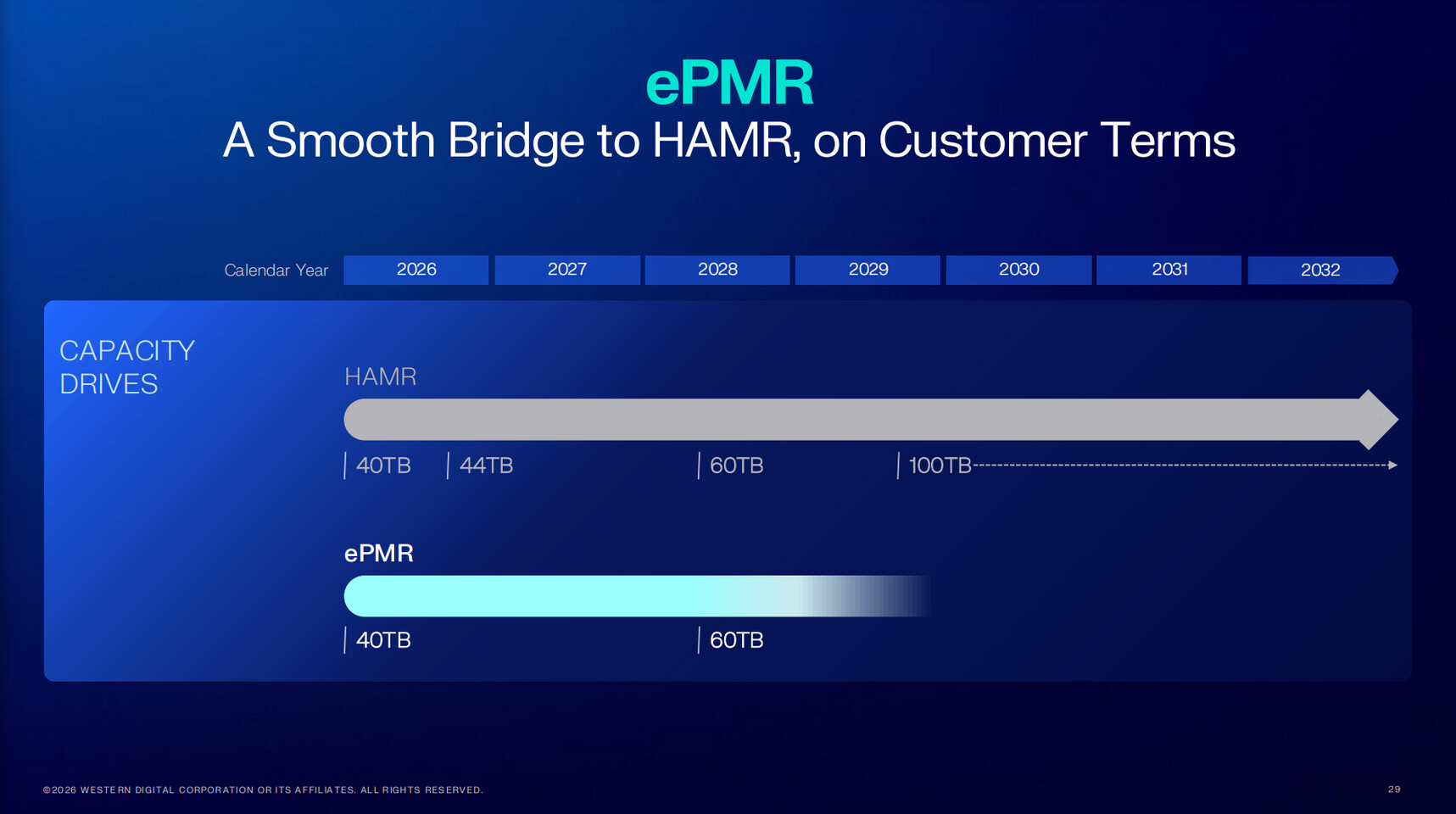
WD will extend ePMR to 60 TB by leveraging HAMR innovations without increasing power consumption, while HAMR will scale to 100 TB by 2029. This dual-path approach is a critical advantage as both ePMR and HAMR are built on a common architecture, enabling greater manufacturing efficiencies, yields, and a smoother customer product transition.
The result is unprecedented flexibility. Hyperscalers and enterprises can adopt either technology on their own timelines with predictable capacity planning and seamless scaling - no forced technology transitions, no infrastructure disruptions, just continuous and accelerating capacity growth built on architecture they already trust.


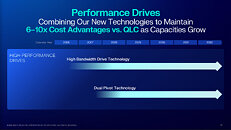 HDD Performance Architecture: Closing the QLC Flash Gap
Addressing the performance demands of AI workloads, WD introduced two industry-first innovations that fundamentally reset HDD performance. These innovations address workloads previously considered flash-only, creating a new performance tier that balances speed and capacity without compromising economics, which is critical as flash faces persistent cost premiums (6-10x vs. HDD) and endurance limitations:
High Bandwidth Drive Technology is already with customers today. HDDs with Dual Pivot Technology are currently in the lab and will become available in 2028.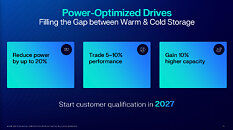 Power-Optimized HDDs: Bridging the Gap Between Warm and Cold AI Data Tiers
AI training and inference is creating massive amounts of valuable cold data that still needs to be accessed in seconds, not hours, rendering this data too active for tape but also too expensive for traditional capacity drives. WD's power-optimized HDDs address this challenge with a purpose-built solution that reduces power consumption, and therefore customer operating costs, while maintaining a sub-second access storage tier with the same 3.5-inch form factor customers use today.
These drives will trade minimal random IO for higher capacity and substantially lower power - an optimal design for cold data - shrinking the gap between warm and cold storage tiers and enabling economically sustainable AI data storage at scale.
Power-optimized drives are expected to be in customer qualification in 2027.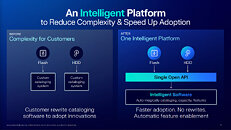

 Platforms Expansion: Reducing Complexity to Improve Customer Time-to-Value
Understanding that mid-scale customers face hyperscale challenges without hyperscale resources, WD announced the expansion of its Platforms business to extend hyperscale storage economics to a broader set of customers. This expansion includes the development of an intelligent software layer, through an open API, expected to launch in 2027, that will enable companies at 200+ petabyte scale to achieve the same storage efficiency and economics that hyperscalers enjoy today.
This intelligent software layer will accelerate storage innovation adoption across WD's UltraSMR, ePMR and HAMR HDD, and flash platforms while dramatically reducing time-to-production and lowering qualification risk across storage tiers. By simplifying the deployment of storage infrastructure for AI-scale workloads, WD will transform time-to-value without requiring architectural disruption - giving up-and-coming cloud and enterprise WD customers a clear path to hyperscale economics.
"For the past year, WD has remained continuously focused on execution and accelerating innovation, which has enabled us to truly reimagine the hard drive to meet the requirements of AI," said Irving Tan, Chief Executive Officer at WD. "Today, we are showcasing innovation that reflects our deep connection to our customers and how we are meeting demand for capacity, scale, quality, enhanced performance, and ease of technology adoption."
"WD Innovation Day is where our customer-centric business transformation meets our breakthrough technology for the AI era," said Ahmed Shihab, Chief Product Officer at WD. "We've organized around how customers build and scale AI infrastructure. WD is challenging conventional storage assumptions and removing the complexity and cost barriers that limit their AI-driven growth. Our capacity, performance, power efficiency, and platform innovations solidify our position as the innovation partner for the AI-driven data economy."
"WD's Innovation Day revealed a company that has genuinely transformed its strategy around customer infrastructure needs," said Ed Burns, HDD Research Director at IDC. "The market validation is already evident - customers are deploying these solutions because WD is solving what matters most for AI infrastructure: reliable capacity at scale, performance that meets demanding workloads, and economics that enable profitability. This customer-centric approach, combined with operational discipline positions WD well in the market going forward."
Source:
Western Digital
As AI generates massive amounts of data, it has spurred intense demand for data storage. To meet the moment, WD has focused deeply on customer needs, particularly capacity with proven reliability and economics, performance, power efficiency, and faster qualifications without customer business disruptions. During its Innovation Day, WD showcased technologies that address these essential customer requirements and will deliver them at scale.


As a capstone to this momentum, the company, now known as WD, also unveiled updated branding that visually references the data center and reflects its transformation into a company that provides essential storage infrastructure for the AI-driven data economy.
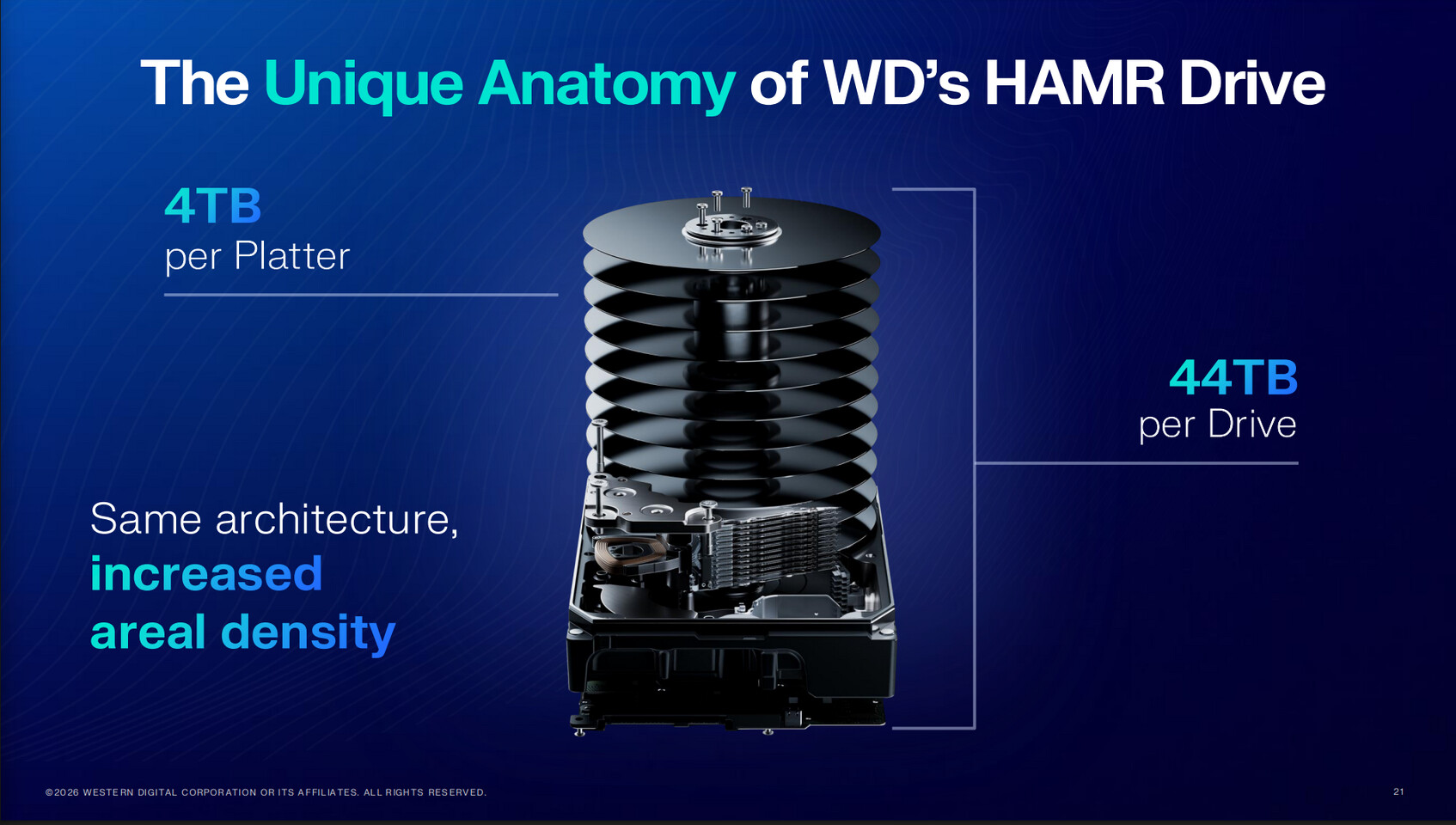
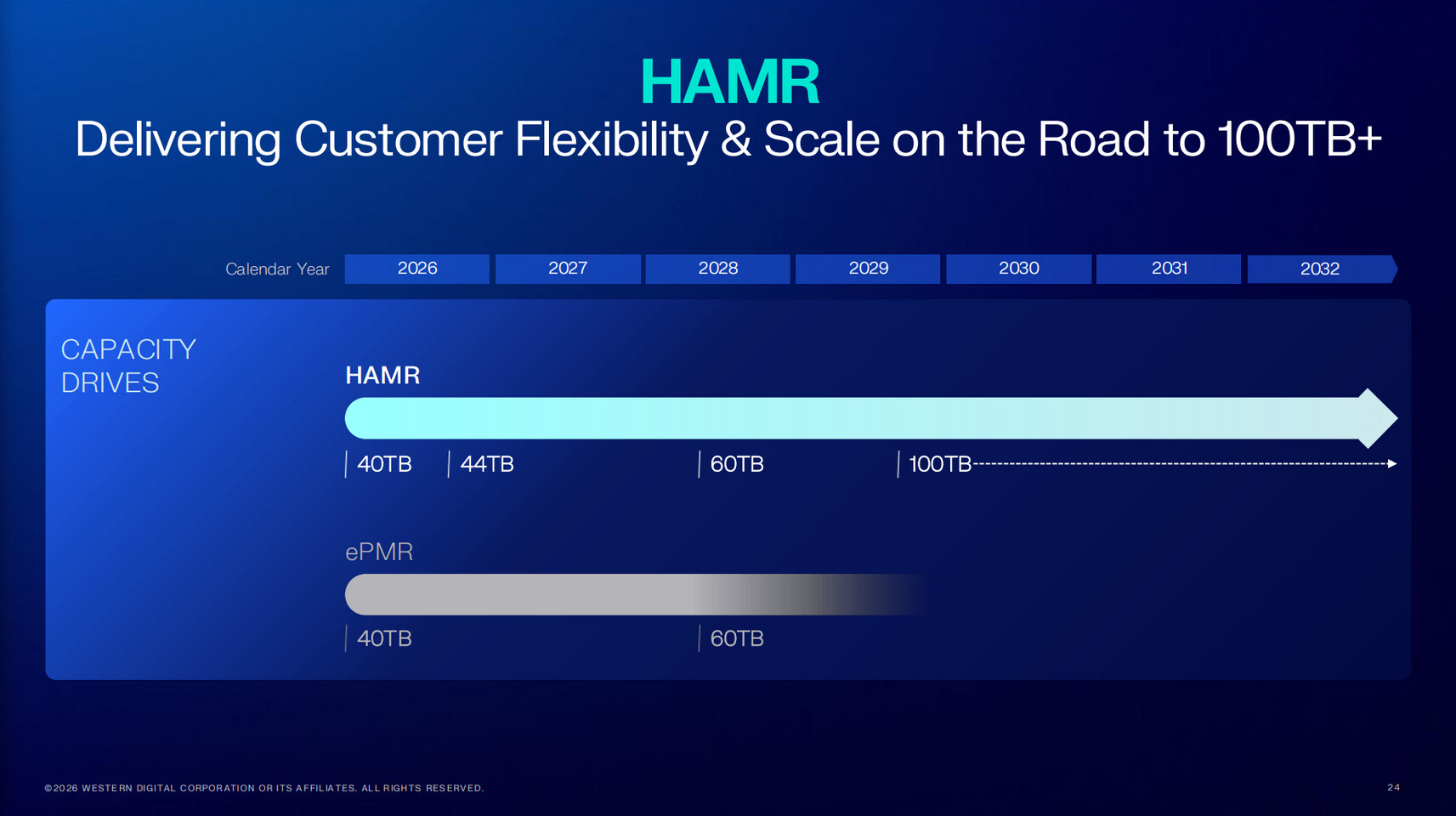

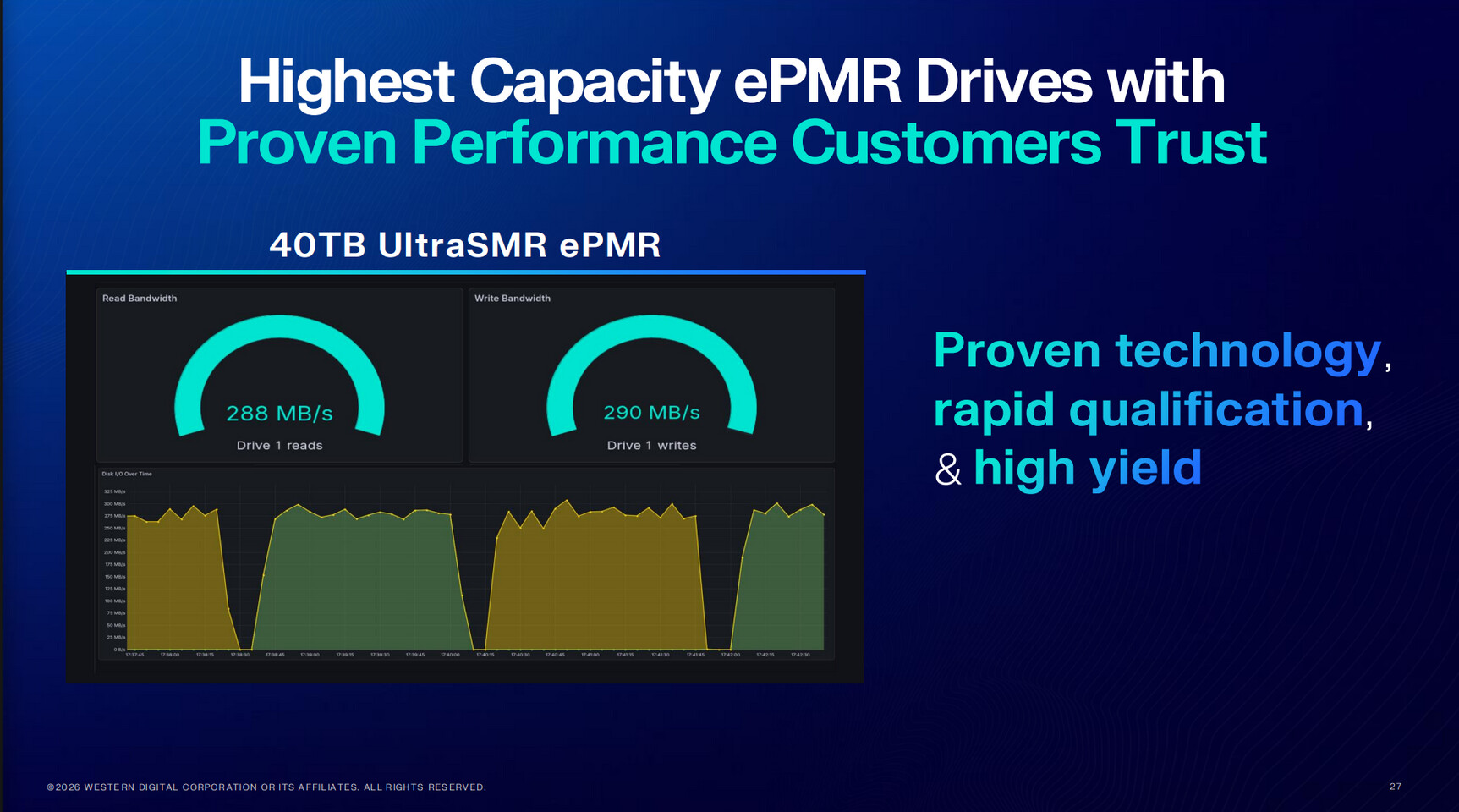
Reinforcing its dual ePMR and HAMR technology leadership approach, WD announced that the world's highest capacity 40 TB UltraSMR ePMR HDD is in qualification with two hyperscale customers with volume production planned for the second half of 2026. WD HAMR HDD qualifications are also underway with two hyperscale customers with ramp production in 2027.
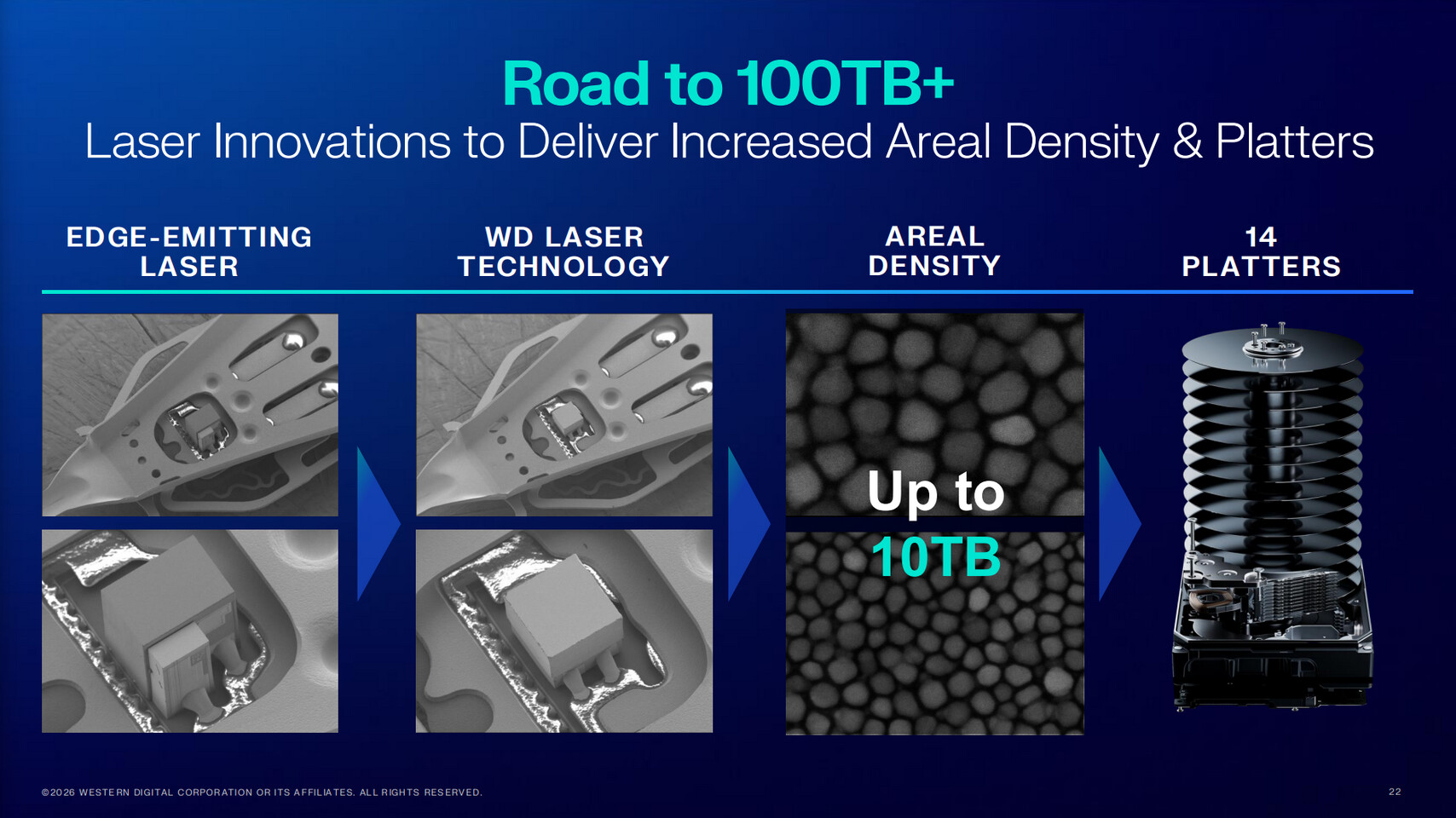
WD will extend ePMR to 60 TB by leveraging HAMR innovations without increasing power consumption, while HAMR will scale to 100 TB by 2029. This dual-path approach is a critical advantage as both ePMR and HAMR are built on a common architecture, enabling greater manufacturing efficiencies, yields, and a smoother customer product transition.
The result is unprecedented flexibility. Hyperscalers and enterprises can adopt either technology on their own timelines with predictable capacity planning and seamless scaling - no forced technology transitions, no infrastructure disruptions, just continuous and accelerating capacity growth built on architecture they already trust.


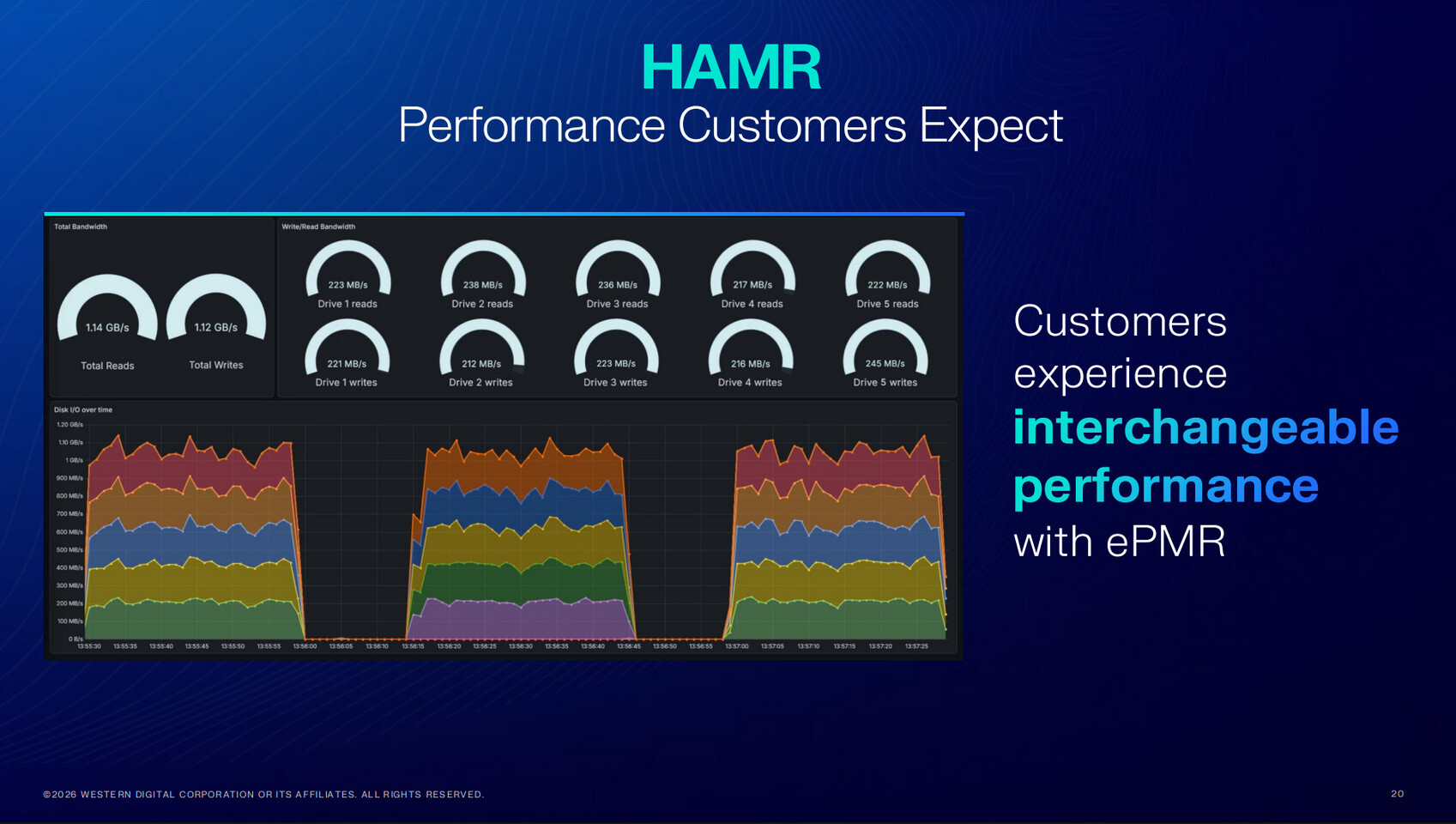
Addressing the performance demands of AI workloads, WD introduced two industry-first innovations that fundamentally reset HDD performance. These innovations address workloads previously considered flash-only, creating a new performance tier that balances speed and capacity without compromising economics, which is critical as flash faces persistent cost premiums (6-10x vs. HDD) and endurance limitations:
- High Bandwidth Drive Technology enables simultaneous reading and writing from multiple heads on multiple tracks delivering up to 2x the bandwidth of conventional HDDs without power penalties. The technology has a clear path to scale up to 8x bandwidth gains and is already in customer hands for validation.
- Dual Pivot Technology adds a second set of independently operating actuators on a separate pivot and will deliver up to 2x sequential IO gain within a 3.5-inch drive. This differs from previous dual actuator designs that sacrificed capacity and required extensive customer software changes. Dual Pivot enables reduced spacing between disks, allowing for more platters per drive and higher overall capacity.
High Bandwidth Drive Technology is already with customers today. HDDs with Dual Pivot Technology are currently in the lab and will become available in 2028.
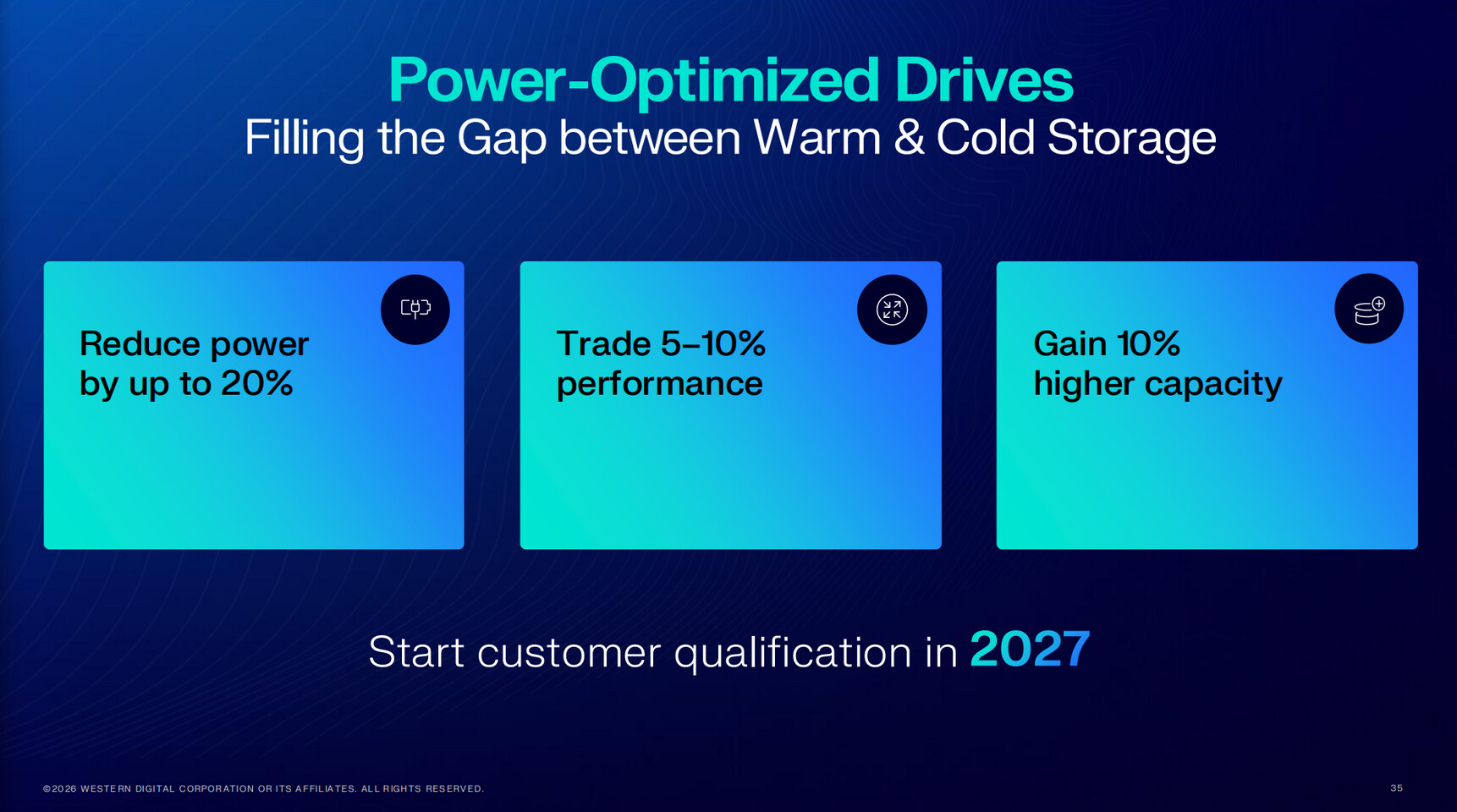
AI training and inference is creating massive amounts of valuable cold data that still needs to be accessed in seconds, not hours, rendering this data too active for tape but also too expensive for traditional capacity drives. WD's power-optimized HDDs address this challenge with a purpose-built solution that reduces power consumption, and therefore customer operating costs, while maintaining a sub-second access storage tier with the same 3.5-inch form factor customers use today.
These drives will trade minimal random IO for higher capacity and substantially lower power - an optimal design for cold data - shrinking the gap between warm and cold storage tiers and enabling economically sustainable AI data storage at scale.
Power-optimized drives are expected to be in customer qualification in 2027.
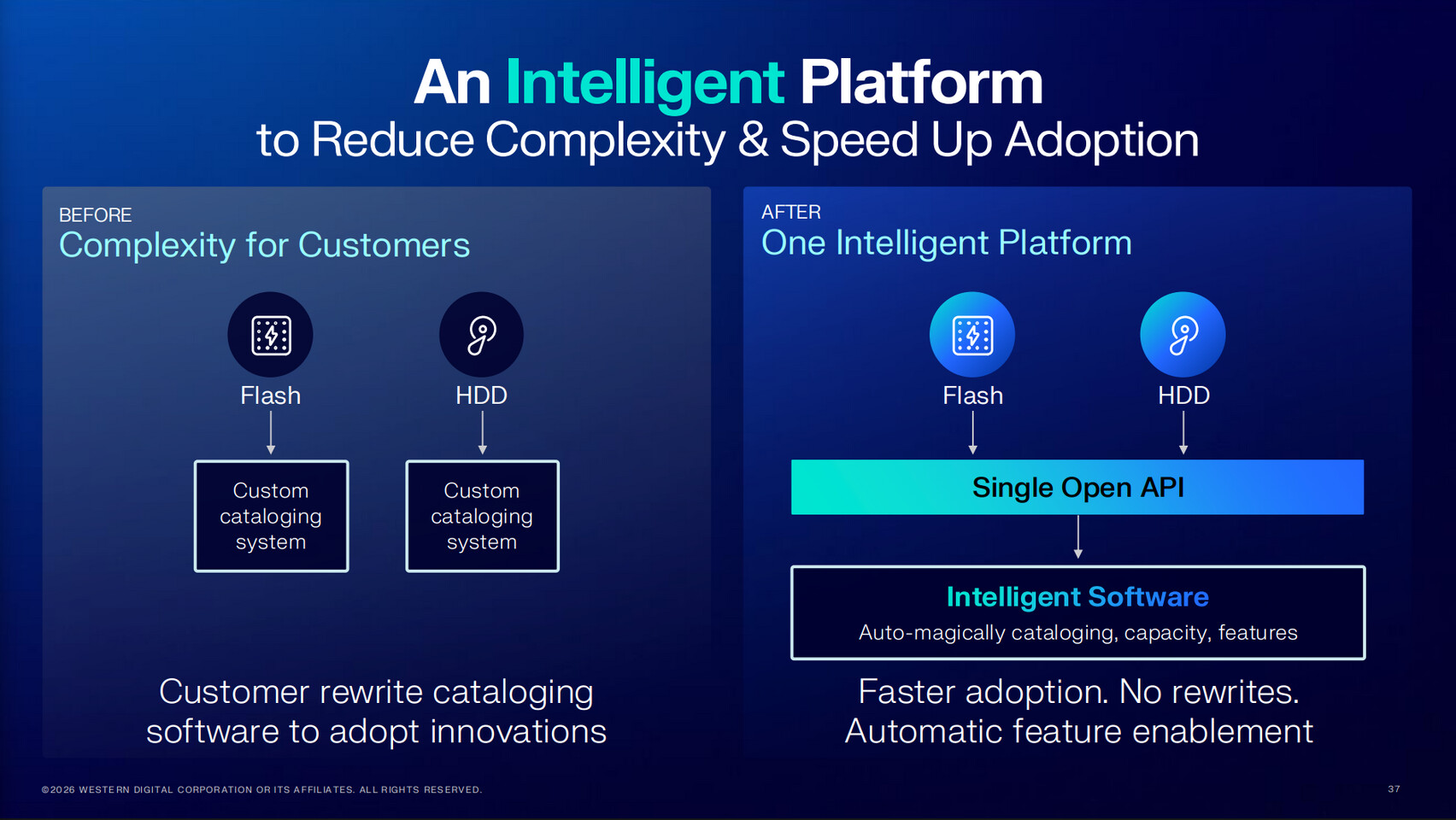


Understanding that mid-scale customers face hyperscale challenges without hyperscale resources, WD announced the expansion of its Platforms business to extend hyperscale storage economics to a broader set of customers. This expansion includes the development of an intelligent software layer, through an open API, expected to launch in 2027, that will enable companies at 200+ petabyte scale to achieve the same storage efficiency and economics that hyperscalers enjoy today.
This intelligent software layer will accelerate storage innovation adoption across WD's UltraSMR, ePMR and HAMR HDD, and flash platforms while dramatically reducing time-to-production and lowering qualification risk across storage tiers. By simplifying the deployment of storage infrastructure for AI-scale workloads, WD will transform time-to-value without requiring architectural disruption - giving up-and-coming cloud and enterprise WD customers a clear path to hyperscale economics.
"For the past year, WD has remained continuously focused on execution and accelerating innovation, which has enabled us to truly reimagine the hard drive to meet the requirements of AI," said Irving Tan, Chief Executive Officer at WD. "Today, we are showcasing innovation that reflects our deep connection to our customers and how we are meeting demand for capacity, scale, quality, enhanced performance, and ease of technology adoption."
"WD Innovation Day is where our customer-centric business transformation meets our breakthrough technology for the AI era," said Ahmed Shihab, Chief Product Officer at WD. "We've organized around how customers build and scale AI infrastructure. WD is challenging conventional storage assumptions and removing the complexity and cost barriers that limit their AI-driven growth. Our capacity, performance, power efficiency, and platform innovations solidify our position as the innovation partner for the AI-driven data economy."
"WD's Innovation Day revealed a company that has genuinely transformed its strategy around customer infrastructure needs," said Ed Burns, HDD Research Director at IDC. "The market validation is already evident - customers are deploying these solutions because WD is solving what matters most for AI infrastructure: reliable capacity at scale, performance that meets demanding workloads, and economics that enable profitability. This customer-centric approach, combined with operational discipline positions WD well in the market going forward."
32 Comments on Western Digital Unveils New Hard Drive Solutions on its Innovation Day
2. 150-200 MB/s is an annoyingly slow transfer rate for a HDD larger than 20TB - note that at the end of the drive (inner cylinders) this means 75-100 MB/s only. It takes 1-2 days to copy 20TB from an older HDD to a new one during an upgrade. High-bandwidth HDDs will enable speeds from 500MB/s (2x: 2 read/write heads on 1 actuator) to 2GB/s (8x: 8 read/write heads on 1 actuator), while consumer non-USB HDD's will most likely be limited to 2x because of SATA3 (there is no SATA4).
3. Only a few PC cases are designed to reduce HDD vibrations. One such example is "HDD Tray kit – Type-B" in "Fractal Design Meshify 2" cases.
Reason 1: Memory prices in 2028-2029 depend on whether GPT-style AI will reach its lowest economically viable error rate in 2028-2029 - or whether the error rate will keep getting lower until year 2040.
Reason 2: Running an AI model locally on a desktop PC (a notebook is an even worse case) will result in much higher error rates compared to running AI in the cloud on a machine 100 times faster than a desktop PC with 100 times larger memory+SSD capacity than a desktop PC.
From a microeconomics perspective, whether you're selling baby food or nuclear reactors, maximum profit margins tend to be roughly comparable across all industries, because high margins attract competition and fuel supply expansion. Current RAM margins are an economic anomaly, and thus temporary.
1. HBM (high-bandwidth memory) manufacturing needs several-times more wafers than a DDR5 chip for the same memory capacity. This isn't an anomaly, and it isn't temporary.
2. Paying GPT users (ChatGPT Plus, Gemini, etc) is an example of shared access to CPUs, GPUs, HBMs and SSDs. The economics that enables OpenAI, Google, etc to pay high prices for ultra-high-performance chips and memory is that 1 paying user is using the cloud machine for 1/100th of a day. Sharing makes cloud-based access to AI 10-times more cost effective compared to a home PC, even if the machines in the cloud cost 10-times more than "an AI home PC". ---- This isn't an anomaly, and it isn't temporary.
3. Demand for AI data centers has postponed the obsolescence of 8 GB and 12 GB gaming GPUs by at least 2 years. It is uncertain by how many years the obsolescence of 16 GB gaming GPUs has been postponed due to AI demand - it could be more than 2 years.
4. If a person is forced to make the choice between (1) gaming and (2) AI, then supposedly 90% of people will choose 2. The reason for this is that gaming is just entertainment, while AI is an essential productivity booster required by people to stay relevant in the modern world. ---- It is impossible for [RAM margins in gaming GPUs] to be equal to [RAM margins in AI machines], the latter margin will always be higher.
5. Gaming has no usage scenario for 512 GB of RAM ---- AI has no usage scenario for 16 GB of RAM.
Will be interesting to learn why it took so many years for this to get realized.
And it's not stated explicitly but sounds like WD's dual-actuator drives access just one platter side per actuator?
Might explain the potential increase in platter density.
Even if this weren't the case, it doesn't change the underlying economics here. As long as margins are this astronomical, supply will expand faster than demand, and new competition will arise. Already, there are a half-dozen major firms seriously discussing -- if not already prepping plans -- to enter the RAM market.It also has exactly zero to do with the economics of RAM production. Again: price is the mechanism by which supply equalizes with demand. Period.Possibly true, quite possibly not. And again, this is utterly irrelevant to the point. I don't know how expensive those 16GB cards will be in 6 months, but two years from now they'll be cheaper than they are today.
So there should chance to increase transfer rates greatly by adding parallelism.
Though of course managing data would become more complex when consecutive bits of data are striped between platters.
But compared to SSDs that should be walk in the parkJust record sound clip, then do spectrum analysis for that:
www.qsl.net/dl4yhf/spectra1.html
7200 RPM drive produces peak at 120Hz and 5400 RPM drive at 90 Hz.
They have dual actuator, but apparently not simultaneous I/O from the same platter, nor more than x2.
And what they have isn't since 2008 but 2019 or 2021:
www.tomshardware.com/news/seagate-lists-dual-actuator-hdd-exos-2x14
(Sad to see no one re-publishing AnandTech's archive.)
www.tomshardware.com/news/seagate-hdd-harddrive,8279.html
Hysterics aside, we're already seeing signs of market improvement:
THG: DDR5 RAM pricing begins to stabilize in Germany, January saw only a 0.1% increase — Some kits even saw price cuts as volatility begins to plateau
(link)"The biggest difference is seen with 64 GB (2x32) 6000 MT/s kits getting a 15% reduction compared to the start of January. The average price for these has fallen from 699 EUR to 596 EUR"
There is't a single 64 GB 6000 kit available at their "average" price. Do they know what average means? But yes, we have seen some small price decreases, I bet vendors that have a bit more stock do this to convince buyers that fear the prices will skyrocket further to buy now.
Sellers -- rational sellers, at least -- set prices by one simple metric: what figure maximizes their profit. If Germany's RAM retailers are even slightly cutting prices, it means they believe current prices have depressed demand below the supply they're receiving, and thus they'll lose money otherwise.