Thursday, February 5th 2026

Intel Core Ultra G3 "Panther Lake" Handheld Gaming Chips to Come in Q2 of 2026

When Intel unveiled its "Panther Lake" Core Ultra Series 3 mobile processors built on the 18A node, the company announced that a separate version fine-tuned for handheld gaming consoles is in the works. Called Intel Core Ultra G3 "Panther Lake," the chip is now scheduled to arrive in the second quarter of 2026, according to Golden Pig Upgrade. The company plans to bring two SKUs to the masses, which will be called G3 and G3 Extreme, each carrying a 14-core CPU configuration consisting of two P-Cores, eight E-Cores, and four additional LPE-Cores. However, the real star of the show of this SoC will be the Arc integrated graphics, which will arrive with 12 Xe3 cores in the G3 Extreme, or 10 Xe3 cores in the regular G3.

For the G3 Extreme, the plan is to run the Arc B380 iGPU with 12 Xe3 cores at 2.3 GHz, which is just 200 MHz shy of the flagship Core Ultra X9 388H's Arc B390. Basically, G3 Extreme handhelds can expect similar gaming performance to what we observed in our review of the flagship SKU, just with two P-Cores less and a slightly lower GPU clock. For the regular G3, the CPU configuration retains its capability, but the GPU drops to a 10-Core Xe3 IP called Arc B360. This integrated graphics drops core counts and GPU boost frequency to 2.2 GHz, which will result in a significant reduction in both gaming performance and TDP. Intel still hasn't revealed plans about TDP configurations, so we have to wait a bit longer for that.
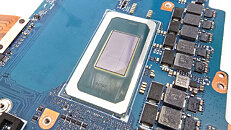
Interestingly, Intel likely fine-tuned the performance and found a perfect balance between the core count, GPU clock, and the new TDP, so the chip becomes suitable for handheld gaming devices without breaking the battery life and TDP barriers. Usual handheld designs from Intel, like the last-generation "Lunar Lake" Core Ultra 9 288V, have a base TDP rating of 30 W, with a maximum turbo power of 37 W. We can expect the new G3 and G3 Extreme to fit in that range, given that Intel likely has massive feedback from OEM partners making these systems and knows exactly how much is needed in that form factor.
Sources: Golden Pig Upgrade, via VideoCardz
Add your own comment

13 Comments on Intel Core Ultra G3 "Panther Lake" Handheld Gaming Chips to Come in Q2 of 2026

#1
Squared
For the G3 Extreme, the plan is to run the Arc B380 iGPU with 12 Xe3 cores at 2.3 GHz, which is just 200 MHz shy of the flagship Core Ultra X9 388H's Arc B390. Basically, G3 Extreme handhelds can expect similar gaming performance to what we observed in our review of the flagship SKU, just with two P-Cores less and a slightly lower GPU clock. For the regular G3, the CPU configuration retains its capability, but the GPU drops to a 10-Core Xe3 IP called Arc B360. This integrated graphics drops core counts and GPU boost frequency to 2.2 GHz, which will result in a significant reduction in both gaming performance and TDP.
Will the lesser G3 really be much slower with 2 fewer cores and 100 MHz slower clock? That translates to 80% of performance on paper (or 73% of the 388H), but I suspect even with 16 MB of cache the G3 Extreme is probably still a little held back by memory bandwidth.
Posted on Reply
#2
dgianstefani
TPU Proofreader
SquaredWill the lesser G3 really be much slower with 2 fewer cores and 100 MHz slower clock? That translates to 80% of performance on paper (or 73% of the 388H), but I suspect even with 16 MB of cache the G3 Extreme is probably still a little held back by memory bandwidth.
Might also be a situation where, like laptop Panther Lake, the top SKU is mandated for OEMs to use the fastest RAM and the rest aren't.
Posted on Reply
#3
LastDudeALive
Not a fan of just two P cores and 12 e cores. Why not just have 4 P cores and the 4 LPE cores? The LPE cores can handle the OS, there's no need for 8 e cores. Especially since people are gonna put SteamOS or Bazzite on these.
Posted on Reply
#4
AntiX3DGlazer
LastDudeALiveNot a fan of just two P cores and 12 e cores. Why not just have 4 P cores and the 4 LPE cores? The LPE cores can handle the OS, there's no need for 8 e cores. Especially since people are gonna put SteamOS or Bazzite on these.
Honestly the E cores are just lower clocked P cores at this point (with the caveat that they are signficantly worse in a few areas like their cache config). I assume the tradeoff was efficiency, P-cores aren't nearly as power efficient compared to E-cores, even in gaming workloads. It allows for more power budget to go to the GPU (which is the most important component here anyways).
Posted on Reply
#5
Squared
LastDudeALiveNot a fan of just two P cores and 12 e cores. Why not just have 4 P cores and the 4 LPE cores? The LPE cores can handle the OS, there's no need for 8 e cores. Especially since people are gonna put SteamOS or Bazzite on these.
Because the E cores are better for gaming. Nearly all games will be GPU-bound and so the GPU needs to have as much of the power as possible. What's left for the CPU is so little that it's an area of the power curve where E cores are faster than P cores. For the exceptions, there are still two P cores.
Posted on Reply
#6
Eliad Buchnik
LastDudeALiveNot a fan of just two P cores and 12 e cores. Why not just have 4 P cores and the 4 LPE cores? The LPE cores can handle the OS, there's no need for 8 e cores. Especially since people are gonna put SteamOS or Bazzite on these.
Those CPUs are going inside very power limited devices, typically around 15-25W, might even go lower to around 10W.
Most of the power will go to the GPU anyways, so you're left with tiny power budget. Intel showed in previous generations when power per core is few watts - E core actually perform better, and E cores can even scale lower minimum power.
I think most of the time most cores will be power gated anyways...
Posted on Reply
#7
DavidC1
SquaredWill the lesser G3 really be much slower with 2 fewer cores and 100 MHz slower clock? That translates to 80% of performance on paper (or 73% of the 388H), but I suspect even with 16 MB of cache the G3 Extreme is probably still a little held back by memory bandwidth.
Pantherlake isn't really bound by memory bandwidth. Even with the much higher performance than Strix Point, it still scales less with memory. The Expertbook in Notebookcheck performs nearly identical to the Zenbook Duo despite the latter having 9600 memory versus Expertbook's 8533. 85-90% of performance is possible.

It has memory compression capability, 16MB L2 cache, and improved hidden surface occlusion performance.
Posted on Reply
#8
Cheeseball
Not a Potato
Hope this the specs of this rumor is fake. Only two Performance cores would be really stupid when the Steam Deck (and even the Z2 Extreme, with three normal Zen 5 cores) prove that at least 4 should be a good enough balance for gaming and battery life.
Posted on Reply
#9
Bruno Vieira
This is how much the world circles around. AMD has played the Intel+1 naming scheme for so long and so many times. The first chip Intel launches for handhelds is the G3 and G3 Extreme, competing with the Z2 and Z2 Extreme. At least they recognise they are the ones catching up now.
Posted on Reply
#10
dgianstefani
TPU Proofreader
Bruno VieiraThis is how much the world circles around. AMD has played the Intel+1 naming scheme for so long and so many times. The first chip Intel launches for handhelds is the G3 and G3 Extreme, competing with the Z2 and Z2 Extreme. At least they recognise they are the ones catching up now.
It's called the G3 because it's the gaming variant of Core Ultra Series 3, Arrow Lake was Series 2, Meteor Lake was Series 1.

Lunar Lake is the best handheld SoC currently on the market, and XeSS is far better than the old version of FSR the RDNA 3/3.5 APUs are limited to, so there wasn't any catching up to do. In fact it seems as if there isn't any competition for Lunar and Panther Lake until the RDNA 5 APUs that should release sometime in 2027.

Again, LNL is not just faster than the equivalent AMD handheld APUs, but also more efficient, and with access to AI based upscaling in the segment where it matters most. Panther Lake is significantly better than Lunar Lake, and the AMD competition for Lunar Lake was based on price, the AMD handhelds were cheaper. So it's safe to say at this point Intel is a full generation ahead of AMD in this segment.


Those results are 800p vs 720p, too. So the LNL handheld is pushing more pixels.
Posted on Reply
#11
DavidC1
CheeseballHope this the specs of this rumor is fake. Only two Performance cores would be really stupid when the Steam Deck (and even the Z2 Extreme, with three normal Zen 5 cores) prove that at least 4 should be a good enough balance for gaming and battery life.
It will be fine, because the frames you are getting with handhelds aren't really that limited by CPU. Intel even said they wanted to prioritize using E cores in gaming because it results in better experience due to being more efficient and being able to allocate more to the iGPU.
Posted on Reply
#12
Cheeseball
Not a Potato
DavidC1It will be fine, because the frames you are getting with handhelds aren't really that limited by CPU. Intel even said they wanted to prioritize using E cores in gaming because it results in better experience due to being more efficient and being able to allocate more to the iGPU.
I get it. As long as the efficiency core's IPC has also improved (which I believe they have, considering my experience with 258V), it should be doable.
Posted on Reply
#13
DavidC1
CheeseballI get it. As long as the efficiency core's IPC has also improved (which I believe they have, considering my experience with 258V), it should be doable.
The P cores are less than 10% faster than the E core. Skymont was 32% faster in Integer and 60-70% faster in FP to the predecessor, and they said it's on par with Raptorlake, the previous P cores per clock. Which means it's also fast as Zen 5. Lion Cove got mere 10% over that. Both Cougar Cove and Darkmont in this generation got about the same gain. So the gap is similar, plus clocks.

The E core is so close that in Arrowlake desktop, in some games a 1+16 config is faster than 8+16. That was unthinkable. This is also why Stephen Robinson, the former chief architect of the E cores, are now chief architect of all the x86 cores, and a Unified Core based on a future E core will replace both P and E in 2028-2029.
Posted on Reply
Add your own comment
Nov 26th, 2026 02:14 CST change timezone

New Forum Posts

Popular Reviews

TPU on YouTube

Controversial News Posts