Friday, March 6th 2026

ASRock Z890I Nova WiFi R2.0 Supports CQDIMM Achieves 256GB DDR5-7400 MT/s
ASRock, a global leader in motherboards, graphics cards, gaming monitors, small form factor PCs, power supply units, and AIO liquid coolers, today introduced that its Z890I Nova WiFi R2.0, paired with two Kingston 4-rank DDR5 128 GB memory modules, has successfully enabled CQDIMM support through optimized circuit design and hardware and software tuning. The platform achieves DDR5-7400 MT/s operation with a total capacity of 256 GB, surpassing the DDR5-7200 MT/s limit commonly seen on most platforms today. This milestone represents a major breakthrough for high-capacity, high-bandwidth DDR5 memory applications.
CQDIMM is based on a 4-rank CUDIMM (Clocked Unbuffered DIMM) design, with a maximum capacity of 128 GB per module and a native speed of DDR5-7200 MT/s, addressing the long-standing challenge of balancing large memory capacity with high bandwidth. With CQDIMM support, the Z890I Nova WiFi R2.0 further pushes memory performance to DDR5-7400 MT/s, delivering a memory configuration that combines both high capacity and high performance to meet the demanding requirements of AI computing, content creation, and professional workloads.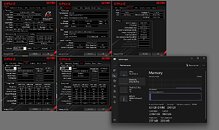

CQDIMM is based on a 4-rank CUDIMM (Clocked Unbuffered DIMM) design, with a maximum capacity of 128 GB per module and a native speed of DDR5-7200 MT/s, addressing the long-standing challenge of balancing large memory capacity with high bandwidth. With CQDIMM support, the Z890I Nova WiFi R2.0 further pushes memory performance to DDR5-7400 MT/s, delivering a memory configuration that combines both high capacity and high performance to meet the demanding requirements of AI computing, content creation, and professional workloads.


12 Comments on ASRock Z890I Nova WiFi R2.0 Supports CQDIMM Achieves 256GB DDR5-7400 MT/s
Close to being even worse than "FOR THOSE WHO DARE" on RoG boards :D:D
Goes to show that boards with 4 DIMMs are stupid (for probably 90% of consumers), now you can have 256GB with 2 sticks which is double than more than enough for 90%.True but I think the voltage was left at 1.1V.
And anyway for such a huge capacity setup enthusiast-level speed and latencies are most likely not the priority.
Ofc pricing for those in the current market would be a total no go as well
And which loss are you talking about? If they've bought 2x64GB before the crisis they are selling for profit now, a profit which will admittedly evaporate when they buy a bigger kit.
Yes, rarer and more expensive per GB but also slightly easier to run. It's always a trade off.
The ones at that level are always going to need to upgrade. How long before 256GB gets insufficient?
The people who game or perhaps are doing the same things which are more or less RAM intensive (but which always fit into 64-96GB) aren't going to cry after 2 extra DIMMs when they're running 2x64GB and are set for years to come.
A mobo with 4 DIMMs is a gimped mobo in my book.