Thursday, August 27th 2026

Buyer Finds DDR4 Memory Chips in a DDR5 Kingston Fury RAM Stick

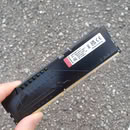
In a time when DDR5 memory prices keep soaring to unprecedented levels, we have seen consumers resort to older DDR4 memory, but not like this. X user @watagjt shared an unusual experience with a DDR5 memory stick that contained no DDR5 memory chips inside. The memory stick, seemingly from Kingston, reportedly had DDR4 memory chips soldered onto the PCB instead, making it clear that it wasn't a regular purchase. According to the buyer, the Kingston FURY Beast DDR5 module was bought unopened, with no visible damage, and its heatsink and label looked normal at first glance.

The teardown, however, revealed a messy soldering job with flux residue and unused PCB pads, leading the buyer to suspect the swap. Interestingly, the DDR4 chips themselves showed valid DDR5 identifiers, which made the swap even more convincing. Of course, what makes this scam deeply concerning is that it is impossible to spot without disassembling the stick, and even then, a trained eye is needed to make the conclusion. The advice for buyers is to stick with brand-new or trusted used components, and never purchase anything from a suspicious third-party vendor.
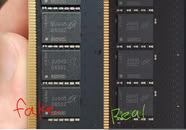
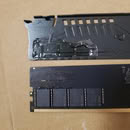
Source: Watagjt on X
Add your own comment

16 Comments on Buyer Finds DDR4 Memory Chips in a DDR5 Kingston Fury RAM Stick

#1
Athena
did this stick even boot up in a machine?

I would think that it would be throwing errors left and right, assuming it even ran at all, which is highly doubtful and I also wonder if the SPD was reprogrammed, or what it was reporting
Posted on Reply
#2
_roman_
bga most likely, ball grid array, the solder joints are below the package and can only be seen with x-ray or desoldering it

Something is missing, did they desolder it with a hot air machine?


Something does not add up or some information is missing. Or i do not see it.

tofu boxes and login required, but the Source, last picture indicates clearly, someone desoldered it with a hot air machine and checked the footprint of the desoldered part with the pcb footprint.

i doubt many end users have the knowledge or a working hot air machine. it is not a trained eye, you see it clearly when you desolder it. I wonder why would you desolder a DRAM stick in the first place?
Posted on Reply
#3
MikOnTopGG
Are you kidding me? Talk about RAM Cartels!
Posted on Reply
#4
Wirko
_roman_Something is missing, did they desolder it with a hot air machine?
There's at least one thing you can see without desoldering: the 2D barcodes (Data Matrix, most likely) on all chips are all equal. The counterfeiters didn't have a proper laser, so they used a potato stamp.
Athenadid this stick even boot up in a machine?
Maybe, if it was combined with a real DDR5 module in the other channel.
Posted on Reply
#5
ir_cow
Someone did the swap and return. It's becoming more common...
Posted on Reply
#6
user5
WirkoThere's at least one thing you can see without desoldering: the 2D barcodes (Data Matrix, most likely) on all chips are all equal. The counterfeiters didn't have a proper laser, so they used a potato stamp.


Maybe, if it was combined with a real DDR5 module in the other channel.
Maybe it was in a 12 though 14th gen Intel system as those CPUs supported both ddr 4 and ddr5 ram that's the only explanation that makes sense but I'm pretty certain it's unlikely as I believe DDR 4 and 5 have different pin outs for the modules
Posted on Reply
#8
ISSEnterprise
I don't know whether it actually boot up on the PC. But I saw some OEMs did that similar way back in 2021 or 2022 when it has DDR5 chip shortage, so it soldered the DDR4 chip on a DDR5 form memory stick. This strange memory stick can work on the DDR5 motherboard which support 12th-14th Intel Core.
Posted on Reply
#9
Chrispy_
ISSEnterpriseI don't know whether it actually boot up on the PC. But I saw some OEMs did that similar way back in 2021 or 2022 when it has DDR5 chip shortage, so it soldered the DDR4 chip on a DDR5 form memory stick. This strange memory stick can work on the DDR5 motherboard which support 12th-14th Intel Core.
I was just scrolling down the thread to say that this scam might actually work in an Intel LGA1700 board since the CPUs support either RAM type.
You've confirmed it would work, now.
Posted on Reply
#10
Wirko
Chrispy_I was just scrolling down the thread to say that this scam might actually work in an Intel LGA1700 board since the CPUs support either RAM type.
You've confirmed it would work, now.
Yes, in principle that's the same thing as a DDR4 DIMM on that Asus's experimental DDR4-to-DDR5 adapter, but it has the adapter's wiring and voltage regulator integrated on the DIMM.
Posted on Reply
#11
Athena
ISSEnterpriseI don't know whether it actually boot up on the PC. But I saw some OEMs did that similar way back in 2021 or 2022 when it has DDR5 chip shortage, so it soldered the DDR4 chip on a DDR5 form memory stick. This strange memory stick can work on the DDR5 motherboard which support 12th-14th Intel Core.
there is no way it could possibly run... it would require much more that just soldering the DDR4 chips onto a DDR5 DIMM

the voltage is not even remotely the same, that DIMM would smoke, and not to mention the DDR5 mobos work completely differently with RAM, the chips couldn't even communicate correctly "as is", not to mention the signal issues

so the only way I see this even booting is to have dummy DDR4 chips that are physically on, but electrically disconnected, except for 1 real DDR5 chip, but as soon as the system tries to access the memory it would BSOD or worse
Posted on Reply
#12
Chrispy_
Athenathere is no way it could possibly run... it would require much more that just soldering the DDR4 chips onto a DDR5 DIMM
So on a dual-generation socket, such as LGA1700 where the memory controller built into the CPUs could handle both DDR4 and DDR5, it could work.

The voltage and timings are all controlled by the processor, which reads the SPD on the RAM for guidance. If the DDR4 connected to the RAM slot identifies itself as 1.2V DDR4, then that's what the CPU is going to run it at. You can't run a DDR4 stick in a DDR5 slot or vice-versa, since the pins in the two different types of slots have different pinouts but if someone designs and builds a PCB to route the correct pinouts for a DDR5 to the correct contacts on DDR4, there's no reason why it wouldn't work.

It's quite a high-level scam, if it works, since you need to be able to make (simple) PCBs but that is nothing the counterfeiting rings haven't done a thousand times before.

Obviously if someone puts this in a board with Arrow Lake, Zen4, or Zen5, it's a non-starter - those CPUs aren't compatible with DDR4 at all.
Posted on Reply
#13
Wirko
Chrispy_So on a dual-generation socket, such as LGA1700 where the memory controller built into the CPUs could handle both DDR4 and DDR5, it could work.

The voltage and timings are all controlled by the processor, which reads the SPD on the RAM for guidance. If the DDR4 connected to the RAM slot identifies itself as 1.2V DDR4, then that's what the CPU is going to run it at. You can't run a DDR4 stick in a DDR5 slot or vice-versa, since the pins in the two different types of slots have different pinouts but if someone designs and builds a PCB to route the correct pinouts for a DDR5 to the correct contacts on DDR4, there's no reason why it wouldn't work.

It's quite a high-level scam, if it works, since you need to be able to make (simple) PCBs but that is nothing the counterfeiting rings haven't done a thousand times before.
Yes, but to clear things up: you have described legit OEM DDR4 modules that are wired to work in DDR5 slots. They have a VRM onboard that takes 5 volts (standard DDR5 slot supply) and convert that to 1.2 volts for the chips. The processor switches its memory controller to DDR4 mode when it detects such modules. It also isn't aware there's a VRM onboard, so it can't control the voltage, but this is OEM anyway.

On the other hand, the Kingston module from the news post is a scam. The only thing on it that works is the SPD, and it presents the module as DDR5. You need another module, one that actually works, to run anything (an OS, a memory tester, anything) on the system, and read and display what's in the SPD.

This has led me to an interesting thought. When the CPU powers up, RAM is inoperable. The memory controllers have yet to be configured, and link training (when necessary) must be performed. This means that the CPU can run and execute code even if its only RAM is its cache. Does that seem plausible?
Posted on Reply
#14
Athena
WirkoThis has led me to an interesting thought. When the CPU powers up, RAM is inoperable. The memory controllers have yet to be configured, and link training (when necessary) must be performed. This means that the CPU can run and execute code even if its only RAM is its cache. Does that seem plausible?
the CPU is programed to hit a specific address, that starts the ball rolling
Posted on Reply
#16
Wirko
DrUsmanSaleemThank you!
And if you're going to stay at TPU, please ask the resident wizard to put another red dot on the appropriate place on the world map. It looks somewhat barren between Eastern Europe and India.

Posted on Reply
Add your own comment
Nov 11th, 2026 04:11 CST change timezone

New Forum Posts

Popular Reviews

TPU on YouTube

Controversial News Posts