Tuesday, March 24th 2026

AMD "Medusa Point" APU Gets "GFX1171" and "GFX1172" RDNA 4m GPU Targets

AMD's RDNA 4m graphics might be the company's most mysterious GPU IP, as they are reportedly rebranding some of their RDNA 3.5 IP to fit INT8 data types and support FSR 4 technology. We previously reported that AMD designated the GFX1170 target for RDNA 4m. However, in the latest merge request for the LLVM compiler, AMD added two new software IDs: GFX1171 and GFX1172 GPUs. These targets are not true RDNA 4 GPUs, which belong to a GFX12 branch, but rather extensions of RDNA 3. What was thought to be RDNA 3.5 has now evolved into RDNA 4m, which will power AMD's Ryzen 500 "Medusa Point" series of APUs. With RDNA 3.5 / RDNA 4m expected to be used by AMD until 2029, it makes sense for AMD to adapt RDNA 3.5 into RDNA 4m with support for FSR 4 upscaling technology.

In contrast, "Medusa Halo" will utilize AMD's next-generation RDNA 5 / UDNA GPU microarchitecture. "Medusa Point" will introduce a desktop-exclusive RDNA 4 with the new RDNA 4m variant. Although we initially lack comparisons between the two, some instruction set extensions, such as WMMA and SWMMAC instructions, indicate support in the new "GFX1170" GPU, which should be associated with the GFX11 generation, also known as RDNA 3. Currently, this is believed to be an upgraded RDNA 3 with many RDNA 4 modules, enabling FSR 4 support even on the less powerful "Medusa Point" APU.

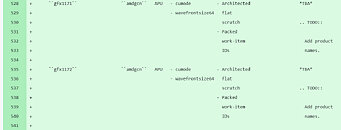
Launching an APU in 2026 with integrated graphics not running FSR 4 upscaling would be detrimental to customers, so AMD is actively porting some functionality like INT8 and FP8 data format processing support to ensure that FSR 4 works on the new generation. AMD plans to make its RDNA 3.5 iGPU long-lived until 2029, so most consumers buying laptops in the coming years will experience the same integrated graphics capabilities as those found in today's Ryzen AI 300 and 400 series processors. This means that the RDNA 4m, with all its cutbacks, will be a welcome addition to the integrated graphics as "Redstone" features like ML-based upscaling and rendering technologies rely on the RDNA 4 IP to function effectively.
Sources: GitHub, via Phoronix, VideoCardz
Add your own comment

19 Comments on AMD "Medusa Point" APU Gets "GFX1171" and "GFX1172" RDNA 4m GPU Targets

#1
TheinsanegamerN
It's amazing how poorly AMDs "rDNA 3.5 till 2029" claim has backfired.
Posted on Reply
#2
john_
— We are having problems supporting our current graphics architectures in the market. What should we do?
— Create more architectures?
— Brilliant!
Posted on Reply
#3
evernessince
TheinsanegamerNIt's amazing how poorly AMDs "rDNA 3.5 till 2029" claim has backfired.
AMD didn't make such a claim, you are confusing a rumor to that effect with an official statement.
Posted on Reply
#4
_roman_
i think my radeon 7800xt is gfx1101. so these gpus belong to the radeon 7000 series basically. the radeon 9000 series afaik have 1200 or higher numbers. it should be noted the first two numbers of the left of 1101 for example count as hidden generation indicator.

thanks for the sources links. which lead me here. github.com/llvm/llvm-project/blob/main/clang/test/Driver/amdgpu-macros.cl
Posted on Reply
#5
melkor_unlimited
RDNA 3.0 / 3.5 / 3.7 / 4m / 4 or gfx 11xx / 12xx ... I do not care.

Could it run Crysis?

... using the ML upscaling?
Posted on Reply
#6
Visible Noise
Don’t worry, true to form they’ll move it to a legacy driver branch a year after release.
Posted on Reply
#7
melkor_unlimited
Visible NoiseDon’t worry, true to form they’ll move it to a legacy driver branch a year after release.
You may be right.

It may or may not be able to run FSR 4.x but definitely not FSR5.
Posted on Reply
#8
rattlehead99
melkor_unlimitedYou may be right.

It may or may not be able to run FSR 4.x but definitely not FSR5.
With RDNA4 they don't lack any instruction necessary for the foreseeable future, they have instruction parity with Blackwell for everything non-Data center.
Posted on Reply
#9
AusWolf
Currently, this is believed to be an upgraded RDNA 3 with many RDNA 4 modules
Or perhaps RDNA 4 without AI cores? They're not needed if there's an NPU on board anyway.
Posted on Reply
#10
melkor_unlimited
rattlehead99With RDNA4 they don't lack any instruction necessary for the foreseeable future, they have instruction parity with Blackwell for everything non-Data center.
Are you sure that RDNA4 has full Shader Model 6.9 support in HW?
AusWolfOr perhaps RDNA 4 without AI cores? They're not needed if there's an NPU on board anyway.
Using NPU to make ML upscaling somehow does not make sense.
Neither using it for FG.

Too slow, too much latency, too much data transfer up and down needed, ...
Posted on Reply
#12
AusWolf
melkor_unlimitedUsing NPU to make ML upscaling somehow does not make sense.
Neither using it for FG.

Too slow, too much latency, too much data transfer up and down needed, ...
Maybe that's not even the point. Ryzen AI chips are marketed for home AI applications, not gaming.
Posted on Reply
#13
TheinsanegamerN
rattlehead99With RDNA4 they don't lack any instruction necessary for the foreseeable future,
INT8 FSR4 exists for a reason. Its not about instruction support.
rattlehead99they have instruction parity with Blackwell for everything non-Data center.
Except for Opacity Micromaps and Periodic Trim Notifications, which AMD has no support for. And Shader Execution reordering, which AMD supports the API but doesnt actually reorder.

AusWolfOr perhaps RDNA 4 without AI cores? They're not needed if there's an NPU on board anyway.
no AI cores means no upscaling support.
Posted on Reply
#14
melkor_unlimited
AusWolfRyzen AI chips are marketed for home AI applications, not gaming.
More like lightweight A.I. tasks which do not need high grade, power hungry GPGPU.
Posted on Reply
#15
TheinsanegamerN
melkor_unlimitedMore like lightweight A.I. tasks which do not need high grade, power hungry GPGPU.
Were still waiting for that killer app that can actually use that NPU for anything.
AusWolfMaybe that's not even the point. Ryzen AI chips are marketed for home AI applications, not gaming.
"ryzen AI" is just the marketing term AMD uses. They are the same consumer lineup, sometimes the very same chips they were previously selling.
Posted on Reply
#16
RinSenpai
AusWolfMaybe that's not even the point. Ryzen AI chips are marketed for home AI applications, not gaming.
Except they're the best offering they have on laptops. Whether you game or not, Ryzen AI is their lineup for highest-performance on mobile devices and the only mobile CPUs using Zen5. All other Ryzen Mobile CPUs that do not have AI in their name are rebrands from older generations, and it goes as far back as Zen2. If you want the best of the best for gaming in a laptop from AMD, you only have Ryzen AI as an option.
Posted on Reply
#17
melkor_unlimited
TheinsanegamerNWere still waiting for that killer app that can actually use that NPU for anything.
Microsoft made a demand for 50 AI TOPs for its Copilot+ program.
So users got NPU instead of stronger iGPU or System Level Cache.
TheinsanegamerN"ryzen AI" is just the marketing term AMD uses. They are the same consumer lineup, sometimes the very same chips they were previously selling.
There are some differences between Ryzen AI CPU and older CPUs like Ryzen 8845. For example that NPU and condesed cores.
Much bigger difference than between Intels 12100 and 14100 (they are the same silicon).
Posted on Reply
#18
AusWolf
TheinsanegamerNno AI cores means no upscaling support.
Like I said above, gaming is probably not the intended market for these chips.
RinSenpaiExcept they're the best offering they have on laptops. Whether you game or not, Ryzen AI is their lineup for highest-performance on mobile devices and the only mobile CPUs using Zen5. All other Ryzen Mobile CPUs that do not have AI in their name are rebrands from older generations, and it goes as far back as Zen2. If you want the best of the best for gaming in a laptop from AMD, you only have Ryzen AI as an option.
Yes, they could very well be marketed as such. I don't know why they aren't.
Posted on Reply
#19
junglist724
AusWolfMaybe that's not even the point. Ryzen AI chips are marketed for home AI applications, not gaming.
NPUs aren't even good at that. I've been testing smaller llms and the iGPU was 2.2x faster than the 50 TOPs NPU in my Krackan point system. The AMD npu also was no faster than the 11 or 12 TOPs NPU in my meteor and arrow lake systems. They have extremely slow access to memory and are not very flexible with types of AI workloads. The only real benefit is power consumption.
Posted on Reply
Add your own comment
Nov 12th, 2026 04:42 CST change timezone

New Forum Posts

Popular Reviews

TPU on YouTube

Controversial News Posts