Wednesday, March 25th 2026

Intel Announces Arc Pro B70 and Arc Pro B65 GPUs, Maxes Out Xe2 "Battlemage" Architecture
Intel today announced the Arc Pro B70 and Arc Pro B65 graphics cards for advanced AI compute workloads on workstations, and professional visualization. The two primarily target local inferencing, software development, and deployments in multi-GPU configurations for rack scale AI GPU compute acceleration. The Arc B70 GPU in particular stands out, because it is the most powerful discrete GPU based on Intel Xe2 "Battlemage" graphics architecture, with 32 Xe cores, and a 256-bit wide GDDR6 interface. If you recall, the Arc B580 gaming GPU only comes with 24 Xe cores and a 192-bit interface, and we for long wondered if Intel would ever max out the silicon for a more powerful SKU. The Arc B70 is that SKU.
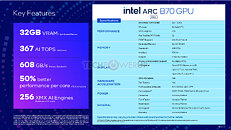
The Intel Arc Pro B70 is configured with 32 Xe cores (Xe2-HPG), 256 XMX engines, and 32 Ray Tracing Units. It comes with 32 GB of GDDR6 memory across a 256-bit wide memory interface, with 608 GB/s of bandwidth on tap. The card comes with a PCI-Express 5.0 x16 host interface. The Arc B70 offers a peak throughput of 367 TOPS (INT8). On the graphics side of things, it supports DirectX 12 Ultimate, OpenGL 4.6, Vulkan 1.3. Compute APIs include Intel's own oneAPI, OpenCL 3.0, and OpenVINO. Its media engine supports AV1, HEVC, VP9, and H.265 hardware-accelerated encode and decode. Display outputs include four DisplayPort 2.1 ports. The card comes with power draw ranging between 160 W to 290 W depending on partner implementation (230 W for the Intel reference card). Intel will provide certified drivers for Windows 11, Windows 10, and Linux.


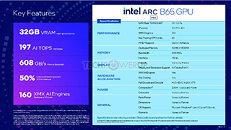
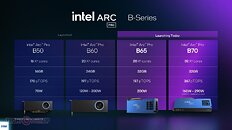 Intel Arc Pro B65 is an interesting variant, it comes with a similar core configuration to the Arc B580 gaming GPU, but with a few key changes. It has 24 Xe cores, 160 XMX cores, and 20 Ray Tracing Units. Where it differs is memory and PCIe. It provides 32 GB of GDDR6 memory across a 192-bit wide memory interface, unlike the Arc Pro B70. The card is probably using asymmetric memory chip configuration to achieve this. Secondly, the card uses the full PCI-Express 5.0 x16 interface available to the GPU, and not PCI-Express 5.0 x8 found on the Arc B580. API support, media acceleration features, and display I/O are same as the B70. The card comes with a 200 W typical board power.


The Intel Arc Pro B70 is configured with 32 Xe cores (Xe2-HPG), 256 XMX engines, and 32 Ray Tracing Units. It comes with 32 GB of GDDR6 memory across a 256-bit wide memory interface, with 608 GB/s of bandwidth on tap. The card comes with a PCI-Express 5.0 x16 host interface. The Arc B70 offers a peak throughput of 367 TOPS (INT8). On the graphics side of things, it supports DirectX 12 Ultimate, OpenGL 4.6, Vulkan 1.3. Compute APIs include Intel's own oneAPI, OpenCL 3.0, and OpenVINO. Its media engine supports AV1, HEVC, VP9, and H.265 hardware-accelerated encode and decode. Display outputs include four DisplayPort 2.1 ports. The card comes with power draw ranging between 160 W to 290 W depending on partner implementation (230 W for the Intel reference card). Intel will provide certified drivers for Windows 11, Windows 10, and Linux.


34 Comments on Intel Announces Arc Pro B70 and Arc Pro B65 GPUs, Maxes Out Xe2 "Battlemage" Architecture
It'd make sense for this to cost about twice what the B50 cost, which would put this around $700; maybe a little less since it doesn't have the SFF tax.
Of course, that framebuffer is the main reason I (and many others I'm sure) want this GPU.
EDIT: Newegg has it listed for $950 and releasing on 4/24. To preorder or not to preorder...
www.intel.com/content/www/us/en/products/compare.html?productIds=245797,245796B70 is $949.
B65 is partner-only.
I can kinda see why intel hasnt had any interest in a consumer version of this card.
As for ML performance (I know, I know), I've found the B50 to be about half as fast as my 9070 XT with diffusion models* (which is insane for a card that only uses 50W), so I'd expect the B70 to be comparable to the 9070 XT.
For LLMs, GPT OSS 20B runs at around 48 tokens/sec* on the B50 and around 57 tokens/sec* on the 9070 XT. In theory, the B70 should be a lot faster here.
*I'll verify these numbers after work.
So it would have been a 5070 competitor. Not bad, with 16GB of VRAM it would have been a better deal. But it would have been power hungry, 290w vs 250w for the 5070.
I was comparing it to my B50 since that has 16 compute units and 16GB VRAM, so the B70 is literally twice the GPU.
That makes it even worse. 9060xt performance while pulling more power them a 5070. oof.
The relative performance calculation would put the B50 at 23.7 FPS, for 0.47 frames per watt. Compare that to roughly 0.24 frames per watt for the 9060 XT (assuming 180W).
I can't verify those numbers for RE9 since I don't own it, but I can say that the B50 consistently seems to perform about half as well as my 6800 XT (at 255W) in games.
I'm also assuming the power figures on TPU are core power only, not total board power (which is 70W for the B50).
I'd imagine the B70 might do well with being power limited and undervolted (assuming the options are even available). Then again, we'll see how big Battlemage scales compared to Alchemist.
1. How many Virtualized Functions are going to be supported? B50 ended-up being only 2 (despite support for 12 at/shortly after launch)
2. Is that an 8-pin EPS on the Intel 1st Party Card? Considering, the 75W PCIe slot power limit and 290W rating, it shouldn't be a single 6+2 PCIe.
Should we continue this discussion over there?As long as we don't get a repeat of the RX 480 apparently sometimes burning out PCIe slots, due to the 150W TBP but only having a single 6-pin PCIe power.
www.techpowerup.com/223981/amd-releases-pci-express-power-draw-fix-we-tested-confirmed-works
You're not wrong though-
It's why MSI more-often uses x1/x16(phys) slots, w/ the full x16's GNDs connected and why many of their boards have a PCIe 8-pin AUX-input for the slots' +12V/GND rail/plane*.
All of their 'AI certified' -or whatever- boards *can* safely support multiple GPUs.
*On PCIe slots, all +12V and +3.3V pins are in the first block of 22 (11 ea. side) pins. However, there are additional ground conductors surrounding ea. lane's Rx and Tx conductors
B770 when???
Intel knows this, which is why it's not even bothering with the consumer market in that segment, instead focusing on workstation cards, where saving $500-1000 over Nvidia can be justified. Especially since AMD and Intel are more competitive on features in the professional segment than the gaming segment.
I went ahead and ran ML tests (because AI is a stupid buzzword and ML is more descriptive) on my B50 (for extrapolating to B70), my 9070 XT (stand-in for R9700?), and my 6800 XT (to let the B50 show off).
TL;DR: The B50 is freaking fast for a 50W card,
and if everything scales linearly, the B70 will be faster than AMD's current-gen best.Intel claims the B70 will be ~2.17x as powerful as the B50 in ML workloads, so in theory, the B70 should get ~11.61 it/s in SD Next and ~96.65 tok/s in GPT OSS 20B.
If we go with just a flat 2x over the B50, the numbers become ~10.7 it/s and 89.08 tok/s.
Of course, who knows how these workloads would actually scale, and I don't know if Vulkan uses the ML hardware or just the general-purpose compute.
Feel free to point out the flaws in my testing methodology.
EDIT: My LM Studio settings were severely handicapping my AMD cards.
New LLM results:
B50 (Vulkan): 48.07 tok/s
9070 XT (ROCm): 124.49 tok/s
6800 XT (ROCm): 93.55 tok/s
B70 theoretical numbers now range from 96.14 tok/s to 104.31 tok/s.
Excuse me, but HEVC is H.265. You probably mean HEVC and H.264.