Wednesday, March 25th 2026

Intel Announces Arc Pro B70 and Arc Pro B65 GPUs, Maxes Out Xe2 "Battlemage" Architecture
Intel today announced the Arc Pro B70 and Arc Pro B65 graphics cards for advanced AI compute workloads on workstations, and professional visualization. The two primarily target local inferencing, software development, and deployments in multi-GPU configurations for rack scale AI GPU compute acceleration. The Arc B70 GPU in particular stands out, because it is the most powerful discrete GPU based on Intel Xe2 "Battlemage" graphics architecture, with 32 Xe cores, and a 256-bit wide GDDR6 interface. If you recall, the Arc B580 gaming GPU only comes with 24 Xe cores and a 192-bit interface, and we for long wondered if Intel would ever max out the silicon for a more powerful SKU. The Arc B70 is that SKU.
The Intel Arc Pro B70 is configured with 32 Xe cores (Xe2-HPG), 256 XMX engines, and 32 Ray Tracing Units. It comes with 32 GB of GDDR6 memory across a 256-bit wide memory interface, with 608 GB/s of bandwidth on tap. The card comes with a PCI-Express 5.0 x16 host interface. The Arc B70 offers a peak throughput of 367 TOPS (INT8). On the graphics side of things, it supports DirectX 12 Ultimate, OpenGL 4.6, Vulkan 1.3. Compute APIs include Intel's own oneAPI, OpenCL 3.0, and OpenVINO. Its media engine supports AV1, HEVC, VP9, and H.265 hardware-accelerated encode and decode. Display outputs include four DisplayPort 2.1 ports. The card comes with power draw ranging between 160 W to 290 W depending on partner implementation (230 W for the Intel reference card). Intel will provide certified drivers for Windows 11, Windows 10, and Linux.


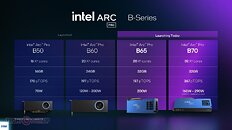 Intel Arc Pro B65 is an interesting variant, it comes with a similar core configuration to the Arc B580 gaming GPU, but with a few key changes. It has 24 Xe cores, 160 XMX cores, and 20 Ray Tracing Units. Where it differs is memory and PCIe. It provides 32 GB of GDDR6 memory across a 192-bit wide memory interface, unlike the Arc Pro B70. The card is probably using asymmetric memory chip configuration to achieve this. Secondly, the card uses the full PCI-Express 5.0 x16 interface available to the GPU, and not PCI-Express 5.0 x8 found on the Arc B580. API support, media acceleration features, and display I/O are same as the B70. The card comes with a 200 W typical board power.




The Intel Arc Pro B70 is configured with 32 Xe cores (Xe2-HPG), 256 XMX engines, and 32 Ray Tracing Units. It comes with 32 GB of GDDR6 memory across a 256-bit wide memory interface, with 608 GB/s of bandwidth on tap. The card comes with a PCI-Express 5.0 x16 host interface. The Arc B70 offers a peak throughput of 367 TOPS (INT8). On the graphics side of things, it supports DirectX 12 Ultimate, OpenGL 4.6, Vulkan 1.3. Compute APIs include Intel's own oneAPI, OpenCL 3.0, and OpenVINO. Its media engine supports AV1, HEVC, VP9, and H.265 hardware-accelerated encode and decode. Display outputs include four DisplayPort 2.1 ports. The card comes with power draw ranging between 160 W to 290 W depending on partner implementation (230 W for the Intel reference card). Intel will provide certified drivers for Windows 11, Windows 10, and Linux.


34 Comments on Intel Announces Arc Pro B70 and Arc Pro B65 GPUs, Maxes Out Xe2 "Battlemage" Architecture
I'd still love to buy a dual B60 if it were ever available in my region :(Too lazy/busy to give a more detailed answer, but the B70 should end up with almost the same perf as the 9700 since both of those have similar memory bandwidth, and inference for most of these models is bottlenecked by that.
Also makes me wonder if the 9070 XT's ML hardware is helping at all, since the (image diffusion) numbers line up with the raw compute performance of it versus the 6800 XT. I have no idea what's going on with the LLM numbers, unless that's the memory bottleneck (which doesn't explain the B50's performance)?
Still, it's clear the B50's ML hardware is really helping make up for the lower general compute performance in those workloads, and I would expect the same for the B70.
Edit: numbers via llama-bench build: b54124110 (8292)
LocalLLaMA/comments/1qp8sov/how_to_easily_benchmark_your_models_with
I'll give llama.cpp a try on its own and see how it compares.
128 tps, same prompt as yours
LM-Studio-0.3.39-2-x64.AppImage running huggingface.co/unsloth/gpt-oss-20b-GGUF?show_file_info=gpt-oss-20b-F16.gguf
B50 (Vulkan): 48.07 tok/s
9070 XT (ROCm): 124.49 tok/s
6800 XT (ROCm): 93.55 tok/s
These numbers align better with the raw compute performance of these cards.
B70 theoretical numbers now range from 96.14 tok/s to 104.31 tok/s, which goes with my original theory of similar performance to the 6800 XT or 9060 XT.
Now if only LM Studio supported Intel's compute API...
but as advertised here, for WORK purposes these gpus should be good and also budget friendly.
It has better efficiency than 7nm cards, but worse than 4nm cards, which is to be expected. 3nm cards will be much better.
32 GB is a very important asset, can be very helpful for some tasks and some people. For $999, a card with 32 GB is alright.