Wednesday, March 25th 2026

Intel Arc Pro B70 Shows Up on Newegg With April Release Date and $949.99 Price
Intel just announced the Arc Pro B70 and B65 GPUs with the Arc Xe2 Battlemage architecture, featuring 32 and 24 Xe2 cores, respectively—see TechPowerUp's launch coverage fore more details—but it did not include information on pricing or availability. Fortunately, for those interested in the workstation graphics cards, Newegg has listed the Arc Pro B70 online, spilling the beans on price and a prospective launch date.
According to the pre-order page, the Arc Pro B70 will cost $949.99 and launch on April 24, 2026. Unfortunately, there is no listing for the Arc Pro B65 just yet, but that should launch around the same time as the B70 and will likely be priced somewhere between the B60's current retail price of $659.99 and the Arc Pro B70's $949.99 price, thanks to the increased VRAM on the B65.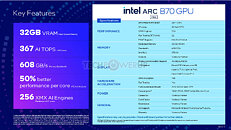


Source:
Newegg
According to the pre-order page, the Arc Pro B70 will cost $949.99 and launch on April 24, 2026. Unfortunately, there is no listing for the Arc Pro B65 just yet, but that should launch around the same time as the B70 and will likely be priced somewhere between the B60's current retail price of $659.99 and the Arc Pro B70's $949.99 price, thanks to the increased VRAM on the B65.


17 Comments on Intel Arc Pro B70 Shows Up on Newegg With April Release Date and $949.99 Price
Was hoping to see a bit more memory bandwidth, but it'll do.
At the rate intel have been improving their drivers, it's well worth supporting them instead of the competition.
I estimate that the B70 will perform similarly to an RX 9060 XT in compute and raster performance, but based on my experience with the B50 and 9070 XT, should be quite a bit faster than the R9700 in certain ML workloads (LLMs) and similar in others (image diffusion).
I'm still tempted by the B70, I really like the B50 so far.
I'll try to buy one
48GB per GPU is where things start to get interesting but I think my points are off-topic.
forum.level1techs.com/t/general-purpose-llm-server-on-a-budget/247346/13?u=lambda
Good card but could be better. I can't buy this stuff locally anyway so I'll wait.
Impressive GPU but does need some work.
maybe if you have something that can inference decently on ARC but for general use and gaming this is dumb
Why do workstation GPUs sell for 2x-3x as much as consumer cards, when they use the exact same silicon chip and are (by nearly all measures) actually less performant than consumer cards, due to lower clock speeds/power limits? Why are they a segmented class of product at all?
- VRAM. Workstation GPUs usually have clamshell VRAM (RAM chips on both sides of the PCB) to double capacity. The 5080 has 16GB of GDDR7 over a 256-bit bus, the 4500 Blackwell has 32GB of clamshell VRAM. On the high-end, the monstrous RTX Pro 6000 Blackwell has 96GB of VRAM (same chip as the 5090 32GB, but clamshell VRAM and 3GB chips for as much memory as possible). More VRAM means the GPUs can be used for larger (i.e. better) AI models and larger rendering projects. If a GPU is more useful for AI and money-making professional programs, it will cost more (which is why Nvidia is very hesitant to give their xx80 and xx70-Ti tier GPUs more than 16GB. The more VRAM a GPU has, the more expensive it will be because AI customers will just buy consumer cards. This is what happened to the 4090 and 5090).
- Related to VRAM, the VRAM on professional GPUs is also ECC RAM, which is slightly more expensive but very valuable to ensure a multi-day rendering session doesn't crash because of a random bit flip. For gamers, this is irrelevant, which is why the products are segmented.
- Form factor. Consumer GPUs are meant for single-GPU systems, so they can take 3 or even 4 PCIe expansion slots to fit large, powerful coolers for maximum cooling and minimal noise. Workstation GPUs are always single or dual-slot with blower coolers. Dual-slot design is neccesary to maximize space in workstations or server racks, blower coolers are neccesary to cool the clamshell RAM. The downside of this is that the GPUs are loud, another reason why they're segmented from the consumer lineup.
- Stability over performance. Workstation GPUs have lower clock speeds and power limits, partially for cooling reasons (because they're dual-slot and often with multiple packed into a single workstation), and also to maintain stability. A gamer will appreciate an extra 10% FPS, and it's not a terrible inconvienence if this means the GPU has a random crash every 3 months because it's clocked to the absolute limit of the silicon. A professional rendering workstation will absolutely take 10% lower performance in exchange for the assurance that a GPU will never crash during a prolonged rendering or LLM session, or that your data analysis is accurate. This is why the GPUs have ECC VRAM and a seperate driver branch.
- Expanded feature set. Workstation GPUs can have their resources split amongst VMs by a hypervisor, have more NVENC/NVDEC units than consumer GPUs, and more. AMD prioritizes workstation GPUs for ROCm (their version of CUDA) support, while many AMD consumer GPUs don't have it.
TLDR: Workstation GPUs are used to make money, so they cost more money. Consumer GPUs are luxuries to have fun, so they cost less money.AMD and Nvidia have a far longer legacy of software they have been supporting over the decades.
This is a card meant for llm's, I wouldn't trust it with mission critical tasks like cad work
But then you should also consider the dual b60 with 48GB per "GPU"...