Monday, March 30th 2026

NVIDIA Readies Rubin-based GeForce RTX 60-series with Massive RT Performance Gains
The rumor mill has started grinding about NVIDIA's next-generation gaming GPU, and it looks like NVIDIA does not want to allow the current market environment to get in the way of implementing its product roadmap, with a roughly 2-year GeForce generation product launch cadence. The next-generation GeForce RTX 60-series will be powered by the "Rubin" graphics architecture. "Rubin" already debuted on NVIDIA's bread-winning AI GPU series, and is making its way to GeForce, reports RedGaming Tech.
The first slice of rumors about GeForce RTX 60-series predicts that NVIDIA will stick to a more conservative approach with foundry nodes, and not go with a sub-2 nm nanosheet-based node. GeForce "Rubin" will be built on some variant of the current TSMC 3 nm FinFET node. They need not be the same N3 node that's in use by Apple, Intel, and others; and NVIDIA might collaborate with TSMC on an exclusive variant just the way it created the NVIDIA 4N node, derived from TSMC N5. Chips in the series will follow the numbering scheme "GR20x," with examples being "GR202" for the biggest part powering the flagship product. The 3 nm node will allow NVIDIA to maintain GPU clock speeds ranging between high 2 GHz and low 3 GHz, which is a minor increase over the current "Blackwell."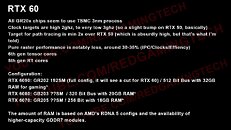 GeForce "Rubin" will introduce the new 6th Gen Tensor cores, and 5th Gen RT cores. We already have some clue about the design goals of the two. The new 6th Gen Tensor cores, along with the generational increase in the main compute muscle of the GPU, should better accelerate neural rendering and DLSS 5, the revolutionary new technology that augments game assets with AI-generated effects in real time. NVIDIA's early demo of DLSS 5 required a pair of RTX 5090 graphics cards, so the goal should be to bring DLSS 5 within the performance envelope of a single GPU, including mid-range and performance segment ones, not just the high-end.
 Next up, is the 5th Gen RT core, and RedGaming Tech says that NVIDIA is chasing a 100% gen-over-gen increase in real-time Path Tracing performance over the current RTX 50-series "Blackwell" series.
As for the traditional pure raster 3D graphics performance, it's predicted that "Rubin" will post modest generational gains, ranging between 30% to 35% SKU-to-SKU versus the current RTX 50-series. This would be banking on the IPC, clock speed, and energy-efficiency advances brought about by 3 nm and the new "Rubin" SM (streaming multiprocessor).
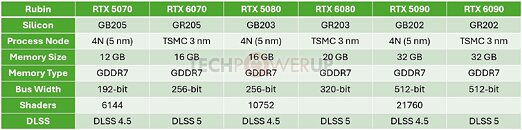
Memory size and bandwidth could increase SKU-to-SKU over the current "Blackwell" generation, with the exception of the top RTX 6090. NVIDIA will stick to GDDR7 as the memory standard, however, the company could increase memory bus width in pursuit of memory size and bandwidth gains. The top-spec "GE202" silicon powering the RTX 6090 will retain a 512-bit GDDR7 memory bus of its predecessor, the RTX 5090. NVIDIA might tap into faster GDDR7 speeds for modest bandwidth increase. The silicon has 192 SM, and the RTX 6090 could be cut down from this. 32 GB might remain the memory size for the RTX 6090.
The RTX 6080 could be based on the "GR203" silicon, which physically features a 320-bit wide GDDR7 memory interface for 20 GB of memory, along with a memory bandwidth increase of at least 25% over the current RTX 5080.
The RTX 6070 will see a major memory size and bandwidth increase. NVIDIA will build the RTX 6070 on the "GR205" silicon, which comes with a 256-bit GDDR7 memory interface, and the RTX 6070 will get 16 GB of it, for an at least 33% memory bandwidth increase
Source:
RedGaming Tech (YouTube)
The first slice of rumors about GeForce RTX 60-series predicts that NVIDIA will stick to a more conservative approach with foundry nodes, and not go with a sub-2 nm nanosheet-based node. GeForce "Rubin" will be built on some variant of the current TSMC 3 nm FinFET node. They need not be the same N3 node that's in use by Apple, Intel, and others; and NVIDIA might collaborate with TSMC on an exclusive variant just the way it created the NVIDIA 4N node, derived from TSMC N5. Chips in the series will follow the numbering scheme "GR20x," with examples being "GR202" for the biggest part powering the flagship product. The 3 nm node will allow NVIDIA to maintain GPU clock speeds ranging between high 2 GHz and low 3 GHz, which is a minor increase over the current "Blackwell."


As for the traditional pure raster 3D graphics performance, it's predicted that "Rubin" will post modest generational gains, ranging between 30% to 35% SKU-to-SKU versus the current RTX 50-series. This would be banking on the IPC, clock speed, and energy-efficiency advances brought about by 3 nm and the new "Rubin" SM (streaming multiprocessor).
Memory size and bandwidth could increase SKU-to-SKU over the current "Blackwell" generation, with the exception of the top RTX 6090. NVIDIA will stick to GDDR7 as the memory standard, however, the company could increase memory bus width in pursuit of memory size and bandwidth gains. The top-spec "GE202" silicon powering the RTX 6090 will retain a 512-bit GDDR7 memory bus of its predecessor, the RTX 5090. NVIDIA might tap into faster GDDR7 speeds for modest bandwidth increase. The silicon has 192 SM, and the RTX 6090 could be cut down from this. 32 GB might remain the memory size for the RTX 6090.
The RTX 6080 could be based on the "GR203" silicon, which physically features a 320-bit wide GDDR7 memory interface for 20 GB of memory, along with a memory bandwidth increase of at least 25% over the current RTX 5080.
The RTX 6070 will see a major memory size and bandwidth increase. NVIDIA will build the RTX 6070 on the "GR205" silicon, which comes with a 256-bit GDDR7 memory interface, and the RTX 6070 will get 16 GB of it, for an at least 33% memory bandwidth increase
162 Comments on NVIDIA Readies Rubin-based GeForce RTX 60-series with Massive RT Performance Gains
Such RAM stinginess.
Boy, how that died out quickly.
Then again, must be in reaction to their stock not holding the $180 4wk average.
3GBx12(384Bit)
3GBx8(256Bit)
3GBx6(192Bit)
3GBx4(128Bit)
Also, can somebody answer me this: if Nvidia apparently only cares about AI and RT, hates gamers, etc, what stops AMD or Intel from delivering the holy grail of 50% (or whatever is supposed to be substantial enough) raster difference and gaining 90% market share?
Who is going to build a gaming PC, or buy a prebuilt in a market with these prices of memory, storage, GPUs, CPUs?
Apparently if the war in Middle East doesn't stop real soon many semiconductor fabs will have to stop production due to Helium shortage.
That's on top of all the price hikes that haven't even been implemented yet.
:p
To put it more simply, I'm pretty sure that if AMD had designs of a Nvidia-killing Raster King GPU, they would come out with it long time ago.
If I had to guess, I’d say a 50% improvement in RT. 3nm isn’t much denser than 4nm.