Friday, April 3rd 2026

Modder Gets Intel Core 9 273PQE "Bartlett Lake" to Boot Windows 11 on Z790 Motherboard
Intel's long-awaited gaming CPU king, the Core 200 "Bartlett Lake-S," is an intriguing CPU generation that isn't actually meant for gaming. The top version, the Core 9 273PQE, is a 12-core, 24-thread processor launched exclusively for commercial and industrial PC OEM markets as an edge/embedded design, and it's not available for the DIY PC crowd. Intel didn't plan for these CPUs to run on commercial motherboard chipsets, and major motherboard manufacturers have confirmed this. However, a modder has achieved something remarkable by booting Intel's "Bartlett Lake" Core 9 273PQE processor into the Windows operating system on a standard Z790 motherboard. Previously, these chips could only reach the POST stage on consumer LGA 1700 boards, but they couldn't run a fully functioning operating system.
Built on the Intel 7 node and designed for Socket LGA1700, "Bartlett Lake" is a non-hybrid chip featuring up to 12 "Raptor Cove" P-cores without any E-core clusters. It was not intended to be compatible with consumer Intel Z790 chipset motherboards. However, main issue was never the socket itself. "Bartlett Lake" shares the same physical LGA 1700 layout as Intel's "Raptor Lake" chips, but that doesn't automatically make it compatible with consumer boards. Typically, the absence of official BIOS and microcode support prevents proper CPU initialization. Earlier attempts usually resulted in startup failures, blank screens, or error codes before progressing further. This recent success changes that narrative. By modifying the motherboard firmware to accept the processor during early boot, the modder overcame the hurdles that had previously caused failures. Once the system accepted the chip at initialization, Windows loaded successfully.
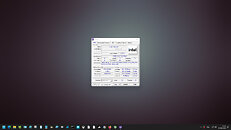
 The flagship "Bartlett Lake" Core 9 273PQE is also notable for its P-core-only design, featuring 12 performance cores and 24 threads. This sets it apart from Intel's more common hybrid desktop CPUs that combine performance and efficiency cores. It requires no work from Thread Director or the Windows 11 kernel to orchestrate the threads, which would significantly boost gaming performance. This uniqueness makes it appealing to enthusiasts, especially those curious about its performance compared to chips like the Core i9-13900K or Core i9-14900K. However, this setup is experimental. There is no official support, and in-app stability isn't guaranteed. Future BIOS updates might also complicate or prevent such modifications. Nonetheless, the successful Windows boot demonstrates that the primary obstacle was firmware-related, not a fundamental hardware incompatibility.
Sources:
Overclock.net, via Wccftech
Built on the Intel 7 node and designed for Socket LGA1700, "Bartlett Lake" is a non-hybrid chip featuring up to 12 "Raptor Cove" P-cores without any E-core clusters. It was not intended to be compatible with consumer Intel Z790 chipset motherboards. However, main issue was never the socket itself. "Bartlett Lake" shares the same physical LGA 1700 layout as Intel's "Raptor Lake" chips, but that doesn't automatically make it compatible with consumer boards. Typically, the absence of official BIOS and microcode support prevents proper CPU initialization. Earlier attempts usually resulted in startup failures, blank screens, or error codes before progressing further. This recent success changes that narrative. By modifying the motherboard firmware to accept the processor during early boot, the modder overcame the hurdles that had previously caused failures. Once the system accepted the chip at initialization, Windows loaded successfully.


35 Comments on Modder Gets Intel Core 9 273PQE "Bartlett Lake" to Boot Windows 11 on Z790 Motherboard
It's performance is going to be very disappointing. It was never designed for gaming, but more industrial applications. The chipset that supports it doesn't support memory overclocking so it's limited to DDR5 5600.
I have little confidence anyone is going to actually get it to run in a z790 board. But I guess people can hold out hope, only to be disappointed later on.
It's a 12P Raptor Lake CPU that boosts to 5.8 GHz, why would the performance be poor?
Literally the first thing I would do after getting something to "work" is hammer that system with every benchmark known to humankind
The lack of E-cores might help with CPU scheduling issues that could affect performance?
Not releasing this for consumers was a huge missed opportunity, it would have been a great option for existing Alder Lake or Raptor Lake builds still using DDR4.
I'd totally put this in my B760 SFF build just to see how bad the thermals would be if it wasn't $800.
www.mouser.com/ProductDetail/Intel/CM8071506031056?qs=PBDs2xEllI%2FGaJ6%2F%2F1hBuQ%3D%3D
So there are some benchmarks. Not gaming but not earth shattering
I'd have to look but I believe my 14900k was around 44k in R23
There's no real reason informed buyers would want these for normal desktop use, it's all driven by hype and misconceptions. For a home server though…
But NOOOOO!
Lets just not do that, right?
Surely after 12 years we'd be able to do better than 128MB of L4 cache.
I still have a 5775c system and played around with both my 5090 and 4090s and ran benchmarks and some games. Its not really suitable these days but it does work and at the time it really punched above it's weight with the edram
and there are people who thanks to the price of memory are stuck on lga 1700 with ddr4
I'm fairly certain intel would have released it on the consumer market if it wasn't facing serious capacity problems like it is.
I can't imagine on what planet that would be a good deal when I could grab a 270k and MB for about $700 and it would crush that cpu in productivity apps and likely gaming as well.
Yes it would be fun to play with but it's not so much fun I feel the need to waste money to try it out.
Neat CPU, not worth the cost of entry where I live to try it out, others can do that instead
99.999% of consumers are better off with E cores and hybrid CPUs.
And if they're stuck on DDR4 LGA 1700 mobos due to memory costs, would they really shell out $500 just for a CPU that's at best even with a 13900K for 95% of workloads? If they already have a 13900K, why would they change? If they have a lower tier CPU, why would they spend $500 for a marginal upgrade on the same platform instead of saving for Nova Lake or Zen 6?
From tests, base multicore performance using JEDEC 3200 DDR4 is actually not too bad, little better than I expected, seems similar to a Core i7 13700.
And since when the official maximum supported memory speed has been a problem?
Performance actually doesn't seem bad on those, but I would have to imagine 12P Cores in Intel 7 (10nm Enhanced SuperFin) may be as if not a bit more power hungry in load than a Core i9 13900.