Sunday, April 5th 2026

Intel Texture Set Neural Compression Shrinks Textures by Up to 18x with Minimal Quality Loss
Intel has recently released a new video showcasing its latest Texture Set Neural Compression (TSNC) technology, which delivers textures up to 18 times smaller while maintaining visual quality with little to no noticeable difference compared to the industry-standard compression. Using AI-based neural networks, Intel's graphics team processes input data from industry-standard BCn textures. These textures are compressed through an AI model encoder, encoded in the latest space values, and then decoded by a network decoder to decompress the textures. The result is output data textures that are up to 18 times smaller, with some quality loss at maximum compression settings. As with any neural technology, TSNC is trained on millions of standardized textures to create an AI model that can replace traditionally compressed textures in the BCn format. This results in new, much smaller game textures that load faster, use less VRAM, and perform better thanks to modern GPU technology.
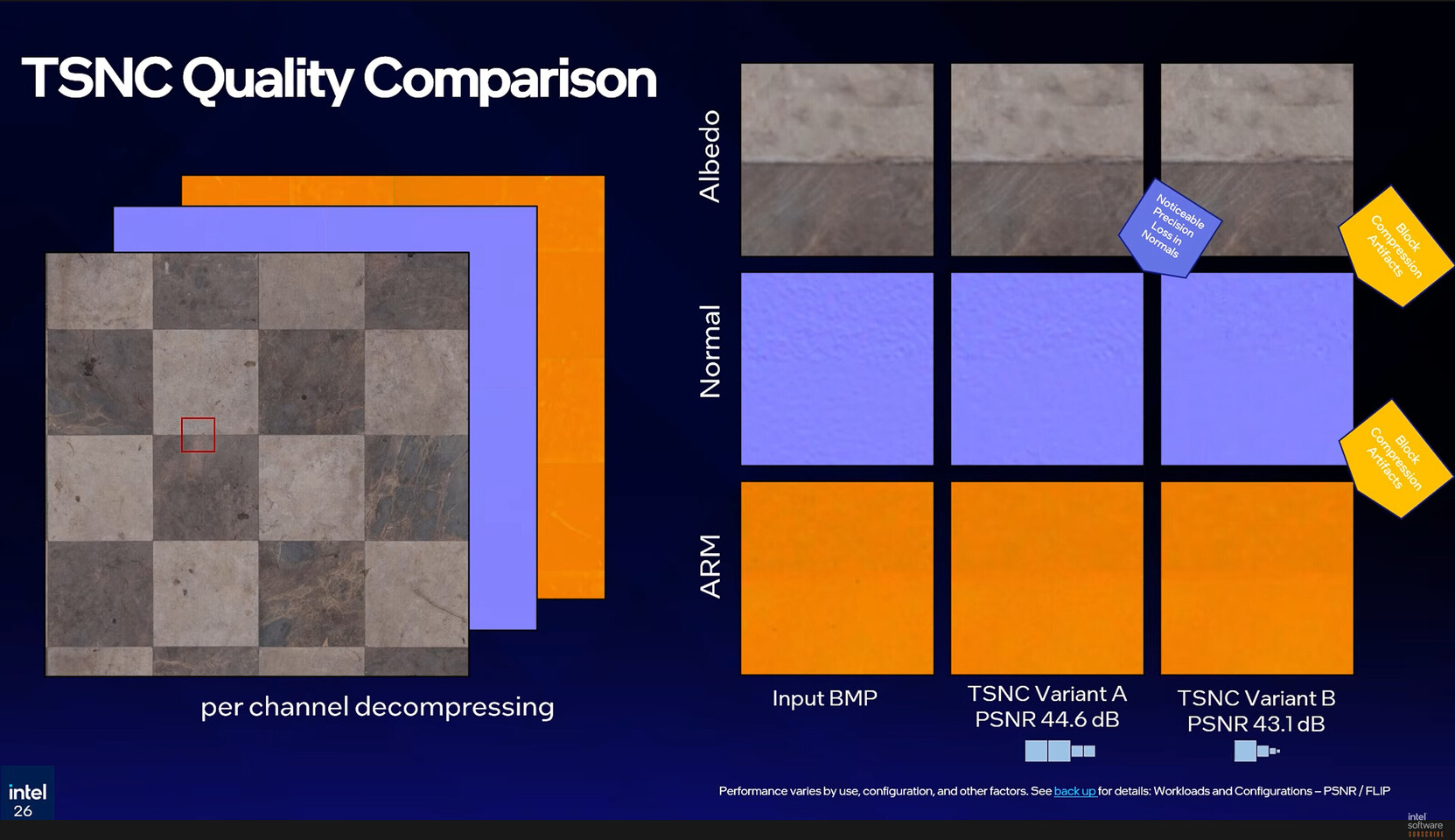
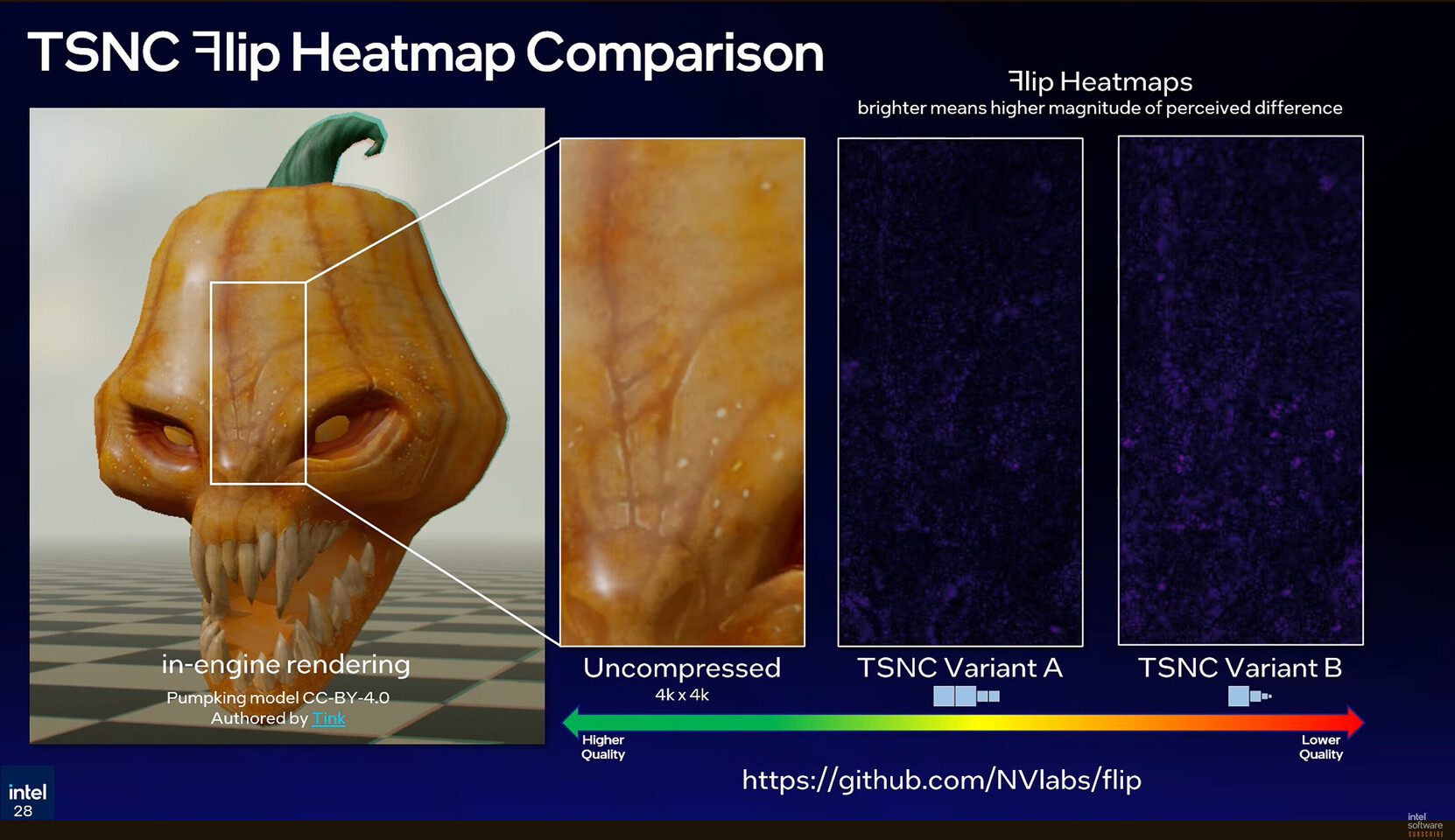
There are several ways to apply TSNC neural compression, depending on the desired outcome, whether it's saving game installation size, reducing VRAM usage, or improving performance. Variant A, as Intel calls it, can achieve up to 9 times compression of the standard texture set, with little to no difference in visual quality—almost an unnoticeable drop. However, when the goal is maximum efficiency and requires up to 18 times texture compression, Intel offers Variant B of the TSNC neural network. This variant provides a significant performance boost, with the trade-off being a modest visual change. Using NVIDIA's FLIP tool to measure quality drop in generated images, Intel notes that Variant A experiences a 5% visual quality drop, while Variant B sees up to a 7% quality drop, which is noticeably more.


 You can judge for yourself by viewing the comparison images below.

 Finally, Intel benchmarked the performance of its Texture Set Neural Compression technology using the latest "Panther Lake" system with Arc B390 integrated graphics, which also includes XMX cores to accelerate these technologies seamlessly. The AI model is producing the first texture pixel in about 0.194 nanoseconds, which is fast enough for users not to notice any additional latency or experience oddities in their game rendering. We can expect this technology to be shipped later this year as an alpha version, with beta and full stable releases expected later on, though no concrete timelines have been provided.

Sources:
Intel Developers, via VideoCardz
There are several ways to apply TSNC neural compression, depending on the desired outcome, whether it's saving game installation size, reducing VRAM usage, or improving performance. Variant A, as Intel calls it, can achieve up to 9 times compression of the standard texture set, with little to no difference in visual quality—almost an unnoticeable drop. However, when the goal is maximum efficiency and requires up to 18 times texture compression, Intel offers Variant B of the TSNC neural network. This variant provides a significant performance boost, with the trade-off being a modest visual change. Using NVIDIA's FLIP tool to measure quality drop in generated images, Intel notes that Variant A experiences a 5% visual quality drop, while Variant B sees up to a 7% quality drop, which is noticeably more.




24 Comments on Intel Texture Set Neural Compression Shrinks Textures by Up to 18x with Minimal Quality Loss
I'm thinking about another hyper-stupid competition focusing on just one of the software's features. From unnecessary big blowing to unnecessary great reduction.
Seeing how Nvidia announced their implementation of this couple of days ago, now Intel did it it's just a matter of time until AMD announces their implementation of the same concept.
So, buckle up as this will be getting worse now as every tech in the world will be getting the AI slop treatment. A handful of geeks and nerds will cry in horror while majority of the population will gulp the slop and ask for more with a smile.
Instead of doing the opposite, hyper optimizing games so they could run on basically anything. Isn't that the goal of making a game, so it can reach the greatest possible audience?
Tessellation had the same issue. Models already looked great, but they turned them into 5x polygons models for absolutely no reason whith most misc objects like railings and stuff remained stupid blocky. Where going the opposite direction and hyper optimizing games to remove even more polygons when not needed would make an amazing effect on performance.
So, yeah, sounds good on paper, I'm not holding my breath because devs surely will cock it up.
The joke's on you though, and your fellow "geeks and nerds", since this lot gets it wrong all the time. This is a very good example: some AI tech that actually might be rather beneficial, with minimal cost, gets thrown into the "AI slop" bucket ...just because!
If the devs program & design the final outcome & decide exactly it would be less heresy than say when bluray players upscaled DvD which I have never heard of any whining about.
Upscale yes transform decided by dev 100%.
No matter how optimized a product, people will still cry because it doesnt run on their ATI HD 4250 or whatever old silicon they found in a dumpster. At some point, you need to upgrade your hardware for modern requirements. Optimization is balanced with features and visual quality, always has been.People said the same of DLSS upscaling when it came out, now look at the magic DLSS4+Transformer is capable of.
here is some more info about it from the last time they talked about this
community.intel.com/t5/Blogs/Tech-Innovation/Artificial-Intelligence-AI/Intel-Co-Presents-Cooperative-Vectors-with-Microsoft-at-Game/post/1674845
www.intel.com/content/www/us/en/developer/articles/technical/cooperative-vectors-demo.html
RE: Requiem is well optimized, but RT performance still requires modern hardware to run well even at 1080p. Should RT and PT be removed so people still using RTX 2060s feel better about being able to run the game? What about Crimson Desert? Both sold very well despite not being designed to "sell the most games" as you say.
Where does the buck stop? How much graphical fidelity should be sacrificed to achieve better performance? Thats what I was getting at. What makes your baseline the acceptable baseline?
Hell, original Far Cry is ancient at this point and it still looks pretty despite being dated now. Same with Crysis.
en.wikipedia.org/wiki/Lossy_compression
companies rediscovered compression
what a surprise. i also rediscovered compression for my file systems and years ago for the kernel.
factor 20 is the usual. which data is dropped? which details are dropped? How much extra instruction cycles do you need for that "neural fancy word bla bla ai fancy texture compression method company a b c d" ?
i agree, tehy may have discovered lossy compression.
wtf
we discuss now bitmaps?
msi uefi generates bmp when i create screenshots as the settings can not be exported!
1.5 mb per file which are 0.05mb when converted for 10xx x xxx resolution most likely 1024x768
note i talk about the (BMP) on the left.
LOL intel discovered bitmaps. haha windows 95 bitmaps.
example, not the same file contents, but 2 original msi uefi files vs converted quick with gimp most likely files
note: i did not care which dataformat jpeg png, whatever, just smaller at that time.
2.4 MB / 0.3 MB = factor 8
arxiv.org/html/2506.06040v1
High VRAM GPUs might be ok as they will have the hardware to cope with uncompressed still.
If people didn't care, we would probably just be riding horses. There would be no Teslas, Lucids, BYDs on the roads. And yeah, that lunch you just finished would look a lot like pig swill or something your cat might not eat. And yeah, you wouldn't be reading this site on a big flat panel display connected to a powerful desktop computer (or even viewing it on your smartphone).
Ultimately consumers set the expectations of what they find desirable. And not everyone is the same everywhere.
Here in the USA, public transit is basically a joke. In Japan and Switzerland, public transit is run by mature, responsible and accountable adults. I'm most familiar with the various transit agencies here in the SF Bay Area and sadly our agencies are NOT operated the same way. Because the vast majority of consumers don't give a sh!t.
DLSS had an especially rough time at its debut because AMD and Intel didn't have anything to challenge Nvidia.
Hell, McDonald's in Japan blow doors on their American counterparts. Because the consumers care.
If no one complained about DLSS 1.0, that's all there would be in 2026.
And your smartphone battery would be dead in 4 hours. And it wouldn't survive a dunking. And the camera would be shooting 640x480p images.