Friday, April 24th 2026

Ubuntu 26.04 "Resolute Raccoon" Launches With Gnome 50 and Linux 7.0
Canonical has today released Ubuntu 26.04 LTS as the company's latest update to the mainstream Linux distro. As we reported previously, Canonical has upgraded the minimum system requirements to 6 GB of RAM, but that change comes alongside a number of upgrades to the distro itself, some of which will be immediately noticeable, while others will silently improve the user experience in the background. Ubuntu users can download Ubuntu 26.04 directly from Canonical, or users of previous Ubuntu versions can simply run "do-release-upgrade -p" in their terminal.
The biggest user-facing change is the move to Gnome 50, which now mandates Wayland and has improved, non-experimental support for both VRR and fractional scaling. Gnome 50 also implements a new feature that allows the cursor to render at the monitor's full refresh rate, even if the foreground app is running at a lower frame rate. The Gnome 50 update also sees the Yaru theme get some nifty visual tweaks that bring it closer to the standard Gnome theme and a new icon pack. Resolute Raccoon also moves Ubuntu up to the Linux kernel 7.0, adding better memory management, removing the "experimental" tag from Rust, and updating various drivers and services, like ZFS, and adding security features, like TPM-backed full-disk encryption. Ubuntu 26.04 is also the first Ubuntu version to ship NVIDIA CUDA out of the box, and AMD's ROCm platform is available in the Ubuntu repos for those looking to run local AI.
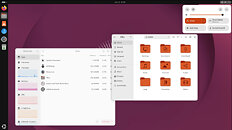 Resolute Raccoon also gets a new Resources app to replace the old System Monitor and Power Statistics apps, providing more comprehensive resource tracking and management. Ubuntu's extensions on Gnome have also been updated with more accessibility requirements, and the Files app (Nautilus) has also been updated with some UI and performance tweaks. A number of bug fixes have also been added, chiefly improved support for suspend and wake when using NVIDIA GPUs. Ubuntu also loses support for Google Drive integration in the Files app, due to security reasons—the libgdata library used to interact with Google's APIs went unmaintained and was consequently dropped from Nautilus.
Source:
Canonical
The biggest user-facing change is the move to Gnome 50, which now mandates Wayland and has improved, non-experimental support for both VRR and fractional scaling. Gnome 50 also implements a new feature that allows the cursor to render at the monitor's full refresh rate, even if the foreground app is running at a lower frame rate. The Gnome 50 update also sees the Yaru theme get some nifty visual tweaks that bring it closer to the standard Gnome theme and a new icon pack. Resolute Raccoon also moves Ubuntu up to the Linux kernel 7.0, adding better memory management, removing the "experimental" tag from Rust, and updating various drivers and services, like ZFS, and adding security features, like TPM-backed full-disk encryption. Ubuntu 26.04 is also the first Ubuntu version to ship NVIDIA CUDA out of the box, and AMD's ROCm platform is available in the Ubuntu repos for those looking to run local AI.


29 Comments on Ubuntu 26.04 "Resolute Raccoon" Launches With Gnome 50 and Linux 7.0
Just make sure you are fully patched before hand.
Pushed it to all my servers in production and so far so good! Had to make some adjustments to ansible because sudo in coreutils is rust now.
not work on ubuntu or are people are not aware of?
i never understood why less nerdy users want to use on every line sudo +command.
-- I wonder how much disk space ubuntu needs. can it work with 30gb for everything without swap and 8gib dram?I had a very polluted kernel config over the last 20 years. I look up every kernel option which is offered new.
there are lots of performance improvements and for myself btrfs. i need the brtrfs file compression feature. 20% less disk space when i factor in my backups is something worth it. i created my ext4 backup containers with only 115 - 120% and i had several times the need to destroy them to recreate them. I m sure amdgpu and other stuff also got updates.
the only reason to stay on an older kernel is stability. less changes imply less issues because the stuff you use may have proven itself that it works.
I started on a distro that had su but not sudo, so I'm very used to looking at that # prompt but I prefer to be completely intentional when I wield the power. You can still shoot your foot off, but you have to aim at your foot to do it.
Does this make it any easier? If you run a command that needs higher priveliges but you forgot to type sudo, just immediately run "sudo !!" and it runs the previous command with sudo.
In related news, Christopher Barnatt over at Explaining Computers has done a review of this new release.
written by someone with no knowledge or by a windows user: pixelcluster.github.io/VRAM-Mgmt-fixed/
the tech article could have been written better if the author would have taken 5 minutes properly reading the sources. edit: rephrased it to more friendly. // removed the kernel option and all hints what to enable
gentoo has 0 support, not officially and not in any third party software.
bazzite has 0 support
i give them credits to break it down more properly only for the userspace which is limited to kde only.
github.com/ublue-os/bazzite/issues/4672
github.com/bazzite-org/kernel-bazzite/issues/52
if it is really useful for slim desktop environments i highly, highly doubt it. for bloaded kde de you for sure need it.
This doesn't have to do with Linux-7.0, though. It is an independent update and they didn't say from what to what version.