Monday, April 27th 2026

Noctua Publishes Free 3D Models for Mechanical Engineering and Rendering Projects
To call Noctua popular in PC building enthusiast circles would be an understatement, but the company may have just scored even more points among its fans by publishing free 3D models of all its fans. According to the post on X announcing the 3D models, Noctua intends for makers, designers, and engineers to use these models for "mechanical design, renderings, or animations," and the actual license on the Noctua page states that the models "may not be used, in whole or in part, for the manufacture, reproduction, or commercialization of the products they represent or any substantially similar products." At the time of writing, a number of fans are not available on the 3D downloads site, but a substantial number are available as STEP files, which makes them almost universally compatible with CAD software.
Aside from using the models themselves as visual references, the CAD files should make it significantly easier for case designers to accurately design mounting points and plan cooling routes using Noctua fans. From poking around in the CAD models, it's notable that Noctua has published the products with separate bodies, which is useful if you want to, for instance, print a missing rubber corner for noise damping. Noctua notes that certain geometry, like the fan blade curvature, has been adjusted to protect the company's IP and to avoid users doing airflow simulation with the 3D models. Publishing 3D models for end-user use is becoming more and more popular, with companies like Keychron and ZSA doing the same for their keyboards. Cooler Master also famously has several case series for which it has released 3D models for users to design and print their own accessories.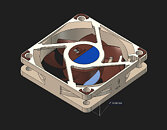

Sources:
Noctua, Noctua on X
Aside from using the models themselves as visual references, the CAD files should make it significantly easier for case designers to accurately design mounting points and plan cooling routes using Noctua fans. From poking around in the CAD models, it's notable that Noctua has published the products with separate bodies, which is useful if you want to, for instance, print a missing rubber corner for noise damping. Noctua notes that certain geometry, like the fan blade curvature, has been adjusted to protect the company's IP and to avoid users doing airflow simulation with the 3D models. Publishing 3D models for end-user use is becoming more and more popular, with companies like Keychron and ZSA doing the same for their keyboards. Cooler Master also famously has several case series for which it has released 3D models for users to design and print their own accessories.


9 Comments on Noctua Publishes Free 3D Models for Mechanical Engineering and Rendering Projects
From what I can tell, the fan blades are made with a special coating of some sort. It's smooth as heck, this is probably so it can slice through the air with minimal effort while being nearly weightless. As for the motor itself, the noise it produces is consistent; that is to say, regardless of RPM, they don't become annoying to the ear by becoming off-beat, maybe a tad louder, but never annoying. I haven't opened one yet, but these things run so stably, there are no wobbles.
You pay for these for a reason. Maybe a bit too much, but meh, my ears and sanity thank me daily.
While Noctua fans are quiet, I attribute this mostly to their low speed and anemic performance. Notably absent from Noctua's consumer fans are advancements like three phase motors and dynamically balanced blades; there are manufactures using dual ring balancing to sub-25mg while Noctua just slaps their fan blades onto their motorhub without balancing... but if you never spin a fan fast this isn't as big of an issue.
Noctua does use high quality motor sleeve bearings though, that is definitely one area they are competitive in.
If it wasn't standardized like that, you would not be able to mount any fans into any case.
However, aside from the OG GTs, the A12x25, and the Thermalright GT-clones, not many of the other GT-clones last as long. The EK Vardars were always hit-or-miss (and were always louder than the GTs at identical RPMs), the Thermaltake versions are more for those who want a color other than Noctua Tan/Brown (and their endurance hasn't been tested much, but they're cheap), and the rest just bandwagoned onto the GT-train, with some of them having cheap bearings that don't last long or have other gimmicks to try and sell them (like quick connectors to chain fans together without too much cord clutter).
Beyond that, when the rest of the 120mm market are mostly standard hub fans with multiple blade designs and airflow-optimized fans rather than static-pressure optimized like the GT and GT-alikes, the A12x25 would easily beat most of them in everything but cost, and in some niche cases, free (unrestricted) airflow rate due to blade design.
For reference, hwcooling.net has Phantek's top of the line 140mm T30-140 flowing 181% of the airflow Noctua's top of the line 140mm NF-A14x25 G2 can and producing 292% the static pressure through their thin radiator test.
I'm not saying Noctua's are bad fans, but I see them often misused in places where performance they can't deliver matters like case partition fans or CPU cooler fans.