Friday, May 8th 2026

DLSS 5: Gamers Prefer Original Visuals, Many Await Real-World Results
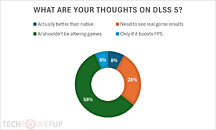
When NVIDIA announced its Deep Learning Super Sampling (DLSS) 5 technology, which the company describes as the first real-time neural rendering technology to bring photorealism to game textures, the response from gamers was not entirely positive. Many were unhappy with the results, and the backlash grew online. That's why we asked the TechPowerUp readers in a poll to share their opinions on the technology and found a consistent theme in the results. After collecting nearly 20,000 votes, a majority of 58% of gamers expressed that AI should not alter games at all. They prefer to keep their favorite titles original and intact, as envisioned by the original game studio, without any changes to lighting or photorealism. They want no alterations, meaning AI should not change character faces, apply realistic material rendering, or add any other modifications.
Interestingly, the second-largest group is still undecided, waiting to see real-world results in their favorite AAA titles. When DLSS 5 is implemented in major releases, about 28% of gamers who have seen NVIDIA's DLSS 5 demos believe that the final release will shape their opinion, whether positive or negative. This indicates that the technology has not yet fully resonated with the gaming community, who require further convincing. A smaller segment, 8.1% of those polled, believes that DLSS 5-enabled titles actually look better than native rendering, showing some optimism that the technology can improve visuals. Finally, about 6.4% of respondents are willing to accept visual changes if they lead to a significant FPS boost. As with DLSS and other upscaling methods, gamers now expect to see a substantial performance increase from neural rendering, and the situation appears similar with DLSS 5.
 What is DLSS 5?
The primary goal of DLSS 5 is to enhance a game's visual fidelity through techniques that improve scenes by adding photorealistic lighting and materials. Notably, DLSS 5 aims to respect the original artistic intent by using the game's color and motion vectors for each frame, aligning the DLSS 5 model with the specific setting. This technology promises to keep the output consistent with what the game developers originally envisioned, and just gives each original frame a visual overhaul without changing the game's original vision.
DLSS 5 processes 2D frames and motion vectors as input, applying its generative AI model to output frames in a 2D context rather than 3D. Although the model is trained on materials that might appear three-dimensional visually, its actual work is based on 2D imagery. It identifies each frame's motion vectors and anchors the model to them, operating in a 2D space instead of a full 3D environment. This approach to handling graphics is much more computationally efficient, as achieving complete photorealism in 3D would require more GPU power than is currently available. No underlying geometry is changed. What about Game Studios?
In my opinion, the vast majority of game studios do not want the artistic intent altered by generative AI. There are artists who carefully plan how the game will look and how it will appear at different settings. However, as an increasing number of game studios rely on AI for their artistic work, this approach might actually benefit those who prefer to offload some creative work. Especially those studios that don't have a distinct artistic style are likely to be among the first adopters of any neural rendering technique to help elevate their otherwise boring styles of game design.
This is especially true for game studios that rely on Unreal Engine 5, which is starting to make every game appear nearly the same over time, as having a universal way of processing video game elements and art creates similar content, just under a different label. While in-game developments may be different, including the main character and their storylines, I feel a bit like games are starting to take on the same feeling. Basically, if you played a single UE5-based game, you will feel more familiar with many other releases, just in a different environment. Gamers are now afraid that this problem will appear with neural rendering techniques if these are applied to many textures and character faces, which could all end up looking the same and bring a monotonous look to the game industry. Until game developers start enforcing their own artistic style through further customization, technologies like DLSS 5 might become problematic for any studio trying to stand out and be unique.
I have no doubt that NVIDIA is taking everyone's feedback into account and incorporating it into their development pipeline. DLSS 5 is expected to launch this fall, giving the company a few months to polish the technology before it goes public. NVIDIA is known for having a very methodical approach to developing the DLSS family of AI models, which includes supercomputers running for years to optimize every part of the technology. In the upcoming release, I hope to see much of the gamers' feedback incorporated and the drawbacks addressed through an improved AI model, which will hopefully fulfill NVIDIA's vision of enhanced, photorealistic textures on every PC.
Interestingly, the second-largest group is still undecided, waiting to see real-world results in their favorite AAA titles. When DLSS 5 is implemented in major releases, about 28% of gamers who have seen NVIDIA's DLSS 5 demos believe that the final release will shape their opinion, whether positive or negative. This indicates that the technology has not yet fully resonated with the gaming community, who require further convincing. A smaller segment, 8.1% of those polled, believes that DLSS 5-enabled titles actually look better than native rendering, showing some optimism that the technology can improve visuals. Finally, about 6.4% of respondents are willing to accept visual changes if they lead to a significant FPS boost. As with DLSS and other upscaling methods, gamers now expect to see a substantial performance increase from neural rendering, and the situation appears similar with DLSS 5.


The primary goal of DLSS 5 is to enhance a game's visual fidelity through techniques that improve scenes by adding photorealistic lighting and materials. Notably, DLSS 5 aims to respect the original artistic intent by using the game's color and motion vectors for each frame, aligning the DLSS 5 model with the specific setting. This technology promises to keep the output consistent with what the game developers originally envisioned, and just gives each original frame a visual overhaul without changing the game's original vision.
DLSS 5 processes 2D frames and motion vectors as input, applying its generative AI model to output frames in a 2D context rather than 3D. Although the model is trained on materials that might appear three-dimensional visually, its actual work is based on 2D imagery. It identifies each frame's motion vectors and anchors the model to them, operating in a 2D space instead of a full 3D environment. This approach to handling graphics is much more computationally efficient, as achieving complete photorealism in 3D would require more GPU power than is currently available. No underlying geometry is changed.

In my opinion, the vast majority of game studios do not want the artistic intent altered by generative AI. There are artists who carefully plan how the game will look and how it will appear at different settings. However, as an increasing number of game studios rely on AI for their artistic work, this approach might actually benefit those who prefer to offload some creative work. Especially those studios that don't have a distinct artistic style are likely to be among the first adopters of any neural rendering technique to help elevate their otherwise boring styles of game design.
This is especially true for game studios that rely on Unreal Engine 5, which is starting to make every game appear nearly the same over time, as having a universal way of processing video game elements and art creates similar content, just under a different label. While in-game developments may be different, including the main character and their storylines, I feel a bit like games are starting to take on the same feeling. Basically, if you played a single UE5-based game, you will feel more familiar with many other releases, just in a different environment. Gamers are now afraid that this problem will appear with neural rendering techniques if these are applied to many textures and character faces, which could all end up looking the same and bring a monotonous look to the game industry. Until game developers start enforcing their own artistic style through further customization, technologies like DLSS 5 might become problematic for any studio trying to stand out and be unique.
I have no doubt that NVIDIA is taking everyone's feedback into account and incorporating it into their development pipeline. DLSS 5 is expected to launch this fall, giving the company a few months to polish the technology before it goes public. NVIDIA is known for having a very methodical approach to developing the DLSS family of AI models, which includes supercomputers running for years to optimize every part of the technology. In the upcoming release, I hope to see much of the gamers' feedback incorporated and the drawbacks addressed through an improved AI model, which will hopefully fulfill NVIDIA's vision of enhanced, photorealistic textures on every PC.
53 Comments on DLSS 5: Gamers Prefer Original Visuals, Many Await Real-World Results
Glad to see the pushback from nearly everyone involved in the gaming production/consumption chain.
Regards,
Fred.
Lol, it was like 95% negative.
We all know leatherjacketman will grab any chance to force AI slop on anything because the more slop the more GPUs he can sell.
If faces are the issue for you, fine, they should just add a toggle under the DLSS 5 settings that says 'Don’t touch faces' and let everyone decide for themselves. But man, the lighting is insane.
In the case of upscaling, what was supposed to be an optional feature to squeeze more performance out of older hardware quickly became a crutch for poorly optimized games to have any chance of running well. The same thing will happen with this; what's supposed to be an optional feature to change the look of a game for fun will soon allow devs to be lazy with art direction, since "AI will fix it all for us".
That being said, in regards to environmental lighting, if it becomes platform agnostic and provides similar results to real time RT with a fraction of the performance impact, then I'll consider that a good step forward. Something like using it to supercharge old-school shadow maps and the like.
It's already bad that all UE5 games somehow feel the same, the last thing we need is having another "feels the same" across games from different studios. Just imagine every woman in every game looking like Grace from showcased Resident Evil. It's awful idea.
that currently the customer cant tell if that's some Monty python relaunch or those behind the messaging are serious. 90% of media message is
constructed with so low on the cognitive complexity of it - one must ask, how did we get here to be treated like cattle herd animals with average
IQ requirements of a 4.5 years old to parse the content or the product it represents and think how reality disconnected those selling it must be to
think you can shove yet another shovel of it and squeeze the next segment of value extraction to the point of breaking it.
As for DLSS, everything AI produces is unquantified because the providers wont dare to deliver explicit quantities because then it would need to be
delivered - and DLSS is following the same blueprint, and applies it by hijacking crafted aesthetic with ai something and telling everyone: thats what you want to have, wtf?Dude, you dont know what you are talking about because nobody has seen the real DLSS 5 aside of some demos that, that were, with very high probability fine-tuned for effect, and the side effect of that is the cargo cult of have opinion experts, so first, you do understand that it is marketing, right? Before you start some elaborate quality assessment you need to see work with the real product, not some prestaged movie that gets the cargo cultists bootetd. If you download some picture from internet and you need to have an opinion on it that has 0 anchor points in reality that's great- but that does not make you some valid data source, or does it?
The logical thing to do is wait and see. But since Nvidia keeps getting more and more ahead of AMD, the knee-jerk reaction is to pretend it's sour.
I, myself, am in the wait and see camp, but I'm pretty sure I'll take having the DLSS option over not having it at all. Especially in a world where a video card that can handle everything you throw at it without upscaling and framegen costs almost as much a used car.
There are several severe issues with DLSS 5 as well.
- It's entirely screen space, so it's at an inherent disadvantage right out of the gate.
- It doesn't have access to a lot of engine data as compared to traditional lighting, so stability will be an issue. There's just no getting around that, even with a control AI still has stability issues.
- AI converges on it's own internal concepts. This is why characters made via FLUX Pro or Dev almost all have butt chins. Faces, lighting, everything generated by a given AI model are pulled towards that model's understanding of those concepts. So if Nvidia is releasing a single DLSS 5 model, it will absolutely pull them towards a similar visual presentation. Nvidia would have to allow devs to make LORAs / finetunes but thos options came with significant challenges as well.
- AI has it's own set of artifacts it'll introduce. Things people who work with AI image gen are well aware of.
It might look nice at first, but the more and more lazy AI generated content you see the more and more you'll get bored of it. I say lazy because it's possible to do it in a way that doesn't suck. This is not it. And frankly, in terms of a single model for every game, that's just not going to work with current AI technology. Not unless you are fine with things converging and being samish. I just wouldn't buy games anymore if that were to happen. I've probably generated some 100,000 AI images and it's a constant battle to ensure images actually look unique and not like AI slop. I delete some 97% of the output and a good 2% is edited.Depends on the kind of upscaling. Nearest Neighbor faithfully reproduces the image.The thing is that you basically have to hope Nvidia solves all or most AI image gen issues. These aren't issues with DLSS5 alone per say, they are issues with the technology broadly. It would be great if they did solve them but it's extremely doubtful. Some of them are rooted in limitations in neural networks right now at their very core. This is ultimately the problem, people with image gen experience can see the issues a tech like this will run into because it's problems they've run into time and again.
Nobody here is claiming to be a peer-reviewed 'valid data source'. I started my post with 'IMHO'. If having an opinion on official tech demos makes someone a 'cargo cultist', then why are you even hanging out in an unreleased tech speculation thread? We all know demos are fine-tuned, but until the real product drops, discussing the showcase is the whole point of being here. When the actual product releases, we can debate the real-world benchmarks. Until then, I'll keep talking about the demos.I think you are confusing generative AI (like FLUX/Stable Diffusion) with real-time neural rendering.
First, regarding performance: Yes, the early showcase ran on two 5090s, but Nvidia already officially confirmed they have it running on a single GPU. More importantly, Nvidia doesn't release major numbered DLSS versions (like DLSS 3 Frame Gen) just for the top-tier halo product. DLSS 5 will be the main selling point of the RTX 5000 architecture. It is obvious that it will scale to work across the whole 5000 series line-up, not just a 5090.
Second, DLSS absolutely has access to engine data. That’s literally the fundamental difference between DLSS and a standard screen-space filter. It uses motion vectors, depth buffers, jitter offsets, etc.
Finally, your point about AI 'converging' and giving everything 'butt chins' applies to text-to-image models that generate pixels from scratch. DLSS 5 is not inventing the characters or the art direction, it is rendering the lighting on top of the actual 3D meshes and textures provided by the devs. It's not going to make every game look the same anymore than traditional ray tracing makes every game look the same. It's just a different way of calculating how light behaves in a scene.
What you're talking about is specifically diffusion models, which use noise to fill in missing information. When you ask for an image of "an astronaut riding a horse" this is nowhere near enough information to generate an image. What color is the horse? Is it daytime or nighttime? Diffusion models use noise to answer these questions.
There is no such need in upscaling as the source image will typically already have the information needed within it to answer these kinds of questions.Nope. Nearest Neighbor induces high-frequency artifacts (i.e., it has a sharpening effect). Upscaling is *always* a pick-your-poison situation.
nVidia: "You'll like what we give you."
Promote properly optimizing games again, and try to get a major studio to put out a game that runs well at native resolution, then work on a framework designed around using the tensor cores for AI for NPCS in the game.
They already did some of the groundwork for it with effectively a tech demo of an NPC with some LLM capabilities, imagine taking that to the next level and have NPCs that can react to text and visual inputs.
It could allow for major improvements by making crowds in towns behave more realistically to player actions and visuals.
For example, for official game content, you can see some games offer things like unlockable skins such as armor with various visual aura effects or other things, but NPCs do not react any differently with it.
Beyond that even if game devs were to add canned reactions to specific unlockables, a more sophisticated AI could allow for dynamic reactions to things the player does that the devs did not predict.
To better visualize it, here is a video I recorded 14 years ago.
Or imagine a game play mechanic where you could interrogate an NPC.
the consumer is always right, as steam claims 95% use ... with 95% usage of ....
Let'S assume this is not ai slopthe *raytracing* is the standard english title for *nvidia* about a *graphic card* wearing invisible *effects*. //i think that fits the best. who sees the naked king and who sees the invisible clothes?
i do not see raytracing. one look worse than the other in the provided screenshots etc.
The only issue is that it is an involved process to get it working.
By not bringing it to older cards, they have significantly reduced the number of people capable of using it, thus turning it into a feature that less than 0.5% if gamers can use. Since game studios do not have unlimited resources, they will rather allocate resources to functions that not only offer very good results, but also are supported on the largest number of cards.
Since Nvidia, as greedy as they are, made the smarter business move of not dropping older RTX cards from newer DLSS models, they ensured that it would be the most widely used high quality upscaling model, thus as soon as a new model comes out, game studios can confidently begin implementing it and optimizing it for their game, even if less than 1% of users have the latest Gen Nvidia card at the time (DLSS is not a turn key solutions, it still needs a lot of tweaking to work well in a game, hence why overrides that replace the model but keep existing parameters will end up with oversharp artifacts with models like DLSS 4.5).
Since Nvidia will allow older cards to use newer models, even if it means running the FP8 model under FP16, which is more crippled under Nvidia than with AMD, a game studio doesn't have to think about a new DLSS model being something that takes time and resources to implement but hardly anyone can use it.
With FSR Redstone, game studios need to take into account those considerations. Furthermore with setting such trends of abandoning older cards when it comes to feature enhancements, as well as the moving of fairly recent cards to a maintenance branch, they instill fear of investing into their proprietary feature ecosystem if it will lead to endless segmentation. For example, DLSS had poor support early on, but as older cards remained well supported, more and more games began using it, because it was rapidly growing with each RTX user regardless of generation. If Redstone doesn't do the same then it establishes a trend of segmentation, where each generation may end up with a set of incompatible core proprietary features where nothing reaches down through the generations.
With this in mind, Nvidia is no less greedy, they are just smart about the greed. If Nvidia wanted, they could easily bring frame gen to older RTX cards, especially since their model no longer relies on the optical flow accelerator ASIC. Nvidia simply chooses to artificially restrict it. This is where the smart nut no less scummy aspect of their greed kicks in. Since frame gen and all newer methods of implementing it, uses the same data and inputs as the DLSS upscaling model. If a game does an extremely good implementation of a newer DLSS model, then they will naturally also get good frame gen results, thus they can bring a new upscaler to all RTX cards to ensure that game devs prioritize implementing DLSS in their games, and they can gatekeep frame gen and other features stemming from it to newer generation cards, and not lose implementation quality of those gatekept features because of it.
Anyway, it's a public poll and since the
AI sloptech isn't out yet, you can't use it either.