Thursday, May 28th 2026

ZALMAN Intros ZM-STC11 Silicone-based Thermal Paste
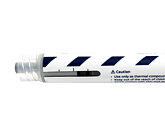
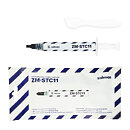
ZALMAN today introduced the ZM-STC11, a silicone-based thermal compound. It is composed mainly of dimethylpolysiloxane, zinc oxide, and aluminium oxide. The star-attraction here is its claimed thermal conductivity of 18 W/mK, making it suitable for high-end CPU and VGA cooler applications. Its viscosity is measured at 2.6 g/cm³, which it holds between its operational temperature range of -40 °C to 150 °C. Another impressive claim by its makers is a rated service life of up to 10 years. ZALMAN is selling the compound in 2 g syringes, the package includes a cleaning wipe and a spatula. The company didn't reveal pricing.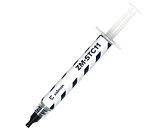



9 Comments on ZALMAN Intros ZM-STC11 Silicone-based Thermal Paste
Is it chobo-friendly? :P or your average PC hobbyist will kill the motherboard :D
Google AI Overview
The viscosity of a paste generally ranges between \(50,000\) and \(200,000+\) centipoise (cPs), placing it in the "high viscosity" category. Because pastes are almost always non-Newtonian fluids, their thickness changes significantly depending on the force or pressure applied, making a single number difficult to define. [1, 2, 3, 4, 5]
Because "paste" is a broad term, exact viscosity measurements rely on the specific material and its properties: [1]
- Tomato Paste: \(\sim190,000\text{ cPs}\)
- Solder Paste / Paste Ink: \(45,000 - 100,000\text{ cPs}\)
- Toothpaste: \(70,000\text{ cPs}\) or higher
- Petroleum Jelly: \(\sim64,000\text{ cPs}\) [1, 2, 3, 4, 5]
Key Rheological Properties of Paste- Thixotropy: Most pastes are thixotropic, meaning they appear gel-like and solid at rest but become much more fluid and easier to pump when agitated or sheared.
- Shear-Thinning: When a force is applied—such as squeezing toothpaste from a tube or pressing solder paste through a stencil—the viscosity drops. Once the force stops, the paste regains its thickness to hold its shape.
- Yield Point: Pastes require a minimum amount of initial force (yield stress) to start moving. This keeps the material stable in its container without flowing like a standard liquid. [1, 2, 3, 4, 5]
For further analysis, you can reference the Ellsworth Adhesives Viscosity Chart or review the Wikipedia Viscosity Entry to understand how non-Newtonian behavior is measured. For more specific engineering or mixing calculations, you can look at the Quilinox Viscosity Reference. [1, 2, 3]Probably a typo, because it looks more like the specific mass of that paste ;) . That would mean the contents of the syringe has 2 g divided by 2.6 g/cm3 = app. 0.78 cm3 paste, which sounds quite plausible.
Like it explains in the text above, giving the viscostiy a fixed number is 🐂💩 in my opinion.
Maybe the Zalman marketing sees it in a different light :D.
Let's just wait untill it gets (independently) thoroughly tested and how it compares to the competition in a real life scenario, that's more relaiable than manufacterers statements :roll:.
Also might want to read about aluminium electrolytic capacitors.
It's that old silver overhype goo that has some conductivity, because silver wants to stay pure and "free of marriage to oxygen".
I'd rather have it written from the manufacturer somewhere than guess it myself. My point was this is not mentioned in the PR from Zalman.
In this regard, I am excellently equipped.
Regards,
Fred.
And aluminium oxidizes instantly and only reason it doesn't crumble to dust at fast rate is aluminium oxide layer being stable...
At least unless you add gallium aka liquid metal paste into mix, which is "very agressive matchmaker between aluminium ond oxygen".