Thursday, May 28th 2026

Samsung Display Develops First 4K 360 Hz QD-OLED Panel for Monitors
Samsung Display has successfully developed the first QD-OLED monitors to combine 4K resolution with a 360 Hz refresh rate. The company will unveil the panel for the first time at COMPUTEX 2026 in June.
Samsung Display announced that it will showcase its 31.5-inch 4K 360 Hz QD-OLED for monitors to customers and media at COMPUTEX 2026, taking place in Taipei from June 2 to 5. While monitors supporting either 4K resolution or refresh rates of 360 Hz and above have been introduced previously, Samsung Display is the first to deliver both specifications simultaneously.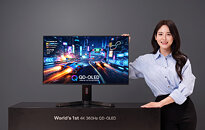
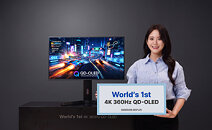 Until now, the industry has typically had to lower the refresh rate to 240 Hz or below to support 4K resolution or reduce resolution to QHD level to enable ultra-high refresh rates of 360 Hz or more. This compromise stems from the sharp increase in pixel data that must be processed per second when combining higher resolutions with higher refresh rates, which places a greater burden on pixel charging time and driving circuitry.
However, with the rise of games featuring photorealistic graphics and ultra-high-definition video content, consumer demand has continued to grow for monitors that can deliver both high resolution and fast screen transitions. In response, Samsung Display has focused on developing a top-tier QD-OLED for monitors that combines 4K resolution with a 360 Hz refresh rate. Through optimization of the panel circuitry and driving system, the company overcame these technical barriers and successfully developed one of the highest-spec QD-OLED for monitors to date.
Beyond ultra-high resolution and refresh rate, this new product boasts industry-leading specifications across other key features, including Dual Mode, high brightness, and text readability.
The Dual Mode feature allows users to flexibly adjust resolution and refresh rate according to their usage environment; when the resolution is switched to FHD, the refresh rate can be increased to an ultra-high refresh rate of 680 Hz. "With Dual Mode, the panel can operate up to 680 Hz, allowing users to enjoy smooth, sharp visuals even in FPS (First-Person Shooter) gaming environments where split-second response time is critical," a Samsung Display representative explained.
Furthermore, the new monitor panel is certified with VESA's DisplayHDR True Black 600, achieving higher brightness than existing premium self-emissive monitors. The VESA DisplayHDR True Black certification is an HDR certification standard that comprehensively evaluates black-level performance and HDR brightness. To achieve the True Black 600 grade, a display must express black levels at 0.0005 nits or lower while also reaching peak brightness of at least 600 nits for white as well as red, green, and blue combined, based on 10% APL. This exceeds True Black 500, which has been regarded as the highest grade in the existing premium monitor market.
The V-stripe pixel structure, a new technology introduced this year, is also incorporated into this new product. V-stripe arranges red, green and blue sub-pixels in vertical stripe patterns, enabling sharper rendering of text edges. This allows the panel to provide an optimal monitor solution for users who are particularly sensitive to text readability, including those working on documents, coding, graphics and content creation.
Samsung Display is currently in discussions with more than 10 global customers regarding the supply of its 31.5-inch 4K 360 Hz product, which combines top-tier specifications with the company's latest technologies. The company plans to begin full-scale mass production in the second half of this year.
"Many customers have described the new 31.5-inch 4K 360 Hz product as a near-perfect monitor that delivers everything consumers expect from a premium monitor, including ultra-high resolution, an ultra-high refresh rate, high brightness, and enhanced readability," said Brad Jung, Vice President and Head of the Large Display Marketing Team at Samsung Display. He further added "Building on the fundamental image quality advantages of QD-OLED and our continuous research and development efforts, Samsung Display will continue to introduce innovative products that exceed market expectations."
Source:
Samsung Display
Samsung Display announced that it will showcase its 31.5-inch 4K 360 Hz QD-OLED for monitors to customers and media at COMPUTEX 2026, taking place in Taipei from June 2 to 5. While monitors supporting either 4K resolution or refresh rates of 360 Hz and above have been introduced previously, Samsung Display is the first to deliver both specifications simultaneously.


However, with the rise of games featuring photorealistic graphics and ultra-high-definition video content, consumer demand has continued to grow for monitors that can deliver both high resolution and fast screen transitions. In response, Samsung Display has focused on developing a top-tier QD-OLED for monitors that combines 4K resolution with a 360 Hz refresh rate. Through optimization of the panel circuitry and driving system, the company overcame these technical barriers and successfully developed one of the highest-spec QD-OLED for monitors to date.
Beyond ultra-high resolution and refresh rate, this new product boasts industry-leading specifications across other key features, including Dual Mode, high brightness, and text readability.
The Dual Mode feature allows users to flexibly adjust resolution and refresh rate according to their usage environment; when the resolution is switched to FHD, the refresh rate can be increased to an ultra-high refresh rate of 680 Hz. "With Dual Mode, the panel can operate up to 680 Hz, allowing users to enjoy smooth, sharp visuals even in FPS (First-Person Shooter) gaming environments where split-second response time is critical," a Samsung Display representative explained.
Furthermore, the new monitor panel is certified with VESA's DisplayHDR True Black 600, achieving higher brightness than existing premium self-emissive monitors. The VESA DisplayHDR True Black certification is an HDR certification standard that comprehensively evaluates black-level performance and HDR brightness. To achieve the True Black 600 grade, a display must express black levels at 0.0005 nits or lower while also reaching peak brightness of at least 600 nits for white as well as red, green, and blue combined, based on 10% APL. This exceeds True Black 500, which has been regarded as the highest grade in the existing premium monitor market.
The V-stripe pixel structure, a new technology introduced this year, is also incorporated into this new product. V-stripe arranges red, green and blue sub-pixels in vertical stripe patterns, enabling sharper rendering of text edges. This allows the panel to provide an optimal monitor solution for users who are particularly sensitive to text readability, including those working on documents, coding, graphics and content creation.
Samsung Display is currently in discussions with more than 10 global customers regarding the supply of its 31.5-inch 4K 360 Hz product, which combines top-tier specifications with the company's latest technologies. The company plans to begin full-scale mass production in the second half of this year.
"Many customers have described the new 31.5-inch 4K 360 Hz product as a near-perfect monitor that delivers everything consumers expect from a premium monitor, including ultra-high resolution, an ultra-high refresh rate, high brightness, and enhanced readability," said Brad Jung, Vice President and Head of the Large Display Marketing Team at Samsung Display. He further added "Building on the fundamental image quality advantages of QD-OLED and our continuous research and development efforts, Samsung Display will continue to introduce innovative products that exceed market expectations."
13 Comments on Samsung Display Develops First 4K 360 Hz QD-OLED Panel for Monitors
Because no modern game will run 360 FPS at native 4K.
Have a read.
This graph also shows the biggest flaw of QD-OLED design - lack of polarizer layer.
cool screen tho, would buy if not blisteringly expensive
The Wikipedia article also talks about QD phosphors being applied to LCD. So I presume there is now two types of panels labelled with QD in the name.
Lets hope there is a menu option to disable DSC and keep the native 240hz.