Monday, June 8th 2026

Thermal Grizzly Shows New WireView Pro II Noctua Edition and New WireView II at Computex 2026
Thermal Grizzly definitely had a lot to show at the Computex 2026 show in Taipei, and it even brought a few new versions of the WireView, a device that measures power consumption of graphics cards, and while the currently available WireView Pro II is a beast that not only measures voltage, power, temperature, and current from the entire 12V-2x6 connector, but from each individual pin as well, the company thinks there is still room for additional improvement and new versions. At the show, the company teamed up with Noctua, bringing a new version of the WireView Pro II, as well as announcing the new, more compact version called the WireView II.
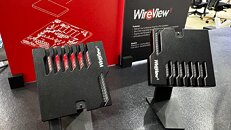
The WireView Pro II Noctua Edition will have all the features and functions of the original WireView Pro II but use a different CNC-machined aluminium case with a Noctua-optimized fan grill that should improve airflow-to-noise performance, as well as use Noctua's frameless NF-A4x10 PWM fan with semi-passive cooling mode. Thermal Grizzly also showcased the new WireView II, a more compact version with slim CNC/machined aluminium housing and built on the same platform as the WireView Pro II. It will retain all the functionality of the WireView Pro II platform but lack the display.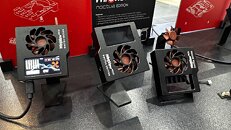
 The WireView Pro II Noctua Edition will be a bit more expensive compared to the original WireView Pro II and should come in September.
The WireView Pro II Noctua Edition will have all the features and functions of the original WireView Pro II but use a different CNC-machined aluminium case with a Noctua-optimized fan grill that should improve airflow-to-noise performance, as well as use Noctua's frameless NF-A4x10 PWM fan with semi-passive cooling mode. Thermal Grizzly also showcased the new WireView II, a more compact version with slim CNC/machined aluminium housing and built on the same platform as the WireView Pro II. It will retain all the functionality of the WireView Pro II platform but lack the display.


26 Comments on Thermal Grizzly Shows New WireView Pro II Noctua Edition and New WireView II at Computex 2026
Can't help but think this has all gotten a little bit out of hand though.
So it doubles as a 180-degree cable adaptor
Yes, things are getting out of hand indeed...
Keep in mind that DerBauer is one of the people making ridiculous videos about the melting problem, as with that sausage custom abused cable and his own abused cable, that he has been using for testing a large number of cards.
And all this on the false premise that the problem is caused by the current imbalance, while the current imbalance is just a secondary issue, and the primary reason for melting is a mechanical damage of the electric contact - which is either shifted back in the plug body or the contact tabs in the contact tube got deformed and lost proper grip on the pin.
Contacts shifted back in the plug body are mostly caused by the fact the plug has been remanufactured (for example for putting custom sleeving on wires).
Loose contact tubes can be caused by too many mating cycles (insertions), or mechanical stress exerted on the plug (e.g. by pulling on the cable). The metal material of the tubes may also be weak and too easy to deform.
Edit: Here is the sad hero, THE SAUSAGE CABLE, that has been tortured in two miniature PCs, and possibly even damaged from the beginning in manufacture, before it got fried...
Most people do stupid stuff like (below) with the connector formerly known as 12VHPWR: ASrock's 9070 XT shows a bend, twist, and torque on the cable to make it fit the visual aesthetics they want for the build. That places uneven pressure on the port, Just a single measly clip to hold it in place.
As the Gamers Nexus coverage showed, the metal contacts within each pin of the power connector can be poorly distributed in the plastic mould. That turns into a blame game of (1) Requirements of design are too loose, (2) subcontractor not held accountable or quality checked, (3) AIB picking the lowest bid for subcon to manufacturer connector, to increase profit as they charge the customer beyond MSRP anyways...
As I recall, that poor pin location IS NOT A PROBLEM unless there's a physical connection issue between port and connector. Which is the ignorant risk performed by users and manufacturers, all the time.
Anyways, Wireview acts as an 180 degree adapter (as shown here). There is no weight or leverage. I'm also not convinced the other features of the product are that useful, and I think Thermal Grizzly should just make a simple, non-LCD variant that's just a 180 adapter. Because that's the best feature of this product.
The Noctua version of everything is just extra expensive for the sake of some brown and beige dye.
to use a normal cable that came with your PSU and use it in a way it was intended to be used.
If everybody did this, I believe that at least 95% of the melting accidents would not have happened at all.
Is there really any reason for the special accessories and weird cables to exist?
BTW does not using a third party cable with your PSU void the PSU warranty? How do you think injecting a third party in the mix (beside the PSU and GPU manufacturers) helps anything?
Given the fact that these cards catch fire, yes, there is a reason for all the accessories and safety cables to exist. Corsair's just happens to be the simplest solution, an official-spec cable with a thermistor. ROG Equalizer being an enhanced, overbuilt cable capable of handling more than the specification asks for, but even then, it's not immune to the problem.
You've seemingly developed many theories about it, but you also seem to circle and circle around just to arrive at the same conclusion, I've done extensive research on this cable since my RTX 5090 caught fire, read this post, which should contain the information that explains why cables like the ThermalProtect and Equalizer exist and are quickly becoming a necessity - it will point you towards the right direction.Now I agree with you that on principle, all you'd need to do is use the cable that came with your power supply. But given the circumstances, doing so is not entirely prudent, especially if your power supply is one of the cheaper models with bronze or gold rating and/or 18 AWG cables. Those are fine if you mean to stop at the RTX 5070.
A few days ago I realised, I am myself in the market for the next hardware change for those 90° or 180° or 270° adapters to reduce bend radius and ease assembling or maintenance of my computer.
i doubt any power supply unit ships out of the box with 90° connectors on the graphic card side.
when i look above on those pictures, the wireview functions like a 180° adapter and reduces indirectly cable bend. which is most likely less mechanical stress most likely on the gpu connector from the power supply cable
OEM cables are advisable only because people were replacing them with cheapo third party aesthetic cables from wherever like that Asiahorse Hydrus cable that gets promoted so much on Youtube.
Your claim about the failures of these adapters is based exactly on what?What are you talking about? The PSU is shipped as a complete unit with cables, that the manufacturer made or at least checked and is responsible for.
Seasonic says:FSP says:The problem is not compatibility of this particular cable, the problem is quality assurance. You can make and sell literally anything, that can be made poorly with all sorts of defects.
In your case you used a third party cable, which the PSU manufacturers forbid, and your cable shows signs of the plug damage - as a result of manufacturing error or you mishandling the cable.
If you did what you are supposed to do, you wouldnt have any problem. You caused troubles for yourself and also for the GPU manufacturer.
It's what I did myself and went to read on the latest developments regarding the problem, Aris and Roman explained it very well on their articles and videos.
Of course Seasonic or FSP will recommend you use their cables with their own power supplies. It's completely meaningless and a non-factor, since it's a mere business formality. If you mean to say Corsair cables are shit, I'm sure Jon will love to take you up on asking for proof lol
Besides I'm not telling you that buying a cable from a random AliExpress supplier is the solution, I'm not even calling it a solution to begin with. It's a safety precaution, both my suggestions have large companies and real engineering chops behind them, designed and explained by actual industry experts.
AIB card designs are acquired by manufacturers as a kit from Nvidia. The official adapter is part of this kit and it is not immune to, nor does it have a lower failure rate than a cable.Mine just arrived! Glad to hear that your feedback on its quality is positive. It was scheduled for next week. That's very nice, looks like my grand rebuild happens today. I already have all other components needed.
Have a doc appointment first though hehe
Cables are a part of the power supply, that some cables are detacheable from the PSU is just a feature to enable consumers removing unused cables. It does not mean that the cables are just an accessory and you can plug anything you want in the PSU!
It is not a formality, PSU manufacturers are liable for the damages their products make and as the cables are a part of the PSU, they cannot be held accountable when you use something they did not supply, approve and are not providing quality assurance for.What are you talking about??? Nvidia supplies the GPU and RAM chips, not power adaptors!
PSU including the supplied cables is a kit to build a PC with, while following all the standard procedures regarding cables installation.
PSUs from different brands come with many different syle of native ATX 3.1 16-pin cables, but the octopus cables that come with Nvidia GPUs all seem to be the same exact Nvidia-badged brand.
The 12V-2x6 cable is standardized. If the power supply offers a native terminal, then the cable can be safely replaced by any other compatible model as it is universally applicable, as long as both ends of the cable are 2x6.That is correct. The octopus cable is provided by Nvidia, is Nvidia branded and the same cable is included on all AIB and FE models.
The same way, if you were selling hamburgers, you do not want your customer to put their own mayo in it and then get sick because of it and then blame it on you.
There is nothing "corporate" in this. It is just common sense.
BTW I just checked the adaptor that came with my Asus 5080 and its part number 14017-00791300 and it seems to be an Asus item. They probably buy these from a large chinese manufacturer and put their stickers on them. Nvidia may have been involved in approving some adaptor suppliers, but they in no way supply the adaptor themselves.
This adaptor with its 3 stiff cables ir really hard to bend and will stress the plug much more, than any native cable that came with the PSU could. There is also a danger than some other cable will snag on those three 8 pin sockets and pull on the adaptor. These adaptors are good only as a solution for old PSUs, when you have a fresh native cable, you really should use that one. Of course a new adaptor is better than worn and abused native cable.
I do not have a 5080 cable, but I do have two unused 5090 4x8 octopus adapters (since RMA sent me a sealed box with another accessory kit), here's a picture of one of them
For example just one insertion of the CPU in LGA socket can damage the contact pads on the CPU in such a way, that remounting the CPU in a different socket can ruin the pads. The pins dig into the pads pretty agressively.
The INTERFACE CONNECTORS as USB or audio connectors are a different story, they are rated possibly for hundreds of thousands cycles.
The GPU cable is an internal PC cable and there is NO REASON for it to be rated for more cycles than all other internal connectors.
Recently I read on our local forum a from a very active PC enthusiast, who commented, that after a few tens of insertions he had to swap his 16 pin native cable for a new one (he wrote 50). I see that as no problem, because the cable is not meant for GPU testing, but to build one PC with, as all other internal cables.
He probably noticed a current imbalance, which is a sign on the surface of the contacts getting a bit worn and uneven, but IMO that is still far from a catastrophic failure and connector melting, which requires a more substantial contact failure.
In any case the issue with 12V-2x6 is that it introduces 12 different failure points and that'd be a good thing if curremt was delivered independetly (like it was until RTX 3000) but now (4000, 5000) they all (except ROG Astral cards) deliver power to a common rail where a failure causes a redistribution of the current load between the working cables. With enough failures the current can overload the working cables, which is what causes the fires.