Tuesday, June 16th 2026

Lexar AI Storage Solution Helps Limited DRAM Run Larger Local AI Models
Lexar has been exploring various technologies to help consumers achieve faster data throughput and more reliable storage. The company now envisions a shift as the PC evolves from a traditional personal computer to a local AI-enhanced experience. We interviewed Lexar's Chief Technical Officer, Daniel Guo, about the technology Lexar is developing to help reduce some DRAM demand and shift the balance towards integrated hardware-software AI storage solution with NAND Flash. According to Guo, DRAM is about six times more expensive to manufacture than NAND Flash, and AI SSDs present opportunities to reduce DRAM requirements for running AI models on local hardware. This is where the Lexar AI Storage Solution comes into play, as the company is creating new storage solutions to support local AI deployments in constrained DRAM capacity by offloading some parts of large language models to SSDs. This approach allows larger and more powerful LLMs to fit into a PC build, reducing DRAM capacity requirements by up to 40% in specific scenarios.
Based on internal testing, Lexar managed to run the Qwen 3.5 122B AI model on a local PC. Traditionally, users would need to invest about $4,500 in a PC with a decent CPU and 128 GB of DRAM to run this model. Through hardware and software optimization, the Lexar AI suite with the Lexar AI SSD can reduce the DRAM requirement to 32 GB and run the model with 35 billion parameters at 15.6 tokens per second, compared to only 5.2 tokens per second using traditional frameworks. When attempting to load the 122B model on 32 GB of DRAM, the traditional Llama.cpp fails to load and crashes, while Lexar's SSD offloading provides about 4.4 tokens per second.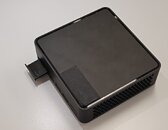

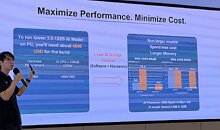 With a more robust configuration featuring 64 GB of DRAM, running the 122B model with a larger context window is possible only with SSD offloading. With about 4,000 tokens in context, both traditional configurations and the Lexar AI stack run at a slightly higher speed. However, for larger contexts, often needed at 256K tokens, only the Lexar AI suite can launch and manage to produce about 19.3 tokens per second. This setup isn't perfect, and not every model size can be offloaded to the SSD. With larger LLMs, system latency increases significantly, as the time between submitting a prompt and receiving a response grows exponentially.
The time to first token, often called TTFM, is about two seconds before the first token appears after the prompt is submitted with a 2K context window. When the context is larger at 4K, the delay increases to between 6 and 8 seconds. Technically, users could offload models about 400 billion parameters large, but the tokens per second and TTFM would be very slow. For some, this might be suitable, but for others, buying more DRAM is the better solution. Either way, this is an intriguing concept from Lexar.
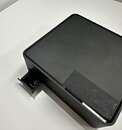
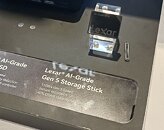
At Computex 2026, the company developed a concept for Mini-PCs and desktops featuring an M.2 slot designed for multiple insertions. An M.2 SSD is encased in a metal jacket and inserted into a 25 mm-wide slot on the front panel of a mini PC, connecting directly to the M.2 slot wired to the processor or chipset. This design eliminates other overheads. The hot-swappable SSD, which offloads AI models onto NAND Flash, reduces dependency on DRAM and aids in running larger models. It is available in both PCIe Gen 5 and Gen 4 versions, with the Gen 5 version offering more bandwidth. This M.2 SSD uses Lexar's custom Storage Processing Unit (SPU) DRAM-less controller for complete control over data movement.
Based on internal testing, Lexar managed to run the Qwen 3.5 122B AI model on a local PC. Traditionally, users would need to invest about $4,500 in a PC with a decent CPU and 128 GB of DRAM to run this model. Through hardware and software optimization, the Lexar AI suite with the Lexar AI SSD can reduce the DRAM requirement to 32 GB and run the model with 35 billion parameters at 15.6 tokens per second, compared to only 5.2 tokens per second using traditional frameworks. When attempting to load the 122B model on 32 GB of DRAM, the traditional Llama.cpp fails to load and crashes, while Lexar's SSD offloading provides about 4.4 tokens per second.


The time to first token, often called TTFM, is about two seconds before the first token appears after the prompt is submitted with a 2K context window. When the context is larger at 4K, the delay increases to between 6 and 8 seconds. Technically, users could offload models about 400 billion parameters large, but the tokens per second and TTFM would be very slow. For some, this might be suitable, but for others, buying more DRAM is the better solution. Either way, this is an intriguing concept from Lexar.
At Computex 2026, the company developed a concept for Mini-PCs and desktops featuring an M.2 slot designed for multiple insertions. An M.2 SSD is encased in a metal jacket and inserted into a 25 mm-wide slot on the front panel of a mini PC, connecting directly to the M.2 slot wired to the processor or chipset. This design eliminates other overheads. The hot-swappable SSD, which offloads AI models onto NAND Flash, reduces dependency on DRAM and aids in running larger models. It is available in both PCIe Gen 5 and Gen 4 versions, with the Gen 5 version offering more bandwidth. This M.2 SSD uses Lexar's custom Storage Processing Unit (SPU) DRAM-less controller for complete control over data movement.


13 Comments on Lexar AI Storage Solution Helps Limited DRAM Run Larger Local AI Models
Of course, lots of integration required for this to work properly and avoid OOM errors.
this is only good for short term, long term, NAND is going to wear out as the models get updated over and over, and need replacement, again, and again, not to mention the fact that they can't produce enough NAND now to meet all the demand, so prices are going to skyrocket even more if lots of companies pick this approach, then the cost savings over DRAM will be even lower
I can not classify Lexar statement when they fail to use proper units.
Using SWAP, windows has ~3-4 different Swap files is not something new.
For it to crash seems like they're forcefully disabling mmap and using some non-default settings to hamper its speed. It'd be interesting to know how that test of theirs was performed, which quants were used and whatnot.Nothing needed, llama.cpp does this by default with mmap on Linux.No, the idea behind MEXT is to be smart on how to schedule page out/in, it's just a software solution.But models are not really updated. You just read the weights out of the disk and that's it, no writes take place.
Also, Lexar isn't the only company pushing this sort of tech using external storage. Why external storage?