Monday, June 22nd 2026

LG Display OLED Becomes World's First to Achieve "Perfect Color/Brightness" Certification
LG Display, the world's leading innovator of display technologies, announced today that its entire lineup of large-sized OLED panels, including for monitors and TVs, has become the first in the world to receive "Perfect Color/Brightness Accuracy up to 500 lux" certification from global testing and certification organization Intertek. This certification confirms that a display can accurately reproduce both color and brightness regardless of viewing conditions or content.
The certification is particularly meaningful as it quantitatively validates how accurately a display reproduces color and brightness. Previously, display quality had largely been assessed based on specifications such as color gamut or peak luminance, which have limitations in objectively verifying how closely a display reproduces real-world colors.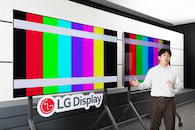 To address this, Intertek conducted comprehensive testing on OLED and LCD displays using a range of test patterns to measure variations in color and brightness, thereby objectively evaluating overall picture quality accuracy.
The test results revealed that LG Display's OLED panels—featuring self-emissive pixels—simultaneously recorded 100% color accuracy, 100% brightness accuracy, and color crosstalk-free performance. Therefore, they deliver the creator's intended color and brightness accurately, whatever the viewing environment or type of content. 100% color accuracy means consistent color reproduction regardless of test pattern size; 100% brightness accuracy refers to uniform brightness regardless of test pattern size; color crosstalk-free performance means no color interference between adjacent pixels, enabling precise color expression.
In contrast, LCD displays—which rely on backlight units larger than individual pixels—showed limitations when displaying high dynamic range (HDR) content such as starry night skies or fireworks, where brightness in highlighted areas can be diminished. In some premium LCD TVs using RGB LED backlights, color distortion was observed depending on the background colors.
These differences in picture quality accuracy stem from fundamental differences in light emission methods.
LCD-based displays control light by zones through a backlight, leading to light leakage into adjacent areas. This structural limitation means that even premium LCD panels exhibit color crosstalk and reduced accuracy in brightness and color reproduction.
LG Display's OLED panels operate using pixel dimming technology, with millions of individual pixels emitting light independently. This self-emissive structure fundamentally eliminates light leakage and interference, enabling precise reproduction of both bright and dark elements, regardless of content size or scene conditions, and delivering a superior viewing experience.
Through this certification, LG Display aims to take the lead in global picture quality competition by quantifying the value of real-world viewing experiences perceived by consumers.
"LG Display's OLED has now been objectively proven to deliver the most accurate color and brightness even in everyday viewing environments," said Hyeon-woo Lee, Head of the Large Display Business Unit at LG Display. "We will continue to strengthen our market leadership by more clearly communicating the differentiated value of premium picture quality that only OLED can deliver to customers worldwide."
Source:
LG Display
The certification is particularly meaningful as it quantitatively validates how accurately a display reproduces color and brightness. Previously, display quality had largely been assessed based on specifications such as color gamut or peak luminance, which have limitations in objectively verifying how closely a display reproduces real-world colors.

The test results revealed that LG Display's OLED panels—featuring self-emissive pixels—simultaneously recorded 100% color accuracy, 100% brightness accuracy, and color crosstalk-free performance. Therefore, they deliver the creator's intended color and brightness accurately, whatever the viewing environment or type of content. 100% color accuracy means consistent color reproduction regardless of test pattern size; 100% brightness accuracy refers to uniform brightness regardless of test pattern size; color crosstalk-free performance means no color interference between adjacent pixels, enabling precise color expression.
In contrast, LCD displays—which rely on backlight units larger than individual pixels—showed limitations when displaying high dynamic range (HDR) content such as starry night skies or fireworks, where brightness in highlighted areas can be diminished. In some premium LCD TVs using RGB LED backlights, color distortion was observed depending on the background colors.
These differences in picture quality accuracy stem from fundamental differences in light emission methods.
LCD-based displays control light by zones through a backlight, leading to light leakage into adjacent areas. This structural limitation means that even premium LCD panels exhibit color crosstalk and reduced accuracy in brightness and color reproduction.
LG Display's OLED panels operate using pixel dimming technology, with millions of individual pixels emitting light independently. This self-emissive structure fundamentally eliminates light leakage and interference, enabling precise reproduction of both bright and dark elements, regardless of content size or scene conditions, and delivering a superior viewing experience.
Through this certification, LG Display aims to take the lead in global picture quality competition by quantifying the value of real-world viewing experiences perceived by consumers.
"LG Display's OLED has now been objectively proven to deliver the most accurate color and brightness even in everyday viewing environments," said Hyeon-woo Lee, Head of the Large Display Business Unit at LG Display. "We will continue to strengthen our market leadership by more clearly communicating the differentiated value of premium picture quality that only OLED can deliver to customers worldwide."
23 Comments on LG Display OLED Becomes World's First to Achieve "Perfect Color/Brightness" Certification
www.lgdisplay.com/eng/company/media-center/latest-news?contentId=5549
Would be nice if they had included the exact models.
A neighbour where I grew up had what I believe was one of these
www.msx.org/wiki/Goldstar_FC-200
We are talking about perfectly calibrated screen vs perfectly calibrated screen. OLED wins.
Probably that's the reason why nowadays ALL Japanese TV companies are bankrupted or bought by Koreans and Chinese competitors. ALL of them.
*I have an LG CX (yes, that old) and I keep it around 50% brightness. Otherwise it just sears my eyes. Unless you're watching it in bright sunlight, OLED has been plenty bright for years.
I mean sure my Hisense uLED can do nearly 2000 nits but I really don't care beyond say, 800. That shits insane.My B9 is still being used as a family TV and ironically, with new varied content, its slight start menu smidge burnin has gone away. Incredible really, its from 2019 and I was outright cruel to it!
Again im not talking about 140 to 500 zones mini leds, which are probably the ones you people have tried. Look at a mackbook with 2000 zones and it gets the black levels of oleds.
but in all seriousness, idk what oled panel that is, you never mentioned anything about it. what the backlight settings are or anything.
I do have an LG G4 and G2. The G4 is sooo much brighter than the G2 so I do know a bit about what you mean when you say they are dim, but they have gotten so much better.
www.rtings.com/monitor/reviews/lg/32gs95ue-b
Brightness is maxed out on both since it's on HDR. The camera doesn't even properly capture how big the difference is due to exposure, I put exposure to the minimum and still the mini led gets over exposured. It's THAT bright.
Not saying that I'm not happy with it, but it's very obvious (especially in games) that oleds really lack brightness. Especially games with night and day circles, they just can't get bright enough to properly make a significant enough difference between night and day. They are good enough for 1 and 5% highlights but they completely fall apart well full screen brightness is required.
EG1. The G4 is bright but they can't scale the technology down for monitors. Which is a problem that mini led doesn't have, apparent from the fact that they put 2000 zones on a 14" laptop monitor. The main problem with mini leds is the power consumption
But no burn-in, so there's that