Friday, September 4th 2026

Modders Get DLSS 5 Working on AMD Graphics Cards, Though Performance is Rough
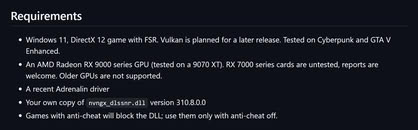
A modder has ported DLSS 5 Neural Rendering onto an AMD GPU for the first time, less than a week after the tech started spreading to older NVIDIA cards. Developer danielblnc released a tool called DLSS-NR for AMD, which allows AMD's RDNA 4 GPUs to run NVIDIA's neural rendering model in supported games. The setup works by dropping a small installer and NVIDIA's own nvngx_dlssnr.dll file into a game's bin folder, then toggling neural rendering through an FSR 3 or FSR 4 profile. It has been tested on Cyberpunk 2077 and GTA V: Enhanced so far, with older AMD GPUs reportedly not supported. Anti-cheat games will block the DLL entirely, so this is single-player territory only for now.
According to tests by YouTuber Ancient Gameplays, performance is still the bottleneck. Early builds tanked Cyberpunk 2077 from over 80 FPS down to around 11-12 FPS at 1080p on the Radeon RX 9070 XT. The modder's latest Alpha v0.2.7 update has clawed back roughly 12%, pushing it to about 30 FPS, still a steep cost for a card that handles native rendering well. The reason this works at all is quite straightforward. DLSS 5 runs on FP8 math, and AMD's RDNA 4 architecture, which powers the RX 9000 series, has native FP8 support, just like NVIDIA's RTX 50-series and 40-series cards.
 As we noted in our DLSS 5 preview, NVIDIA has been firm that the feature is Blackwell-only for now, even as modders got it running on RTX 40-series and 30-series cards within days of the leak. NVIDIA has since confirmed that support for the RTX 40-series is in the works, which is understandable, since those cards also support FP8. The AMD support is early and unofficial, so don't expect this to be a practical way to play anytime soon. However, it's another sign that NVIDIA's neural rendering tech is spreading faster and wider than the company planned for.
Sources:
Ancient Gameplays on YouTube, DLSS-NR on AMD (GitHub)
According to tests by YouTuber Ancient Gameplays, performance is still the bottleneck. Early builds tanked Cyberpunk 2077 from over 80 FPS down to around 11-12 FPS at 1080p on the Radeon RX 9070 XT. The modder's latest Alpha v0.2.7 update has clawed back roughly 12%, pushing it to about 30 FPS, still a steep cost for a card that handles native rendering well. The reason this works at all is quite straightforward. DLSS 5 runs on FP8 math, and AMD's RDNA 4 architecture, which powers the RX 9000 series, has native FP8 support, just like NVIDIA's RTX 50-series and 40-series cards.


60 Comments on Modders Get DLSS 5 Working on AMD Graphics Cards, Though Performance is Rough
But you don't need to trust me, just take a look on how xess performed with dp4a vs xmx, and that was a way simpler model than the ones we have nowadays. Doesn't mean it couldn't be done, just that it'd not be actually practical.No model fits on the on-chip memory. The scratch memory for the units are way too small, the weight blacks are always fetched from memory.
And that's talking about the weights alone, don't forget about the actual kernels to do your forward passes, your inputs and outputs, as well as the actual game data in this spec.
But it's not something I can rip out of the GPU and swap for the 30% extra performance that the additional shaders, which should have been there, would have given me.
I suggest doing more in depth research about how the trained model uses the math, and how the largely varying computing power affects real world results. Float VS Integer math is completely different and only an understanding of that, plus an understanding of the hardware limitations of each architecture and its supporting memory and cache subsystem will provide the real answer. In the past year I have spent hundreds of hours reading, testing and researching it and even with access to MS and other AI hardware and models I still don’t have a complete picture, it’s about 70% filled in.
Long story short, we can’t just swap between Int and Float with a model trained for XYZ hardware and expect reasonable performance. The one nugget of gold in this shit show is AI is at least cresting the hill of being able to take a model of itself and rewrite it for another architecture with 50% of absolute possible performance, and rerunning for performance is an option, it just takes time. A LOT of time.
Nvidia might as well call its next gen NTX 6000. And we're all cued up for another "revolutionary" technology push no one asked for and which only runs remotely decently on the most expensive hardware. Just like the original RTX was conceived. The leather-jacket man has a way of creating FOMO like no other tech CEO could manage. Pay up or be left out.
Not to be confused with a LLM, ofc, but it's still a transformer architecture with attention and whatnot.Yes, I agree. At FP8 that means the model is at least 154MB in size.
The 5090 has a total of 96MB shared LLC. It's easy to figure out that the model alone won't fit in there.I don't get what you're talking about. I'm mentioning that a regular modern model architecture can run on regular scalar units as opposed to matrix units, but they will run slow, period. What's exactly wrong about that?I don't think I've said so at all, but quite the opposite instead.
The user I'm replying to said it could be made to run. I agree to that, it could, but you'd sacrifice performance and/or quality to do so.I'm not exactly sure what kind of "in depth research" you're talking about, but I'd be glad if you could point your references, as well as to discuss both papers in the field that I use as references for my research, as well as my practical experience training and deploying quantized and distilled models.
Sorry in advance if I misunderstood something, but maybe you meant to reply to the person I quoted instead?
I say this as a Radeon owner but I wonder if the people working on FSR at AMD are looking at this going "Ok but how can we copy this but implement it 10 times worse".
--
I read this on my tablet first and someone is on my ignore list.
FSR4 i tested it with caravansandwitch recently, i see distortions in my calibrated screen. I tested it for over 45 minutes to determine power consumption etc at the initial game area.
FSR4 most games do not support it. Some game only support FSR1.
I tune my windows 11 pro radeon graphic cards driver for the target fps rate, 45fps at a 75 fps screen for power consumption. i turn off raytracing etc when it did not show any difference in avatar pandora, star wars jedi survivor, the last of us part I.
i am not sure i may have tested caravan sandwitch with fsr4 performance mode or disabled it. not sure, but the difference to native was only 10 watts waht i remember from a few days ago for the acer predator bifrost radeon 9070 OC. FSR4 is junk because it wastes too much time in the option menu and i saw distortions, random wrongly rendered areas which annoys me a lot.
--
DLSS etc is not a topic for me as a radeon gamer. I did test a nvidia card in 2023 again and saw issues with a supported graphic card, that windows 11 pro had to reini9tialise the screen two times during bootup. binary drivers, the old dated drivers etc. made it an informaiton based decission not to buy a nvidia graphic card. that was a fair evaluation for over 3 months to see the driver quality. I doubt many forum users here bought the other product and tested it for a while. 3 months in gaming etc, not being able to render subnautica on a nvidia 960 with 4gib vram, no thanks.
CUDA -> 21 year do i use only gnu gentoo linux, i am in the game since 1996, no use, useless feature. hardly any softawre uses it, afaik one package, low value package in 21 years. 11 packages are using AVX512 which is rather new, but CUDA was just one pacakge of over 120o to 1400 installed packages.
DLSS -> hardly any game uses it - some newer games but older games nope - i also not fond of the screenshots. I tested hogwards legacy with raytracing on the amd graphic card, i am not impressed. it is not worth it for myself.
When you like nvidia marketing and when you like those features go for it. I assume some radeon users do not see the use for CUDA, DLSS and physx. AFAIK mabe 3 times since 1996 i saw physx in a game.
--
It is a different code path. Code. It is the compiler task on how to generate code. And it is the users tasks to get hardware with proper features. Amd64 with avx512 over ARM v9x over AMD64 from intel without AVX512 with mixed cores - ryzen 5000 or below.
i highly doubt they wrote the code in assembler. Especially for a graphic card in 2026. Some higher language will quite often generate the target code. The same principles since 1985 - i doubt that has changed.
We are talking about one missing cpu feature, for some reason the linux kernel names it flags for my ryzen 7700x. feel free to replace cpu with gpu, but at the end of the day ti is the same. you have cpu / gpu featues and code which was build for it. AVX512 is more than a single insturtion.
special instructions may run code faster, same principle as Water is wet.Exactly
that has not changed for several years, as can be seen on ucontrollers and special libraries which convert floating maths to integer maths on 8 bit cpus.
edit: i do not expect having knowledge about cpu cores, compiler, cpu instructions as common knoweldge, cpu architectures ... -> float vs integer // 8bit vs 16 bit etc are classics of such topics
While the die size is very slightly in favor of the 9070 XT, the 9070 XT packs more transistors than a 5070 Ti.
I compared a nvidia 5090 number with a radeon 9070xt performance number. Yes your comparison makes much more sense.
I barely enable FSR as an AA method by running it in Native mode because I don't want no AI generated pixels on my screenI tolerate upscaling for low end GPUs when people want more FPS or better quality and they can't afford a 70Ti-tierGPU or better
I tolerate RT when there is substantial improvement over baked lighting that I can observe
(PT can go fuck itself, I don't have any need for an FPS killer that makes everything look all mirrory with shiny surface literally everywhere)
- do not push all of sliders to the right most settings
- be happy with lower resolution than 4k
- be happy with stable 60 fps
- choose another game which is not as demanding
PS: I have 4k 144Hz screen and set my games to be (slightly) over 60 fps.
It was a standard since 2009, 5 years before Nvidia found a way to sell a free feature.
The technical aspect of it was decent, but not a hugely better thing than just using v sync which we all learned to use on CRT monitors before flat screens were good.
The problem was cost and the limited compatibility, the fact that they really only work with Nvidia GPUs through DisplayPort. Earlier GPUs like the 10 series don't support VRR through HDMI. If you want to use an older hardware G-Sync monitor with any other input, like a console or AMD GPU, it'll only work in FRR mode, and it turns out people who purchase expensive displays usually want to use it with more than one device.
G-Sync has continued to evolve at the high-end, like the Ultimate HDR monitors (similar to FreeSync Premium Pro) or the Pulsar ultra-high-refresh monitors with low latency and blur, there's also a whole host of exclusive display technologies like Reflex Analyzer which basically gives you realtime GPU-to-panel frame latency data, or even mouse-to-screen latency figures, it's nuts (and equally expensive)Transistor density on the process used in N48 is substantially higher, it is a much newer node. Blackwell reuses Ada's custom 5 nm Nvidia 4N node. Transistor count doesn't necessarily translate into performance anyway.