Friday, September 4th 2026

Modders Get DLSS 5 Working on AMD Graphics Cards, Though Performance is Rough

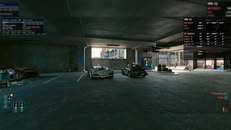
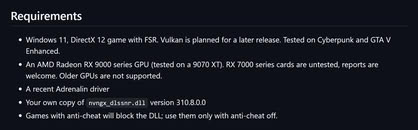
A modder has ported DLSS 5 Neural Rendering onto an AMD GPU for the first time, less than a week after the tech started spreading to older NVIDIA cards. Developer danielblnc released a tool called DLSS-NR for AMD, which allows AMD's RDNA 4 GPUs to run NVIDIA's neural rendering model in supported games. The setup works by dropping a small installer and NVIDIA's own nvngx_dlssnr.dll file into a game's bin folder, then toggling neural rendering through an FSR 3 or FSR 4 profile. It has been tested on Cyberpunk 2077 and GTA V: Enhanced so far, with older AMD GPUs reportedly not supported. Anti-cheat games will block the DLL entirely, so this is single-player territory only for now.

According to tests by YouTuber Ancient Gameplays, performance is still the bottleneck. Early builds tanked Cyberpunk 2077 from over 80 FPS down to around 11-12 FPS at 1080p on the Radeon RX 9070 XT. The modder's latest Alpha v0.2.7 update has clawed back roughly 12%, pushing it to about 30 FPS, still a steep cost for a card that handles native rendering well. The reason this works at all is quite straightforward. DLSS 5 runs on FP8 math, and AMD's RDNA 4 architecture, which powers the RX 9000 series, has native FP8 support, just like NVIDIA's RTX 50-series and 40-series cards.
As we noted in our DLSS 5 preview, NVIDIA has been firm that the feature is Blackwell-only for now, even as modders got it running on RTX 40-series and 30-series cards within days of the leak. NVIDIA has since confirmed that support for the RTX 40-series is in the works, which is understandable, since those cards also support FP8. The AMD support is early and unofficial, so don't expect this to be a practical way to play anytime soon. However, it's another sign that NVIDIA's neural rendering tech is spreading faster and wider than the company planned for.

Sources: Ancient Gameplays on YouTube, DLSS-NR on AMD (GitHub)
Add your own comment

60 Comments on Modders Get DLSS 5 Working on AMD Graphics Cards, Though Performance is Rough

#1
Tyler-98-W68
But DLSS5 is crap right? Now that Radeon can "run it" its better and its ok and is superior on AMD cards because AMD right guys?
Posted on Reply
#2
Vya Domus
Tyler-98-W68But DLSS5 is crap right? Now that Radeon can "run it" its better and its ok and is superior on AMD cards because AMD right guys?
What does this even mean.
Posted on Reply
#3
Dr. Dro
My sides, this YouTuber put a reference to TPU's April 1st prank on his thumbnail :roll:
Vya DomusWhat does this even mean.
"Any and all new graphics techniques, features or extensions are horrible and unnecessary until a Radeon can somehow do them"
Posted on Reply
#4
Bigshrimp
Who doesn't want more slop? Radeon owners, do you want it? Lisa Su and Jensen Huang are cousins, so it tracks, lol. :P
Posted on Reply
#5
JustBenching
Dr. DroMy sides, this YouTuber put a reference to TPU's April 1st prank on his thumbnail :roll:


"Any and all new graphics techniques, features or extensions are horrible and unnecessary until a Radeon can somehow do them"
The same people crying AI slop all over the forum are the ones that are complaining that nvidia won't backport it to RTX 20 series or something. People are nuts. I have no idea - is it the water?
Posted on Reply
#6
Vya Domus
Dr. Dro"Any and all new graphics techniques, features or extensions are horrible until a Radeon can somehow do them"
This doesn't make any sense, Nvidia fanboys assume these things would never work on AMD hardware in the first place because they're crap anyway, am I right.

And I can assure you a lot of people still hate upscaling and ray tracing, even though AMD does that too.
Posted on Reply
#7
JustBenching
Vya DomusThis doesn't make any sense, Nvidia fanboys assume these things would never work on AMD hardware in the first place because they're crap anyway, am I right.

And I can assure you a lot of people still hate upscaling and ray tracing, even though AMD does that too.
I would bet a fat paycheck most people with access to FSR 4 use it
Posted on Reply
#8
Vya Domus
JustBenchingI would bet a fat paycheck most people with access to FSR 4 use it
Dude, everyone is using whatever upscaling is available because they don't have a choice, performance is simply not good enough. I use it, I loathe it, I wish I didn't have to. I wish games didn't look like smeared out noisy garbage either but I don't have much of a choice with that as well, ray tracing is becoming mandatory. I loathe that too.
Posted on Reply
#9
Dr. Dro
Vya DomusThis doesn't make any sense, Nvidia fanboys assume these things would never work on AMD hardware in the first place because they're crap anyway, am I right.

And I can assure you a lot of people still hate upscaling and ray tracing, even though AMD does that too.
I mean, the obvious roadblock is somehow getting past the NGX framework - RDNA 4 is fully capable of executing FP8 (3 only does INT, but can be converted), and as such there is little stopping them from running the model, provided you are able to somehow load it. Only minor modifications would be needed - this is the same reason it runs on Ampere and Turing. I found about this mod early this morning when I shared it on the other thread. Seems the author still hasn't gotten it to be able to change the render presets (currently DLSSNR offers A, B, C type) or the strength sliders, mostly proof of concept at this stage and it's already massive IMHO.

RDNA 1 and 2 will never be able to though, because they don't support any matrix multiplication formats. GTX 10 series have the same limitation (Titan V included, its tensor cores can only do FP16 and are unable to fetch vector data from the core, reason why DLSS never worked on it to begin with).

For the record, while it's still hit and miss (I have not been able to get it to work in a game I really want to), the RenoDX mod essentially enables the full Streamline stack even on games with zero native DLSS support through a DLSS feeder companion app, so from here on out essentially means DLSS with all features are technically able to be supported on pretty much any game that ReShade can load into. (Mod apparently does not work on Vulkan for the time being, and resolution scaling is not supported)
Posted on Reply
#10
Vya Domus
Dr. DroRDNA 1 and 2 will never be able to though, because they don't support any matrix multiplication formats. GTX 10 series have the same limitation (Titan V included, its tensor cores can only do FP16 and are unable to fetch vector data from the core, reason why DLSS never worked on it to begin with).
You are confusing a feature with it's implementation. DLSS doesn't work on 10 series because Nvidia didn't want to write shaders that ran on those, that doesn't mean ML upscaling wasn't doable and we know it was because Intel did it.
Posted on Reply
#11
Hecate91
It working at all is impressive given otherwise it would be a proprietary feature. I couldn't care less about the AI slop filter, however modders are doing amazing work.
This "the feature is crap unless it works on AMD" mentality makes no sense and is childish. The fact is these features would be a lot better if they were hardware agnostic.
Oh and of course I love how upset Nvidia fans get when this feature isn't exclusive to their Geforce cards,lol.
Posted on Reply
#12
Dr. Dro
Vya DomusYou are confusing a feature with it's implementation. DLSS doesn't work on 10 series because Nvidia didn't want to write shaders that ran on those, that doesn't mean ML wasn't doable and we know it was because Intel did it.
Not possible to begin with, it cannot process the relevant data formats. This is not a shader, it does not use shaders or the traditional graphics pipeline - it is a "3D-Guided Neural Image Rendering" system, pure generative AI that executes in real-time.
Posted on Reply
#13
Vya Domus
Dr. DroNot possible to begin with, it cannot process the relevant data formats.
Models can be converted, FSR4 used FP8 now it uses INT8 on RDNA3 and by everyone's reckoning quality is indistinguishable.
Dr. DroThis is not a shader, it does not use shaders or the traditional graphics pipeline
Shader, kernel, it's all the same.
Posted on Reply
#14
ZoneDymo
Tyler-98-W68But DLSS5 is crap right? Now that Radeon can "run it" its better and its ok and is superior on AMD cards because AMD right guys?
Are you saying Nvidia users have no brain or opinion of their own and just love whatever Nvidia pumps out regardless?
Because you are kinda implying that.


Anywho, from what I have seen DLSS5 is as often ass looking as good, so I would not use it.
Posted on Reply
#15
Steevo
Tyler-98-W68But DLSS5 is crap right? Now that Radeon can "run it" its better and its ok and is superior on AMD cards because AMD right guys?
Yes its still garbage, but keep on with your delusion of grandeur though, you are going to be big and the leather jacket man will hoist you on his shoulders and your dad will finally love you and all your wildest dreams will come true.

I wonder how many years this modder will spend in prison for this?
Posted on Reply
#16
Hecate91
Vya DomusThis doesn't make any sense, Nvidia fanboys assume these things would never work on AMD hardware in the first place because they're crap anyway, am I right.

And I can assure you a lot of people still hate upscaling and ray tracing, even though AMD does that too.
Nvidia fanboys assume any similar feature AMD has is crap, except the torches and pitchforks only come out when AMD doesn't have those features.
I hate that GPU's have stagnated so much we're being sold on upscaling as a solution to the performance hit of using ray tracing, I'd rather play at a native resolution with RT off since games plateaued in quality and graphics well before any company decided we needed RT in games.
Posted on Reply
#17
Damwaso
Dr. DroMy sides, this YouTuber put a reference to TPU's April 1st prank on his thumbnail :roll:
Yep that's exactly what i thought seeing the thumbnail, just a way to cram the most hyped terms in the same little image without bothering :kookoo:
Posted on Reply
#18
Dr. Dro
Vya DomusModels can be converted, FSR4 used FP8 now it uses INT8 on RDNA3 and by everyone's reckoning quality is indistinguishable.

Shader, kernel, it's all the same.
No, it's not the same - and models can be converted, as long as you don't know or care about what "FPS" means, which, for gaming, you do. TPU's GPU DB has recently been updated with all the important numeric data formats that GPUs support, it's a very important update to understand this limitation across architectures.

Blackwell


Ada / Ampere


RDNA 4


RDNA 3


RDNA 2
Posted on Reply
#19
Steevo
Vya DomusModels can be converted, FSR4 used FP8 now it uses INT8 on RDNA3 and by everyone's reckoning quality is indistinguishable.

Shader, kernel, it's all the same.
This is different.

There is matrix math that IS the essential hardware "tensor" that is required. We can debate the nuance of doing it in software through emulation and with tricks to use the existing hardware in ways unexpected. The fact remains though, Matrix math and sparse matrix math is "AI" algorithm hardware. Nvidia bet bigly on sparse matrix math two generations before AMD. Their biggest issue is it still takes a metric F ton of energy and bandwidth, there is no way to NOT have it in the direct pipeline and the only serious way to speed it up from the 5090 is through a better process node in die manufacturing to fit more of everything especially cache on the dies and to go with HBM.

Thats it guys, Nvidia beat AMD at something only a small percent of people have the hardware to play with and that costs over 5K to make it play, we might as well all just throw our computers in the trash and line up for the green serial number to be applied to our ass.

Also I still don't use frame gen, up-scaling in video games. I guess I will keep my rig until they find me.
Posted on Reply
#20
Aretak
Vya DomusWhat does this even mean.
Nvidia fanboys have this weird complex where they like to pretend to be the voice of the put-upon underdog, battling valiantly against legions of evil AMD GPU owners who just criticize Nvidia and their beloved, brilliant and sexy leather-jacketed CEO for no reason. I guess nobody wants to face the reality that they're the Stormtrooper.
Posted on Reply
#21
Vya Domus
Dr. DroNo, it's not the same - and models can be converted, as long as you don't know or care about what "FPS" means, which, for gaming, you do. TPU's GPU DB has recently been updated with all the important numeric data formats that GPUs support, it's a very important update to understand this limitation across architectures.
I genuinely don't know what you are trying to say. All GPUs have had different capabilities since the dawn of time, it's why everything that runs on a GPU is essentially determined at runtime, that's how you deal with this issue and yet most features work just fine on most GPUs even though architecturally they might differ a lot. Well, it used to be that way for quite a while until Nvidia was like "Nah".

AMD's driver simply swaps the FP8 version with the INT8 implementation at runtime, why couldn't Nvidia do the same thing on the 10 series GPUs when DLSS was released ? They couldn't do it or didn't want to ? You are sure that they couldn't but then Intel did release ML upscaling which worked on basically everything. So what am I to believe here, that they were such idiots they couldn't figure out a way to convert the models to run on Pascal ?
Posted on Reply
#22
SiliconSeraph
Though I think this is an... ironic thing to cry victory over given criticism over DLSS 5 by AMD and Nvidia fans in general, it's always cool to see modding wins/milestones like this. Especially when the it's proven to work in games, even at a performance deficit. Neat!
Posted on Reply
#23
Dr. Dro
Vya DomusI genuinely don't know what you are trying to say. All GPUs have had different capabilities since the dawn of time, it's why everything that runs on a GPU is essentially determined at runtime, that's how you deal with this issue and yet most features work just fine on most GPUs even though architecturally they might differ a lot. Well, it used to be that way for quite a while until Nvidia was like "Nah".

AMD's driver simply swaps the FP8 version with the INT8 implementation at runtime, why couldn't Nvidia do the same thing on the 10 series GPUs when DLSS was released ? They couldn't do it or didn't want to ? You are sure that they couldn't but then Intel did release ML upscaling which worked on basically everything. So what am I to believe here, that they were such idiots they couldn't figure out a way to convert the models to run on Pascal ?
It's simple, FSR 4 INT8 is not a mere conversion of FSR 4 FP8. It's fundamentally different in the way it calculates numbers. I'm going to use FP16 and FP32 math as an example, as this is where it all began:

Traditionally, you can run FP16 on hardware that can run only FP32 natively. You can even lower-precision math, but by doing this, it is consequently executed at the same rate of FP32 if the hardware does not support packing. One would be correct to note that the Nvidia Pascal architecture runs it at an extremely slow 1:64 rate, this seems to be an artificial limitation and the official instruction to regain performance is to upcast.

The GP100 processor supported 2:1 execution rate for FP16, which AMD brought to consumers when they introduced "Rapid Packed Math" with the Vega architecture, it works by dual issuing and packing two 16-bit numbers into a 32-bit register. This means a GPU that has 10 TFLOPS of traditional FP32 math can execute FP16 at a rate of 20 TFLOPS. Support for further lower mathematical precision (which AI loves) greatly increases the FLOPS rating, for example, the RTX 5090 can execute 104.8 TeraFLOPS of FP32 math at its rated specification, but densely packed FP4 (which it natively supports), increases this to an absurd 1.67 PetaFLOPS (16x rate). We reached a point with this generation where focus will be shifted for mixed precision, focusing on efficiency and flexibility of how the hardware calculates numbers.

We've been trending towards lower-precision math for AI instead of high-precision math (FP64), support for which has been waning for many years now and only present in datacenter grade GPUs.
Posted on Reply
#24
igormp
Dr. DroOnly minor modifications would be needed - this is the same reason it runs on Ampere and Turing.
Dr. DroRDNA 1 and 2 will never be able to though, because they don't support any matrix multiplication formats. GTX 10 series have the same limitation (Titan V included, its tensor cores can only do FP16 and are unable to fetch vector data from the core, reason why DLSS never worked on it to begin with).

For the record, while it's still hit and miss (I have not been able to get it to work in a game I really want to), the RenoDX mod essentially enables the full Streamline stack even on games with zero native DLSS support through a DLSS feeder companion app, so from here on out essentially means DLSS with all features are technically able to be supported on pretty much any game that ReShade can load into. (Mod apparently does not work on Vulkan for the time being, and resolution scaling is not supported)
I don't really get what you're trying to convey in the end.
The "minor modifications" that allows it to run on Ampere and Turing (on the fly upcasting from FP8 to FP16 and running fp16 gemms) are no different conceptually from processing those using the regular vector units instead of matrix units on the fly. Ofc the latter has a way worse perf impact than the former, but the concept is almost the same still.
Vya DomusModels can be converted, FSR4 used FP8 now it uses INT8 on RDNA3 and by everyone's reckoning quality is indistinguishable.
Quantizing a model offline (what AMD did with FSR) is different from repacking values on the fly (what modders did to run DLSS5 on 3000 series).
Dr. DroAda / Ampere
You are showing the Ada table there, not the Ampere one.
Vya DomusAMD's driver simply swaps the FP8 version with the INT8 implementation at runtime
No, it does not. It actually uses TWO different models, each with their own specific kernels.
Vya Domuswhy couldn't Nvidia do the same thing on the 10 series GPUs when DLSS was released ?
Performance would suck and it'd require then to quantize the original model and write new kernels to use scalar instructions instead of matrix ones.
Also, FWIW, Nvidia has different models and kernels for the previous DLSS-RR implementation. The 4000 and 5000 models were a mix of FP16 and FP8, whereas the 2000 and 3000 models were solely FP16.
Vya DomusYou are sure that they couldn't but then Intel did release ML upscaling which worked on basically everything.
Intel used the same model, but had kernels available for XMX units as well as a fallback path to DP4a, which was way slower.
Dr. DroIt's simple, FSR 4 INT8 is not a mere conversion of FSR 4 FP8.
It IS a mere conversion, they quantized their original model into INT8 instead of FP8. Those are different models in the end, and each have their own kernels to execute the required matmuls.
Posted on Reply
#25
W4llBangdMyself
reading this discussion it seems crazy to me how some people can have such strong feelings towards a company that makes the chips in their PC. is this what "being on the spectrum" is?
anyway, dlss5 is garbage, nobody cares which HW can run it and which cannot. except for AI bros maybe, but those can go jump off a bridge for all I care.
Posted on Reply
Add your own comment
Nov 26th, 2026 22:29 CST change timezone

New Forum Posts

Popular Reviews

TPU on YouTube

Controversial News Posts