Friday, September 4th 2026

Modders Get DLSS 5 Working on AMD Graphics Cards, Though Performance is Rough
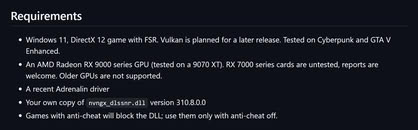
A modder has ported DLSS 5 Neural Rendering onto an AMD GPU for the first time, less than a week after the tech started spreading to older NVIDIA cards. Developer danielblnc released a tool called DLSS-NR for AMD, which allows AMD's RDNA 4 GPUs to run NVIDIA's neural rendering model in supported games. The setup works by dropping a small installer and NVIDIA's own nvngx_dlssnr.dll file into a game's bin folder, then toggling neural rendering through an FSR 3 or FSR 4 profile. It has been tested on Cyberpunk 2077 and GTA V: Enhanced so far, with older AMD GPUs reportedly not supported. Anti-cheat games will block the DLL entirely, so this is single-player territory only for now.
According to tests by YouTuber Ancient Gameplays, performance is still the bottleneck. Early builds tanked Cyberpunk 2077 from over 80 FPS down to around 11-12 FPS at 1080p on the Radeon RX 9070 XT. The modder's latest Alpha v0.2.7 update has clawed back roughly 12%, pushing it to about 30 FPS, still a steep cost for a card that handles native rendering well. The reason this works at all is quite straightforward. DLSS 5 runs on FP8 math, and AMD's RDNA 4 architecture, which powers the RX 9000 series, has native FP8 support, just like NVIDIA's RTX 50-series and 40-series cards.
 As we noted in our DLSS 5 preview, NVIDIA has been firm that the feature is Blackwell-only for now, even as modders got it running on RTX 40-series and 30-series cards within days of the leak. NVIDIA has since confirmed that support for the RTX 40-series is in the works, which is understandable, since those cards also support FP8. The AMD support is early and unofficial, so don't expect this to be a practical way to play anytime soon. However, it's another sign that NVIDIA's neural rendering tech is spreading faster and wider than the company planned for.
Sources:
Ancient Gameplays on YouTube, DLSS-NR on AMD (GitHub)
According to tests by YouTuber Ancient Gameplays, performance is still the bottleneck. Early builds tanked Cyberpunk 2077 from over 80 FPS down to around 11-12 FPS at 1080p on the Radeon RX 9070 XT. The modder's latest Alpha v0.2.7 update has clawed back roughly 12%, pushing it to about 30 FPS, still a steep cost for a card that handles native rendering well. The reason this works at all is quite straightforward. DLSS 5 runs on FP8 math, and AMD's RDNA 4 architecture, which powers the RX 9000 series, has native FP8 support, just like NVIDIA's RTX 50-series and 40-series cards.


60 Comments on Modders Get DLSS 5 Working on AMD Graphics Cards, Though Performance is Rough
Anything that runs across hardware, especially competitor hardware is superior to anything that is proprietary from a consumer point of view.
If FSR 4.1 could work on Intel and Nvidia cards it would be superior in my book. Likewise, if DLSS worked on AMD and Intel cards that would also be superior to something that only runs on Nvidia hardware. Same thing for Intel.
As it currently stands you need to use optiscaler to get it working on competitor hardware.
Everything we have been doing these last few years with AI, we have been doing for 10, 20, 30, 40 years. First ray-tracing demo was in 1986. Took 1hr to render each frame. Then you have the GF-16 series that does RT but it drops to like single digit frames. Imagine that, not a single bit of RT hardware, yet you can render RT without it. Just 30yrs later it still doesn't perform all that great for games. Sure, you can get DLSS3, 4, 5, running on whatever hardware you want. Shoot, you can get it running on a GeForce 6800, or a GeForce 2 Ultra if Nvidia really really want to. The thing is, performance. You get to a point where too many things are missing that just doesn't make it worth it. 30yrs of advances and RT goes from 1 frame per hour to 6fps, which still is not good for games. Add in a little dedicated silicon and now you are getting 60-100fps. Thats good for games!
Older hardware doesn't have specific instructions to speed up certain tasks. So it runs slower if the software supports the older hardware. Sometimes it might be too difficult to get the software working on older hardware with the hardware not having specific support for certain instructions. So software is going to want to require certain things to run. If you are missing an instruction set, it won't work. Sure you can program your software around it, but then performance may not exist.
Saying "oh both these cards from two different generations both support FP8, FP4, etc" doesn't paint a complete picture either. The newer architecture can still support newer instructions for specific tasks that are FP4, FP8 that speed up the processing 10 fold the old one does not. Just because multiple things support FP8 or FP4 does not make them the same.
The issue with Nvidia, is they block features just to block features. It is their requirement with all new things. We are seeing it currently with the DLSS5. We saw it with DLSS4 and MFG. Nvidia released THEIR OWN benchmarks of DLSS 3 running and performing on 2000 Series and 3000 Series just fine. Hmmm... I wonder why they would lock out such a great technology? We see competition doing the same thing on INT8, DP4a, looking just as good and doesn't perform too bad either. Shoot, even Intels XeSS on XMX (uses FP16) and has great performance. Guess who supports DP4a. Oh yea, the GeForce 1000 series!
Most of what Nvidia does is two things. They artificially lock it out on older architectures like DLSS5 and DLSS4 even with evidence it runs on older architectures just fine. Or they just don't want to take their FP8 code and models and convert it to INT8 code to support things like the GeForce 1000 series, or even support DP4a so that DLSS can natively work on Intel and AMD graphic cards.
Given that modders will soon manage to run DLSS 5 on a Cyrix CPU paired with a Matrox graphics card, maybe Microsoft should take over standardization from here on out—obviously in collaboration with Nvidia, but also the rest (AMD, Intel, Qualcomm, MediaTek, ARM, others).
This might also present an opportunity for the Linux community and Valve. If Valve, or the Linux community in general, could build a Neural Rendering engine that works independently of the graphics card, Linux would, for the first time maybe, have a clear advantage over Windows in gaming.
github.com/RankFTW/RHI