Sunday, September 27th 2026

Thermal Grizzly and Noctua Introduce WireView Pro II Noctua Edition GPU Monitoring Device
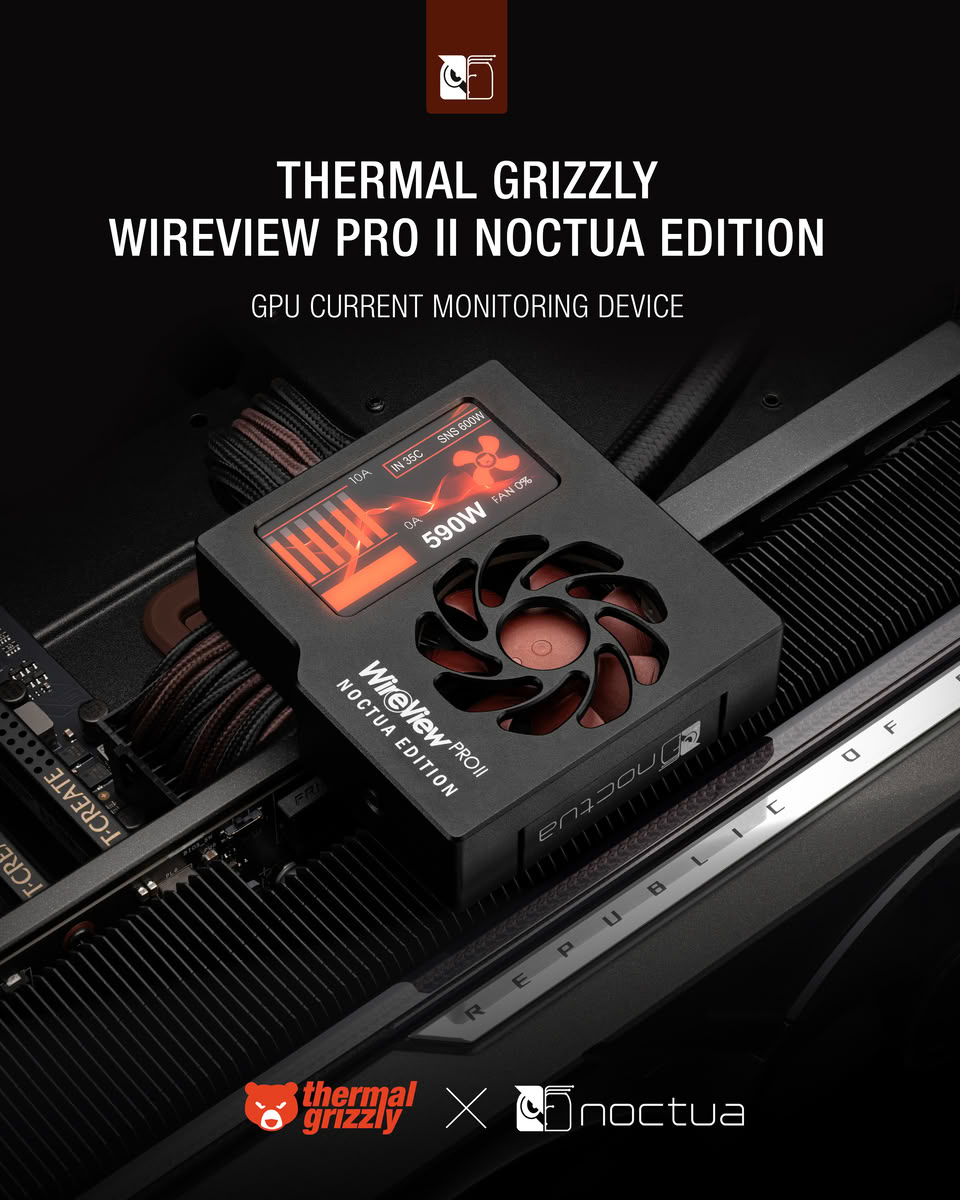
Thermal Grizzly, a German specialist in thermal interface materials, liquid cooling and PC enthusiast hardware, and Noctua, an Austrian leader in premium quality quiet cooling components, today introduced the Thermal Grizzly WireView Pro II Noctua Edition. Combining Thermal Grizzly's patented WireView Pro II platform with a customized Noctua cooling solution, the new device helps to safeguard high-end graphics cards against 12V-2x6 connector damage while running significantly quieter than the standard version.
"The WireView Pro II has been extremely successful and has already helped many users detect potentially dangerous connector issues before they could cause damage", says Roman Hartung, CEO of Thermal Grizzly. "One of the most common points of feedback, however, was that the fan could still be noticeable in very quiet systems, so working with Noctua on a significantly quieter cooling solution was the logical next step - and, for us, really completes the product."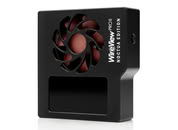
 "The WireView Pro II is an exciting, cleverly engineered and genuinely useful device for protecting today's high-end GPUs, so we were thrilled when Thermal Grizzly approached us about collaborating on a quieter version", says Roland Mossig, CEO of Noctua. "We couldn't be more pleased with the end result: The customised heatsink does most of the work passively, so the fan stays switched off in the majority of use cases - and you can barely hear it when it does spin up."
Developed specifically for modern high-end graphics cards with 12V-2x6 power connectors, the WireView Pro II measures current individually on every 12 V conductor rather than only as a total value. This makes uneven load distribution and potential contact issues visible at an early stage, helping users to identify conditions that could otherwise lead to localized heating and connector damage.
If a configurable threshold is exceeded, the device issues a visual warning on its integrated TFT-IPS color display and triggers an audible alarm; using the supplied splitter cable, it can also initiate an optional automatic system shutdown. All essential monitoring and configuration functions are available directly on the device, so it works fully plug-and-play, while optional PC software adds further functionality and the USB-C connection allows users to install firmware updates themselves.
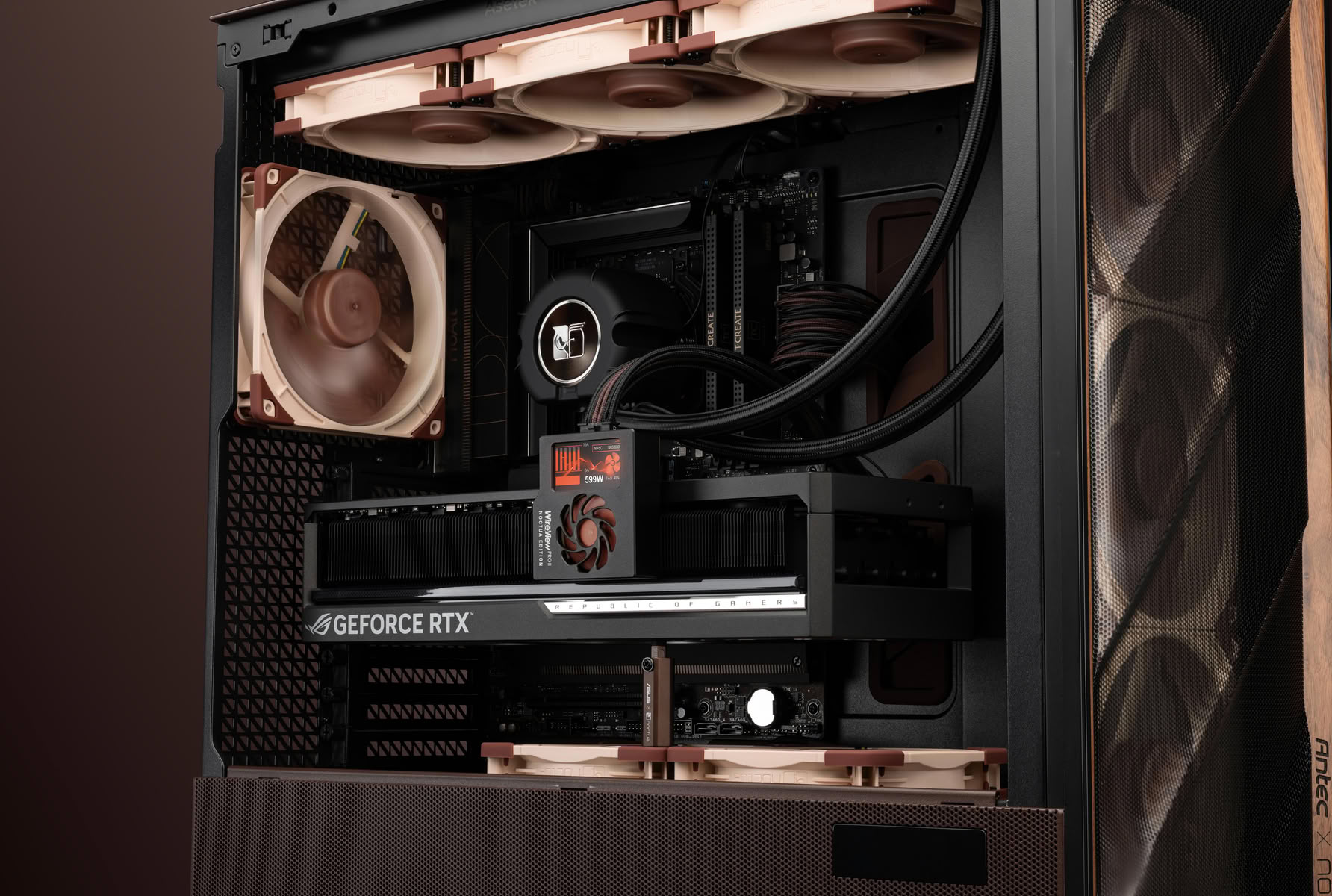
For the Noctua Edition, the cooling system has been extensively customized around a CNC-milled aluminium heatsink, an integrated frameless NF-A4x10n fan and a signature Noctua fan grille. In a worst-case test with all case fans disabled and in-case temperatures above 40°C, the Noctua Edition kept its fan switched off completely at up to 300 W GPU load, whereas the standard version started up after 5 minutes 40 seconds at 200 W and 2 minutes 15 seconds at 300 W. At 400 and 480 W, it more than doubled the time until the fan started up and kept the GPU connector around 3°C cooler.
When the fan does run, it runs much slower and quieter: In the same test, the standard version ran at around 5000rpm and 39.4dB(A) measured from 10 cm, which corresponds to 19.4dB(A) at 1 m - quiet, but potentially audible over other components in ultra-quiet systems. The Noctua Edition settled at slightly below 2000rpm and only 21.5dB(A) from 10 cm or 1.5dB(A) at 1 m, which is so quiet that it will remain inaudible over other fans even in extremely quiet setups.
Combining the proven, sophisticated protection features of the WireView Pro II, two years of Thermal Grizzly coverage for the graphics card's 12VHPWR or 12V-2x6 connector and a further refined thermal and acoustic design, the WireView Pro II Noctua Edition is the ideal choice for customers who seek to protect high-end GPUs in ultra-quiet builds.
Suggested retail price
The manufacturer's suggested retail price is EUR 189.90 / USD 189.90.
"The WireView Pro II has been extremely successful and has already helped many users detect potentially dangerous connector issues before they could cause damage", says Roman Hartung, CEO of Thermal Grizzly. "One of the most common points of feedback, however, was that the fan could still be noticeable in very quiet systems, so working with Noctua on a significantly quieter cooling solution was the logical next step - and, for us, really completes the product."

Developed specifically for modern high-end graphics cards with 12V-2x6 power connectors, the WireView Pro II measures current individually on every 12 V conductor rather than only as a total value. This makes uneven load distribution and potential contact issues visible at an early stage, helping users to identify conditions that could otherwise lead to localized heating and connector damage.
If a configurable threshold is exceeded, the device issues a visual warning on its integrated TFT-IPS color display and triggers an audible alarm; using the supplied splitter cable, it can also initiate an optional automatic system shutdown. All essential monitoring and configuration functions are available directly on the device, so it works fully plug-and-play, while optional PC software adds further functionality and the USB-C connection allows users to install firmware updates themselves.
For the Noctua Edition, the cooling system has been extensively customized around a CNC-milled aluminium heatsink, an integrated frameless NF-A4x10n fan and a signature Noctua fan grille. In a worst-case test with all case fans disabled and in-case temperatures above 40°C, the Noctua Edition kept its fan switched off completely at up to 300 W GPU load, whereas the standard version started up after 5 minutes 40 seconds at 200 W and 2 minutes 15 seconds at 300 W. At 400 and 480 W, it more than doubled the time until the fan started up and kept the GPU connector around 3°C cooler.
When the fan does run, it runs much slower and quieter: In the same test, the standard version ran at around 5000rpm and 39.4dB(A) measured from 10 cm, which corresponds to 19.4dB(A) at 1 m - quiet, but potentially audible over other components in ultra-quiet systems. The Noctua Edition settled at slightly below 2000rpm and only 21.5dB(A) from 10 cm or 1.5dB(A) at 1 m, which is so quiet that it will remain inaudible over other fans even in extremely quiet setups.
Combining the proven, sophisticated protection features of the WireView Pro II, two years of Thermal Grizzly coverage for the graphics card's 12VHPWR or 12V-2x6 connector and a further refined thermal and acoustic design, the WireView Pro II Noctua Edition is the ideal choice for customers who seek to protect high-end GPUs in ultra-quiet builds.
Suggested retail price
The manufacturer's suggested retail price is EUR 189.90 / USD 189.90.
58 Comments on Thermal Grizzly and Noctua Introduce WireView Pro II Noctua Edition GPU Monitoring Device
Though looking at both, he only highlights this in the German (original) version of the video:
The 5090 is already using 96% of the spec, the RTX Pro 6000 is at 100% of spec.
If nvidia wants more power, they'll need to make a revision of spec or add a second power connector.
AMD - 1
Nvidia - 0
They are optimizing and brute forcing at the same time. The two are not mutually exclusive.Right now the trend seems to be that the gap between the lower tiers and the enthusiast tier is getting ever wider at nvidia while AMD has once again given up on competing at the top, so not really.
Though I'll give you that the x80 class has been slowly pushing up the TDP from 180 (1080) -> 250 (2080) -> 320 (3080) -> 320 (4080) -> 360 (5080), which is a doubling.
Then again, the 1080 Ti was at 250 W and the 5090 is now at 575 W, which is more than a doubling, so I still say that at the top end, the gap is widening.
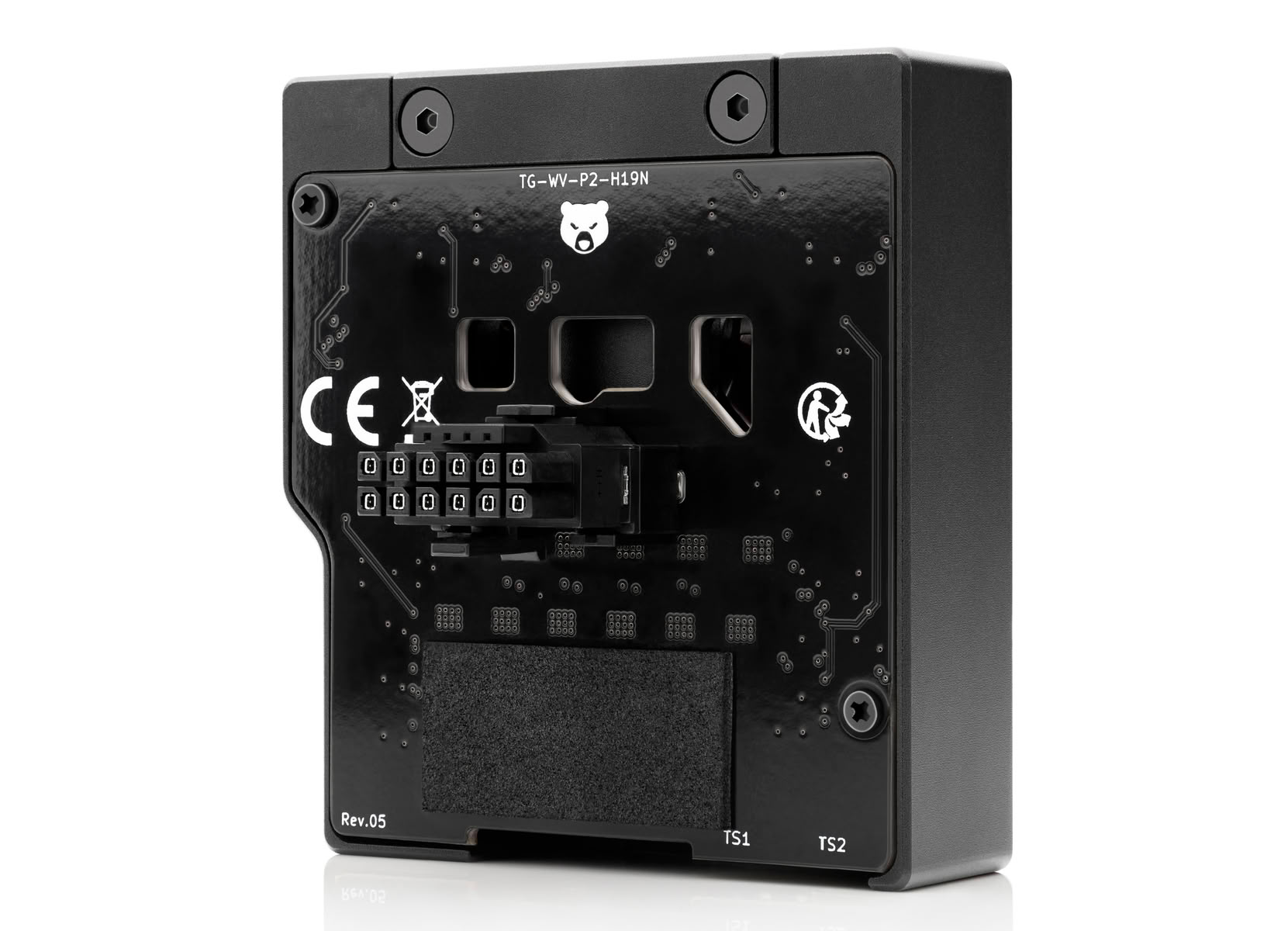
3-dimple (Astron-style) terminals: These typically use a rectangular/tubular body with a double-slit (or multi-slit) construction. The slits allow the sides to flex, and the contact is made primarily via discrete raised dimples (usually three contact points). The double slit is a characteristic external/visible feature of this style when looking at the open end of the female terminal.
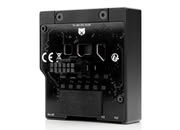
If you look carefully on the Photo showing the backside of the Device, you will be able to see 2 slits on each female terminal. This is a solid indicator that strongly suggests the 3-dimple (Astron-style) design.
The 3-dimple (Astron-style) design has a lower contact area compared to the alternative 4-Spring (also called leaf-spring, tulip, or NTK-style) design. It is also more prone to higher contact resistance, especially after repeated mating cycles or if the terminal loses tension over time.
I would have hoped, that TG would use the superior 4-Spring design! These generally have a single slit (or a different continuous spring geometry) and rely on continuous leaf/spring elements that bow inward on multiple sides for larger contact area. They do not show the same prominent dual-slit appearance at the mating end, as the Photos here on the WireView show.
Compared to the inferior 3-dimple (Astron-style) terminals, the 4-Spring design is superior because:
- The female terminal uses continuous spring/leaf elements that bow inward on multiple sides (typically four contact surfaces: sides + top/bottom or equivalent).
- Provides a larger continuous contact area with the male pin (reported ~66% greater contact area in some analyses).
- Better normal force (gripping pressure), lower and more stable contact resistance, and improved resilience to side-loading or slight misalignment.
- Often a single-split or different housing geometry in the terminal.
- Recommended by Intel in the ATX 3.0 / 3.1 documentation
Because of this, i can not recommend this WireView Pro II, except TG would change the Female terminals to the 4-Spring design!Device costs 20$ but with noctua name 190$ so the fools can buy it "the main issue is consumers not sellers"
Sounds like a better solution to me.
Whole new psu costs 35-40€ and still they somehow are making profit on that.
I wasn’t a keyboard cowboy and instead bought one and took it apart.So again like I said originally. Unless it’s specific to the noctua edition which I doubt. There is no heatsink on the pro 2s.
Maybe you have something meaningful to discuss or add like the tear down of the noctua edition? Just hot air?
Noctua editions having a custom heat sink is normal. I'm not aware of any noctua collaborations where they only did a fan swap and left it at that.
All noctua edition GPUs have a changed heat sink with thicker fin stack. The Seasonic Noctua 1600W also had some changes made.
In this case here's the fan assembly with integrated heat sink and you can just see the edges of the thermal pad on the bottom. Which Roman explains at the given timestamp.
This product is just another link in the chain of products designed to cover basic flaws produced by the enshitification we're living in. The price and specifications is what must be discussed? You cannot discuss the fundamental reason why people needs 190€ gadget to somehow ensure their gpu survive? Is this the K7-amd-era where you had 30% chance your cpu would burn out in a second if the cooler was unproperly mounted or the fan stopped?
It took almost 10 years and gamers nexus to change the glass trend on pc cases. Do we expect at least 10 years of survival-accesories for GPUs? Are we waiting for PSU oems to implement the shunts on the PSU connector? Thas the solution? Praise the product and dont point to the issue?
I've installed only about 5-6 of 5090s and after the third I recommended everyone a heatsink with fan for the "backplate" as this lowers all temps from 5-7 degrees. There are several on amazon, from 15-20€ which must cost about 2-4€ in parts, maybe a little more if it was specifically designed for the gpu. Why the backplates of 5090 are so bad? Just because adding a proper backplate would cost on origin 1-2€ more.
Lets say they sold 1M 5090 chips. Thats 2M€ combined. Lets multiply by 10, to 20M. Lets count the costs on PR, SAT, etc. not only on campagins but in labour, stock, shipping, related to 5090s to compensate the connector and other fiascos. Absurd, as this product, and yeah thats on jensen policy, as they can enforce lots of design constrains for OEMS when producing their cards.