Tuesday, October 6th 2026
Pimax Unveils Crystal Pro Wireless PC VR Headset with Native Foveated Streaming
Pimax, a leading manufacturer of high-end PC virtual reality headsets, today unveiled Crystal Pro, a wireless PC VR headset built around a streaming technology it calls Native Foveated Streaming, at its "Frontier: Change To Stay The Same" launch event. Pimax also debuted Ringless VR Controllers, the Spation mini-PC, and a refreshed brand identity built around a new signature color, Stratosphere Blue.
Crystal Pro ships with built-in Wi-Fi streaming and a dedicated Wi-Fi 6E adapter. For the GPU's native image, Pimax offers an optional 60G AirLink kit, bundled or sold separately. Using eye-tracking, its 60 GHz connection sends the GPU's native image directly to the panels in the user's focus area, without the encoding Wi-Fi streaming requires. The kit's two Room Antennas run in a 2x2 MIMO configuration—a first for VR headsets, Pimax says—for up to 6 Gbps combined throughput and under 2 ms of added latency.
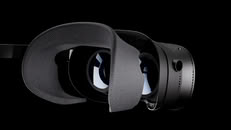
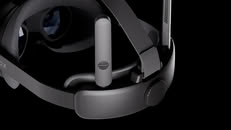 The headset pairs aspheric glass lenses with QLED panels at 2880 x 2880 pixels per eye, a 110-degree field of view, and refresh rates up to 120 Hz. Tracking combines eye-tracking, SLAM 2.0 inside-out tracking, and a swappable faceplate for optional Lighthouse support or MR passthrough with LiDAR depth. No battery is built in; power comes from an included 16,000mAh external pack.
Ringless VR Controllers replace Pimax's earlier tracking ring with camera-based hand tracking plus infrared and motion-sensor tracking, under 15 ms latency, and clip into a gamepad for Windows and Steam.
Spation is a mini-PC with desktop-class components in a chassis smaller than a typical tower, pairing an AMD Ryzen 7 9800X3D CPU with an AMD RX 9070 XT or NVIDIA RTX 5070 Ti GPU. It supports Windows and SteamOS, with a DIY configuration also available.
Crystal Pro is priced at $1,399, or $1,899 bundled with the AirLink kit; the kit alone is $599. Shipping dates, and pricing for Ringless VR Controllers and Spation, will follow. Customers can reserve one for $1 today at pimax.com.
Pimax is a virtual reality hardware company known for high-resolution, wide-field-of-view PC VR headsets, including the Crystal and Dream Air series.
Source:
Pimax
Crystal Pro ships with built-in Wi-Fi streaming and a dedicated Wi-Fi 6E adapter. For the GPU's native image, Pimax offers an optional 60G AirLink kit, bundled or sold separately. Using eye-tracking, its 60 GHz connection sends the GPU's native image directly to the panels in the user's focus area, without the encoding Wi-Fi streaming requires. The kit's two Room Antennas run in a 2x2 MIMO configuration—a first for VR headsets, Pimax says—for up to 6 Gbps combined throughput and under 2 ms of added latency.


Ringless VR Controllers replace Pimax's earlier tracking ring with camera-based hand tracking plus infrared and motion-sensor tracking, under 15 ms latency, and clip into a gamepad for Windows and Steam.
Spation is a mini-PC with desktop-class components in a chassis smaller than a typical tower, pairing an AMD Ryzen 7 9800X3D CPU with an AMD RX 9070 XT or NVIDIA RTX 5070 Ti GPU. It supports Windows and SteamOS, with a DIY configuration also available.
Crystal Pro is priced at $1,399, or $1,899 bundled with the AirLink kit; the kit alone is $599. Shipping dates, and pricing for Ringless VR Controllers and Spation, will follow. Customers can reserve one for $1 today at pimax.com.
Pimax is a virtual reality hardware company known for high-resolution, wide-field-of-view PC VR headsets, including the Crystal and Dream Air series.

8 Comments on Pimax Unveils Crystal Pro Wireless PC VR Headset with Native Foveated Streaming
I don't see the point in aping a competing product without offering a greater value proposition than what's being aped. No one tells me they reconsidered their intentions of getting a Beyond 2e after seeing what the Dream Air has to provide. I imagine many will speak of the... Crystal... didn't they already name a headset the Crystal, or are the generic names starting to confuse me? in comparison to the Frame. You pay more, for an overall less convenient experience, at a delivery date far beyond the release of the competing headset. What is there to love?
Also wording such as "without the encoding Wi-Fi streaming requires".
And isn't the fastest mode of 802.11ax (WiFi6E) theoretically faster than 6Gb?
Then there's 802.11be (WiFi7), and 802.11ay (60GHz) with up to >150Gb or maybe 300Gb.
The primary appeal with direct wireless video is to allow for the lowest latency possible, 2ms as the quoted number here—you can cut down a lot on processing time when you're sending the video output as-is over the air, no encoding or routing necessary. That said, I haven't seen it done since that one funky W-HDMI card and the failed wireless adapter kit for the Index. I would curb my expectations for the technology, since it got left behind multiple times already.