News Posts matching #mini-PC

Return to Keyword Browsing

Pimax Unveils Crystal Pro Wireless PC VR Headset with Native Foveated Streaming

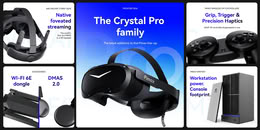
Pimax, a leading manufacturer of high-end PC virtual reality headsets, today unveiled Crystal Pro, a wireless PC VR headset built around a streaming technology it calls Native Foveated Streaming, at its "Frontier: Change To Stay The Same" launch event. Pimax also debuted Ringless VR Controllers, the Spation mini-PC, and a refreshed brand identity built around a new signature color, Stratosphere Blue.

Crystal Pro ships with built-in Wi-Fi streaming and a dedicated Wi-Fi 6E adapter. For the GPU's native image, Pimax offers an optional 60G AirLink kit, bundled or sold separately. Using eye-tracking, its 60 GHz connection sends the GPU's native image directly to the panels in the user's focus area, without the encoding Wi-Fi streaming requires. The kit's two Room Antennas run in a 2x2 MIMO configuration—a first for VR headsets, Pimax says—for up to 6 Gbps combined throughput and under 2 ms of added latency.
Framework Teases Desktop with Ryzen AI Max+ PRO 495 and 192GB Memory

Framework teased its first mini-PC qualification platform for AMD Ryzen AI Max+ PRO 495 processor. Unveiled earlier this year at Computex, the Ryzen AI Max+ PRO 495 is a major update to the Ryzen AI Max+ 395 that supports a maximum unified memory of 192 GB, a 50% increase over the 128 GB that its predecessor supports, enabling significantly larger 300 billion-parameter AI models to be run, or multiple concurrent agentic AI workflows. The test platform's specs were confirmed in its Insyde UEFI splash screen, revealing its processor model number to be "AMD Ryzen AI Max+ PRO 495 with Radeon 8065S," and its memory configuration of 192 GB of LPDDR5X-8533. The Radeon 8065S is a minor update over the 8060S, with slightly increased engine clock.

AMD plans to formally launch the Ryzen AI Max+ PRO 400 series later this year as mainly an AI development and inferencing platform processor, given that it's main feature over the Ryzen AI Max 300 series is 192 GB memory support. AMD standardized its PRO feature-set across the series, which gives the chip remote management capabilities similar to Intel vPro.

Team Group Memory at Computex 2026: T-Create and T-Force Lead the Charge

Team Group brought a large selection of new products to Computex 2026 across its main brand, the T-Force brand targeting PC enthusiasts, and the T-Create brand targeting creative professionals and AI developers. We begin our tour with the new Team Group T-Force Vulcan DDR5 CAMM2 module. Intended to be installed along the plane of the motherboard, CAMM2 modules conserve Z-Height around the CPU socket, and are dual-channel memory modules. The T-Force Vulcan CAMM2 somes with a thick heat spreader with a carbon fiber decal on top. Next up, is the T-Force Delta CAMM2, which is among the first CAMM2 modules we've seen with an ARGB LED lighting setup. Both these CAMM2 modules offer speeds of DDR5-8000. The T-Force DARK Low-Profile RGB are a line of DDR5 UDIMMs with reduced Z-Height, yet featuring ARGB LEDs. These come in mid-range speeds of DDR5-6400.

Next up, is the T-Create Expert AI 4R CUDIMM, a quad-rank memory module with CKD. A single module offers 128 GB of density across four ranks, along with speeds of DDR5-8000 and timings of 64-64-64-128, at 1.1 V. Team Group demoed this module on an MSI MEG Z890 Unify-X motherboard that has a 1 DIMM per channel topology. The new T-Create Master AI DDR5 RDIMM series is targeted at HEDTs and workstations that support ECC RDIMMs. The module shown offers 64 GB of density (per module), with DDR5-7600 speed at CL38. Winding things up on the memory front is the T-Create Expert AI LPCAMM2 for notebooks and mini-PCs that support LPDDR5X.
More pictures follow.

Shuttle Showcases Its Latest Mini-PC Barebones at Computex 2026

At Computex, Shuttle presented its portfolio of Mini-PC barebones systems starting with fanless Intel Twin Lake designs to compact Arrow Lake-powered workstations. The XB860G2 is a compact desktop barebone launched in April and based on Intel Core Ultra 200S "Arrow Lake-S" processors up to 65 W TDP. It supports up to 128 GB of DDR5-5600 memory, includes three M.2 slots, one PCIe 5.0 x4 and two PCIe 4.0. For expansion it has PCIe 5.0 x16 and PCIe 4.0 x1 slots. It has HDMI 2.1, HDMI 2.0, and DisplayPort 1.4a ports with support for up to three independent displays.

The company also showcased the DL40N, a fanless successor to the older DL30N. It is powered by Intel Core 3 N350, N250, or N150 processors and supports up to 16 GB DDR5 memory. Specs are completed by a 2.5-inch drive, M.2 NVMe storage, dual 2.5 GbE networking, and a selection of HDMI, DisplayPort, VGA, and eight USB 3.2 Gen 1 ports.

AMD Ryzen AI Halo Mini-PC to Arrive in June

AMD previewed its Ryzen AI Halo mini-PC during the CES 2026 showcase, and the machine is set to be released as soon as June arrives. According to a Reddit user, AMD presented a Ryzen AI Halo box during AMD AI Dev Day, showcasing the system in its full glory. This machine is powered by a Ryzen AI Max 395+ APU, featuring a 16-core/32-thread "Zen 5" CPU, a large integrated GPU based on the RDNA 3.5 graphics architecture with 40 compute units, and a Microsoft Copilot+ ready NPU with 50 TOPS. It supports up to 128 GB of unified LPDDR5X memory, is compatible with Windows 11 and Linux, and comes with pre-loaded AI models optimized for the hardware. At the AI Dev Day, AMD demonstrated the device running on the Ubuntu operating system, which is likely to be the preferred OS for many AI developers targeted by this system.

AMD has developed an innovative cooling solution for the "Strix Halo" SoC, which includes a baseplate, a network of direct-touch flat heatpipes, an aluminium channel heatsink, and two lateral airflow blowers. AMD stated that the Ryzen AI Halo AI developer platform will be available from Q2 2026 which matches this supposed June launch. Interestingly, the price of this 128 GB model remains unknown, which is the biggest mystery, but don't expect it to come cheap. Below are some of the first real-life pictures, showcasing the design illuminated by a programmable RGB strip surrounding the box.

Shuttle Presents the XPC Barebone XB860G2

Compact design meets workstation performance: With the new XB860G2, Shuttle is expanding its portfolio with a high-performance solution that bridges the gap between ultra-compact mini-PCs and bulky tower systems. Thanks to the Intel B860 chipset, support for 'Arrow Lake-S' and a PCIe 5.0 slot for dual-slot graphics cards, the system offers maximum flexibility for demanding professional applications.

Hardware requirements in professional environments are diverse: whilst ultra-compact 1-liter systems are the ideal choice for efficient office applications and space-critical installations, computationally intensive projects often require additional hardware resources. The new Shuttle XPC Barebone XB860G2 fills precisely this market niche. With a chassis volume of around 4.7 liters, it offers space for dedicated components and optimized cooling performance that was previously reserved for significantly larger systems, without sacrificing the advantages of a compact form factor.

Intel "Bartlett Lake-S" Flagship Appears, Won't Boot on Consumer Motherboards

Intel's flagship "Bartlett Lake-S" processor—Core 9 273 PQE—has reached enthusiasts who are testing whether any consumer motherboard can boot the CPU and utilize its 12 P-Core gaming performance. According to Overclock.net user "Talon2016," who managed to obtain a sample of the LGA-1700 flagship CPU SKU, the processor won't boot using a consumer ASUS ROG Maximus Z790 Apex motherboard. These CPUs are designed for edge and embedded deployments with specialized platforms that lie outside the consumer sector. This high-TDP PQE variant has a base power of 125 W, powering a 12 P-Core variant with 24 threads and a base frequency of 3.4 GHz. This model can boost all 12 cores to 5.3 GHz, while a single thread can reach up to 5.9 GHz independently for tasks requiring intensive single-threaded performance. It is equipped with 36 MB of L3 cache and an integrated GPU with 32 EUs of Xe-LP graphics.

Unfortunately, regardless of the SKU or consumer motherboard choice, the platform will not work, and the CPU will not boot, as Intel has restricted "Bartlett Lake-S" to keep it away from consumers. Companies like ASRock have confirmed that the "Bartlett Lake-S" Core 200E will not be available for consumer motherboards and will only be used in the embedded and edge computer sector. This means you can technically buy and use this CPU for any Windows or Linux task, including gaming, but you will have to go through a process of acquiring an industrial-grade motherboard or a mini-PC that suits this platform. This means gaming support will be limited, as Intel explicitly will not bring any optimizations like APO/IPO to the platform for gaming. Instead, it will be treated as a generic x86-64 Intel CPU, just like any other processor. Extracting the maximum gaming performance could also be problematic, as there could be compatibility issues, given that Intel has envisioned other applications for this platform.

Framework Pushes DDR5 Pricing 50% Higher Amid Shortage

Framework has published an official company blog post announcing that it is preparing a 50% price increase for its DDR5 memory upgrade configurations. In an effort to remain transparent with customers, the company has stated that it intends to raise the price of DDR5 memory available in Framework Laptop DIY Edition orders by 50%. This decision is a direct response to the significantly higher costs the company is facing from its DRAM suppliers and distributors. As a result, the company cannot absorb all of these cost increases on its own and needs to pass some of them on to the consumer.

The company will not increase the prices of its existing pre-configured systems that include DRAM, as these were acquired at earlier, standard prices. As the memory market becomes more volatile, this might be just the first wave of price hikes, since the company cannot absorb the added costs of new memory orders. Since Framework manufactures various components, from laptops to mini-PCs, the company uses a mix of DDR5, LPDDR5X, and GDDR. All of these are in tight supply due to the AI boom depleting any remaining DRAM inventory.

GMKtec Teases EVO-T2 Mini-PC with Intel's Upcoming Panther Lake CPU

GMKtec has previewed the EVO-T2, its next compact mini-PC and the first system the company has shown built around Intel's upcoming Panther Lake platform. The system was shown at Intel's 2025 Technology Innovation and Industry Ecology Conference in China and is planned for release in early 2026. The EVO-T2 is based on the "Panther Lake H 12Xe3" mobile processor, which GMKtec lists as an Intel 18A part with a configurable TDP of up to 80 W. The chip carries 12 Xe3 GPU cores, likely the same Arc B390-class iGPU used in other high-end Panther Lake laptop parts and is rated for up to 180 TOPS of combined AI compute. GMKtec also mentions that the system will ship with Intel's "AI PC" software stack preinstalled. Memory support goes up to 128 GB of LPDDR5X running at 10,677 MT/s. Storage is handled by two M.2 slots: one PCIe 5.0 and one PCIe 4.0, with a stated maximum of 16 TB across both drives.

Up front, the system includes three USB-A ports, one USB-C port, and a 3.5 mm audio jack. Full rear-I/O details and final pricing are still pending. The EVO-T2 follows the EVO-T1 launched earlier this year, which shipped with a Core Ultra 9 285H and multiple SSD options including OCuLink and USB4 for external GPUs. The T2 effectively replaces it as GMKtec's high-end Intel offering and moves the lineup into Intel's next-gen architecture. GMKtec says more information, including final specs and launch date will be announced in Q1 2026.

Acer Unveils the Veriton GN100 AI Mini Workstation Built on the NVIDIA GB10 Superchip

Acer today introduced the Veriton GN100 AI Mini Workstation, a compact yet powerful computer designed to run large AI models locally, minimizing dependence on cloud services and helping reduce associated costs.

The device is built on the NVIDIA GB10 Grace Blackwell Superchip, delivering up to 1 PFLOPS of FP4 AI performance. This powerhouse combines next-generation CUDA cores, fifth-gen Tensor Cores, and 20 Arm-based CPU cores, backed by 128 GB of unified system memory and 4 TB of NVMe M.2 SSD storage. This robust configuration enables server-grade performance in a mini-PC form factor.

Banana Pi Launches BPI-R4 Lite DIY Router Board

The newly launched Banana Pi BPI-R4 Lite is a networking-focused single-board computer that can be an alternative to the Raspberry Pi 5. It is built around the MediaTek MT7987A system-on-chip, integrates four Arm Cortex-A53 cores and features 2 GB of DDR4 memory and 8 GB of eMMC flash storage. Connectivity-wise the BPI-R4 Lite is focusing on high-speed capabilities with a wide range of ports. The primary networking interface includes one 2.5 Gigabit SFP port and one 2.5 Gigabit RJ45 WAN port, with the latter supporting Power over Ethernet when equipped with the appropriate module. Four additional Gigabit Ethernet LAN ports provide support for router applications. Storage expansion utilizes multiple flash memory configurations. It uses 256 MB SPI-NAND flash and 32 MB SPI-NOR flash along with the main eMMC storage.

Speaking of expansion, users can expand the device in several ways. There's one mini-PCIe slot that works with a PCIe 3.0 dual-lane interface. This slot is suitable for use with Wi-Fi 7 network cards. An M.2 Key-B slot with USB 3.0 interface provides support for a 5G cellular module. Another mini-PCIe slot gives USB 2.0 connectivity while the single USB 3.0 port shares resources with one HSGMII/SGMII interface; however, it requires selection between these options during operation. Dual 8-pin MikroBUS headers provide expansion capabilities for various applications such as UART, I2C, SPI, and PWM functionality. Power delivery utilizes a traditional barrel connector configuration, and system debugging access is provided through a USB Type-C console interface. Looking at the specifications, Banana Pi BPI-R4 Lite seems to be a neat alternative for the Raspberry Pi 5 as it has what is needed to be used as a platform for a Wi-Fi 7 router or a NAS. Regarding pricing, the Banana Pi BPI-R4 Lite costs around $86, a bit more than the $66 for the Raspberry Pi 5.

Colorful Presents SMART 900 AI Mini PC

Colorful Technology Company Limited, a leading brand in gaming PC components, gaming laptops, and HiFi audio products, proudly introduces the SMART 900 AI Mini PC - a powerful, compact system designed to accelerate AI-driven content creation. Engineered for students and professionals, the SMART 900 combines cutting-edge performance with a sleek industrial design, pushing the boundaries of what a mini-PC can deliver.

At its core is the new Ryzen AI Max+ 395 processor, built on the advanced Zen 5 architecture. With 16 cores and 32 threads, a turbo frequency of up to 5.1 GHz, and 80 MB of cache, it delivers desktop-class performance in a 4-liter form factor. The integrated Radeon 8060S graphics, based on the RDNA 3.5 architecture with 40 compute units, offer GPU performance rivaling discrete mobile GPUs. For AI tasks, a dedicated 50 TOPS NPU provides outstanding acceleration for machine learning and generative workloads. The SMART 900 is built for creators on the move. It features a rich set of connectivity options including 3x USB 3.2 Gen 2, 2x USB 4.0, 2x USB 2.0, and a high-speed SD 4.0 card slot - making high-resolution image and video transfer seamless and efficient.

Minix Summer Splash Offer: Upgrade Your Tech for Less

Minix is launching new Mini PCs in May, designed to simplify digital life. To show our appreciation for customers' support, Minix offers exclusive discounts on popular products, including Wireless Display Series, GaN PD Charger Series, CarPlay Adapters, Mini PCs, and Portable Monitors. These offers will be available until June 3rd.

In addition, use the discount code MINIX0520 to get an extra $10 off selected products on official webiste - CP89-HD, NEO Z97, Z150-0dB, Z150 Aero, NGC N512 (512G), NGC NR660, SF15 FOLD Monitor. Don't miss this golden opportunity!

Please use the coupon code MINIX0520 on the following items to avail the prices you see here.
Buy Minix NEO Z97 at $179.99 | Buy Minix Z150-0db at $239.99 | Buy Minix SF15 FOLD at $269.99 | Buy Minix CP89-HD at $159.99

ASUS Celebrates DOOM: The Dark Ages Collaboration with Global Bundle

ASUS today announced its continuing partnership with Bethesda and id Software to deliver the highly anticipated title DOOM: The Dark Ages directly to gamers through a comprehensive global bundle initiative. The campaign follows the launch of the ROG Astral GeForce RTX 5080 DOOM Edition graphics card, with fittingly, only 666 produced exclusively for preorder on the Bethesda Gear Store. Encompassing over forty regions and over two hundred products, this bundle allows many fans to get an included copy of the game alongside purchases of displays, motherboards, graphics cards, power supplies, AIO coolers, ROG NUC mini PCs, and more.

DOOM: The Dark Ages is the prequel to the critically acclaimed DOOM (2016) and DOOM Eternal that tells an epic cinematic story worthy of the DOOM Slayer's legend. Gamers can "Stand and Fight" as the super weapon of gods and kings in this never-before-seen dark and sinister medieval war, with idTech8 native ray tracing delivering next-level graphics fidelity, speed, and visuals. When powered by GeForce RTX 50 Series, AI-powered NVIDIA DLSS 4 with Multi Frame Generation boosts FPS and constructs high-quality images, further enhancing the visuals for the definitive DOOM: The Dark Ages PC experience.

ASUS Introduces a New Class of NVIDIA-powered Desktop AI Supercomputers

They say that the most difficult part of transportation planning is last-mile delivery. A network of warehouses and trucks can bring products within a mile of almost all customers, but logistical challenges and costs add up quickly in the process of delivering those goods to the right doors at the right time. There's a similar pattern in the AI space. Massive data center installations have empowered astonishing cloud-based AI services, but many researchers, developers, and data scientists need the power of an AI supercomputer to travel that last mile. They need machines that offer the convenience and space-saving design of a desktop PC, but go well above and beyond the capabilities of consumer-grade hardware, especially when it comes to available GPU memory.

Enter a new class of AI desktop supercomputers, powered by ASUS and NVIDIA. The upcoming ASUS AI supercomputer lineup, spearheaded by the ASUS ExpertCenter Pro ET900N G3 desktop PC and ASUS Ascent GX10 mini-PC, wield the latest NVIDIA Grace Blackwell superchips to deliver astounding performance in AI workflows. For those who need local, private supercomputing resources, but for whom a data center or rack server installation isn't feasible, these systems provide a transformative opportunity to seize the capabilities of AI.

Shuttle Expanding AI-Accelerated XPC Nano Series With Intel-Based Model

Following the successful launch of our AMD-powered AI-PC NA10H7, Shuttle is proud to announce the release of two new additions to our compact XPC nano family: NT10H5 and NT10H9. Designed in the same ultra-compact 1-liter chassis, both newcomers offer powerful AI-acceleration and multitasking capabilities - now based on Intel's cutting-edge Core Ultra processors.

Compact Yet Powerful: The New NT10H Series
The NT10H5 and NT10H9 mini-PCs carry the same DNA as the NA10H7, delivering high-performance computing in a nano-sized footprint (132 x 143 x 55 mm). They are equipped with Intel Core Ultra 5-125H and Intel Core Ultra 9-185H processors respectively, featuring integrated Intel Arc graphics and the dedicated Intel AI Boost NPU. These systems reach up to 34 TOPS of AI performance, making them ideal for machine learning, content creation, and real-time data processing in modern business or creative environments.

Sapphire Develops Edge AI Mini-PC Series with AMD Ryzen AI 300, Targeting Gamers and Creatives

It seems that Sapphire is making a return to the Mini-PC consumer market as ComputerBase discovered during Embedded World 2025 event. There, Sapphire showcased engineering samples of its new Edge AI mini-PC family. These compact computing solutions are based on the latest AMD Ryzen AI 300 series processors.. The two models in this lineup—the Edge AI 340 and 350—feature AMD Ryzen AI 5 340 and Ryzen AI 7 350 processors respectively, with the former offering 16 GB of RAM and the latter providing 32 GB, both supporting impressive 5,600 MT/s memory speeds across two SO-DIMM slots. A more powerful model featuring AMD Ryzen AI 9 HX 370 will also be available.

Even measuring just 117 × 111 × 30 mm in size (the power supply is just a regular external adapter), the Sapphire Edge AI series features a wide range of connections. They boast two HDMI 2.1 ports, two USB4.0 ports, 2.5 GbE LAN, Wi-Fi with Bluetooth, and two extra USB ports. As for storage, there's a regular 2280 M.2 slot for SSDs, plus another 2242 slot. Accessing internal components is easy; no tools are needed, as Sapphire makes use of a magnetic case-cover. This includes access to the SO-DIMM slots and storage areas. Sapphire says these mini-PCs will hit stores worldwide by late April (no word about pricing yet), however, some regions might get different setups or bare-bones versions without pre-installed RAM and storage.

Intel Previews Sustainable Modular PC Design Concept

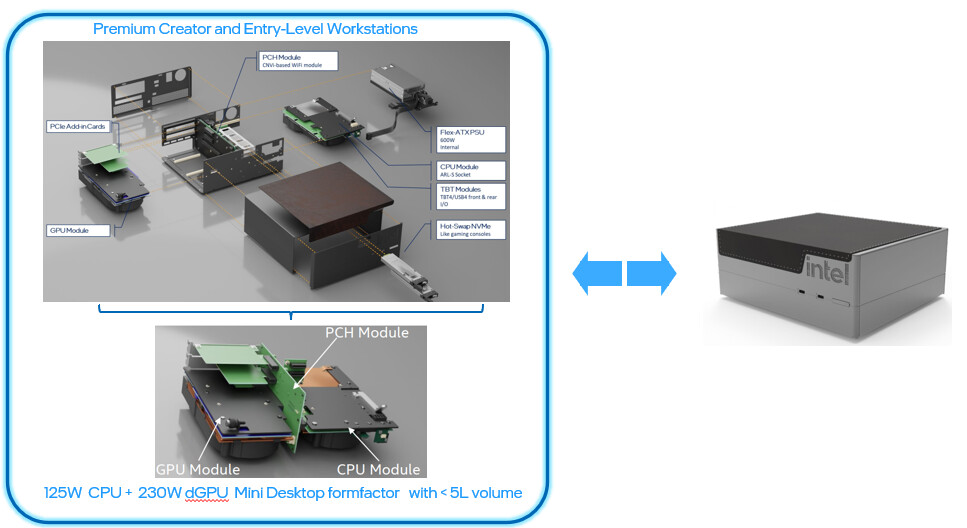
Intel's Platform Engineering and Client Segments groups are actively looking into ways of reducing computer e-waste, and (in parallel) enhance product repairability. The company's newly proposed "Modular PC Design" is set to take a "sustainable approach" across three key modularity levels: factory, field and user. Team Blue's blog post goes into great detail about revised laptop and mini-PC designs—with the "right-to-repair" movement serving as a major influence. Many "consumer activists and environmental groups" have advocated for improvements in personal computer design—Intel appears to be listening, but a firm release timeline has not been set.

Intel's proposed new standards will revolve around repairability and upgradability—as explained in their blog: "the right-to-repair emphasizes the importance of being able to fix and upgrade PCs on one's own. Improving repairability requires fundamental changes starting from the design methodology." Team Blue's Modular PC program—for laptops—breaks away from the tradition of utilizing an "all-in-one motherboard." A reference diagram shows off three internal modules: a motherboard package and two "universal" left and right I/O units. These separate boards can be: "utilized across various platforms or market segments leads to cost savings by streamlining the duration of the design cycle and minimizing the engineering investment required. The I/O boards for Premium Modular designs are engineered to be common between the fan-less Thin & Light system, which operates within a 10 W power envelope, and the premium fanned designs, which function within a 20 W (single fan) and 30 W (dual fan, Wi-Fi only SKU) power envelope." Framework recently celebrated its fifth year of operation—its modular laptop designs have seemingly "inspired" a few copycats.

Intel's "Wildcat Lake" Emerges as New Entry-Level Processor Series

According to recently discovered shipping manifests, Intel is developing a new processor series codenamed "Wildcat Lake," potentially succeeding their entry-level "Intel Processor" lineup based on Alder Lake-N. The documents, revealed by x86deadandback, suggest a 2025 launch timeline for these chips targeting lightweight laptops and mini-PCs. The shipping records from October 30 mention CPU reball equipment compatible with BGA 1516 sockets, measuring 35 x 25 mm, indicating early validation testing is underway. These processors are expected to be manufactured using Intel's advanced 18A process technology, sharing the same manufacturing node as the upcoming Panther Lake series. Early technical specifications of Wildcat Lake point to a hybrid architecture combining next-generation "Cougar Cove" performance cores with "Darkmont" low-power efficiency (LPE) cores in a 2P+4LPE configuration.

This design appears to separate the core clusters, departing from traditional shared ring bus arrangements, similar to the approach taken in Intel's Lunar Lake and Arrow Lake processors. While Wildcat Lake's exact position in Intel's product stack remains unclear, it could serve as a modernized replacement for the what were Pentium and Celeron processor families. These chips traditionally power devices like Chromebooks, embedded systems, and home servers, with the new series potentially offering significant performance improvements for these market segments. The processor is expected to operate in the sub-double-digit TDP power envelope, positioning it below the more powerful Lunar Lake series. Graphics capabilities will likely be more modest than Lunar Lake's Xe2 architecture, aligning with its entry-level market positioning.

ASUS Announces NUC 14 Pro AI

ASUS today announced ASUS NUC 14 Pro AI, the world's first mini PC featuring Intel Core Ultra processors (Series 2) integrated with Microsoft Copilot+. This revolutionary device is engineered to deliver unparalleled performance for use across diverse sectors, easily handling business, entertainment, and industrial apps. Boasting compact dimensions and advanced AI capabilities, ASUS NUC 14 Pro AI sets a new benchmark for mini PC innovation, offering an alternative to traditional desktops in a compact package.

World's first AI-enabled mini PC, powered by Intel Core Ultra processors (Series 2)
ASUS NUC 14 Pro AI represents a major leap in AI mini PC technology. It's powered by up to the latest Intel Core Ultra 9 processors (Series 2) that feature a multi-architecture design incorporating CPU, GPU, and NPU technologies. Delivering a total of 120 platform TOPS and 48 NPU TOPS, ASUS NUC 14 Pro AI provides 3X the AI performance of previous-generation NUC models, making it ideal for commercial use, edge computing, and IoT applications.

GIGABYTE Sets the Benchmark for HPC at CES 2025

Renowned for its groundbreaking innovations in computing technology, GIGABYTE Technology continues to spearhead advancements that redefine the industry. From January 7 to 10, 2025, GIGABYTE will participate in CES, showcasing its latest breakthroughs in high-performance computing and personal computing solutions. Under the theme "ACCEVOLUTION," GIGABYTE's booth will present a diverse range of cutting-edge technologies. Highlights include:
  • Rack-scale cluster computing solution for large-scale data centers
  • AI servers supporting next-generation "superchips"
  • Advanced cooling technologies that optimize energy efficiency and performance
  • Workstations tailored for smaller-scale workloads
  • Mini-PCs, embedded systems, and in-vehicle platforms designed for endpoint deployment and commercial applications

GEEKOM Teases World's First Snapdragon X Elite Desktop Mini PC

This was bound to happen sooner rather than later—desktop mini-PC designer GEEKOM, which specializes in mini-PCs powered by mobile processors, teased its first product powered by a Qualcomm Snapdragon X Elite processor. This marks one of the first consumer desktop with Windows 11 Arm. The company hasn't put out specs for the desktop, but it should go up against the base model of the Apple Mac Mini M4 in use-case—as a slick and efficient everyday desktop for Internet and office productivity. The GEEKOM desktop has a very Mac Mini-like product design. The front features a power button in the right place, next to a 4-pole headset jack, and a couple of type-A USB 3.x ports. The side appears to have a multi-format card reader. There are no pics of the rear I/O.

Shuttle Announces Four New Fanless Mini-PC Barebones

Shuttle is expanding its successful XPC slim product line to include four new Mini-PC Barebones: DS50U, DS50U3, DS50U5 and DS50U7. These models embrace modern technology and offer impressive performance while taking up minimal space. In a compact 1.3-liter format and with a thermally optimized, fanless chassis, the new devices are perfect for use in noise-sensitive environments.

Each model in the range has a soldered processor and is optimized specifically to suit different requirements:
  • DS50U - The entry-level model: Equipped with an Intel Celeron processor of the 12th generation (Celeron 7305) and up to 64 GB of DDR5 RAM.
  • DS50U3 - The sprinter: With an Intel Core i3 processor of the 13th generation (Core i3-1315U) and support for up to 96 GB of DDR5 RAM.
  • DS50U5 - The powerful model: Powered by an Intel Core i5 processor of the 13th generation (Core i5-1334U), also designed for up to 96 GB of DDR5 RAM.
  • DS50U7 - The record holder: The most powerful model in this range with an Intel Core i7 processor of the 13th generation (Core i7-1355U) and up to 96 GB of DDR5 RAM.

Shuttle Launches New XH610G2 4.7-Litre XPC Barebone Series Mini-PC

Shuttle is expanding its XPC Barebone range with the new XH610G2, a compact Mini-PC in a 4.7-liter format (dimensions: 25 × 20 × 9.5 cm). The device offers outstanding flexibility because it's possible to integrate either two PCI-Express cards in a single-slot format or one dual-slot card. Thanks to a PCIe-x16-5.0 and a PCIe-x1-3.0 slot, users can customize the Mini-PC in a variety of ways and add powerful components.

The XH610G2 supports Intel Core desktop processors of the 12th, 13th and 14th generation (LGA1700) and offers a solid performance base with up to 96 GB of DDR5 RAM. Graphics and multimedia connectivity is guaranteed by two HDMI 2.0b ports and one DisplayPort 1.4. A 2.5 Gbit/s Ethernet port and a 1 Gbit/s Ethernet port is available to provide a network connection.

MSI Launches PRO MP275QPDG Docking Monitor

MSI is proud to announce the launch of the PRO MP275QPDG, a docking monitor designed to revolutionize office setups and boost productivity. This all-in-one monitor simplifies workspace configurations, providing professionals with seamless connectivity and advanced features that deliver both efficiency and convenience.

One cable, Multiple solutions
The PRO MP275QPDG is a true docking monitor, featuring the Type-C port that handles power delivery, data transmission, and display functions, making it the ideal solution for users who want a clutter-free, organized workspace. With 98 W Power Delivery, it can charge devices while driving a display, offering maximum functionality with minimal cables. For users who need multiple screens, support for daisy-chaining makes it easy to expand your workspace. Simply connect a second monitor via the DisplayPort to the PRO MP275QPDG, solving the problem of the PC's lack of IO ports or cables that are too short.
Return to Keyword Browsing
Nov 11th, 2026 03:08 CST change timezone

New Forum Posts

Popular Reviews

TPU on YouTube

Controversial News Posts