Friday, October 9th 2026
Frore Systems Announces New LiquidJet Diamond Coldplates for AI Factories
Frore Systems today announced LiquidJet Diamond, a new AI Factory liquid cooling coldplate featuring an integrated diamond spreader. The accelerating demand for AI Tokens, coupled with energy scarcity, is spurring hyperscalers to find new ways to increase the efficiency of AI Factories. LiquidJet Diamond Coldplate boosts AI Tokens/Watt and revenue by 35% compared to traditional skived coldplates, with the increased revenue flowing directly to profit.
LiquidJet Diamond builds on the previously announced Frore Systems LiquidJet coldplate. LiquidJet coldplate employs a unique 3D ultra short-loop multi-stage design which can be precisely customized to the power map of each GPU, including extreme hotspots. This precision is critical as GPUs grow in complexity and power draw to meet AI demand. LiquidJet delivers 12°C reduction in GPU die temperature which directly translates to 25% higher tokens/watt efficiency. LiquidJet Diamond adds an additional spreader with integrated diamond wafers to the coldplate bottom, positioned precisely at the hotspot locations. LiquidJet Diamond delivers an additional 10 °C reduction in hotspot die temperature, boosting increase in Tokens/Watt to 35%.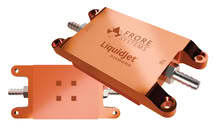
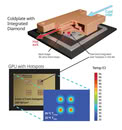 "AI Factories are facing major performance barriers," said Seshu Madhavapeddy, Founder and CEO of Frore Systems. "GPUs are increasing power density and creating extreme hotspots which, if not properly cooled, hinder the GPU from maximizing performance. LiquidJet Diamond, which features an integrated diamond spreader in addition to innovative 3D ultra short-loop multi-stage design, can cool extreme hotspots up to 770 W/cm², unleashing high-performance AI GPUs and delivering even more AI Tokens/Watt." He continued, "When each GPU is more efficient, each AI Token costs less to produce, and more AI Tokens can be generated within the available power budget, using the same AI Factory infrastructure. This increases AI Factory profitability, while conserving local resources."
Power available to AI Factories is finite and expensive to expand. Utility interconnection, transformer capacity, and physical power delivery infrastructure are all limiting factors on total AI Factory power draw and are areas which have local communities increasingly concerned. Facing this power constraint, AI Factory operators understand that power is a strategic asset, and every watt allocated must be used to generate tokens as efficiently as possible.
"If each AI Factory could produce 35% more AI Tokens with the same resources by deploying LiquidJet Diamond, hyperscalers would reach their growth goals faster with fewer AI Factories," Seshu commented. "Each new AI Factory costs tens of billions of dollars to build and more to operate, so the ability to generate more AI Tokens/Watt with existing resources can significantly increase profits, conserve energy and make a significant difference to all stakeholders."
LiquidJet Diamond: The innovative 3D ultra short-loop multi-stage coldplate built for the rapid growth of AI
LiquidJet Diamond performance compared to a skived coldplate:
LiquidJet addresses the industry's most pressing thermal challenges - not only through superior performance and hotspot management, but also through its ability to scale to hyperscaler volumes.
Traditional skiving cannot deliver the exacting thermal performance demanded by today's AI GPUs. Newer approaches such as ECAM (electrochemical additive manufacturing, also known as 3D metal printing) offer design flexibility but cannot meet hyperscaler quality, reliability, volumes, or timelines. LiquidJet combines the precision of semiconductor fabrication with high-volume manufacturing capability - satisfying both the performance and scale requirements of leading AI data center coldplate deployments.
Higher thermal performance and high-volume manufacturing are not the only challenges LiquidJet solves. GPU die sizes are increasing dramatically. Die sizes range from 1,488 mm² NVIDIA Blackwell Ultra all the way to 46,225 mm² Cerebras Wafer-Scale Engine, roughly 30x the footprint. With LiquidJet, Frore Systems has pioneered the only coldplate manufacturing process capable of supporting not only the power and performance, but also the size requirement of these larger AI GPUs.
See LiquidJet in action
At the 2026 OCP Global Summit, Frore Systems is showcasing its latest innovations with live demos of LiquidJet and LiquidJet Diamond Coldplates delivering cooling for the 2300 W NVIDIA Rubin and 770 W/cm² extreme hotspot density, along with LiquidJet Nexus, the integrated coldplate system for ½ U compute trays.
Experience Liquid Cooling built for AI. Thermal Stack Innovation Starts with Frore Systems in Booth F4 on the Show Floor at San Jose McEnery Convention Center in San Jose, California October 12-16, 2026.
Source:
Frore Systems
LiquidJet Diamond builds on the previously announced Frore Systems LiquidJet coldplate. LiquidJet coldplate employs a unique 3D ultra short-loop multi-stage design which can be precisely customized to the power map of each GPU, including extreme hotspots. This precision is critical as GPUs grow in complexity and power draw to meet AI demand. LiquidJet delivers 12°C reduction in GPU die temperature which directly translates to 25% higher tokens/watt efficiency. LiquidJet Diamond adds an additional spreader with integrated diamond wafers to the coldplate bottom, positioned precisely at the hotspot locations. LiquidJet Diamond delivers an additional 10 °C reduction in hotspot die temperature, boosting increase in Tokens/Watt to 35%.


Power available to AI Factories is finite and expensive to expand. Utility interconnection, transformer capacity, and physical power delivery infrastructure are all limiting factors on total AI Factory power draw and are areas which have local communities increasingly concerned. Facing this power constraint, AI Factory operators understand that power is a strategic asset, and every watt allocated must be used to generate tokens as efficiently as possible.
"If each AI Factory could produce 35% more AI Tokens with the same resources by deploying LiquidJet Diamond, hyperscalers would reach their growth goals faster with fewer AI Factories," Seshu commented. "Each new AI Factory costs tens of billions of dollars to build and more to operate, so the ability to generate more AI Tokens/Watt with existing resources can significantly increase profits, conserve energy and make a significant difference to all stakeholders."
LiquidJet Diamond: The innovative 3D ultra short-loop multi-stage coldplate built for the rapid growth of AI
LiquidJet Diamond performance compared to a skived coldplate:
- Hotspot cooling: over 150% higher max power density
- 75% higher heat transfer efficiency
- 16-22°C cooler GPU
- 30 - 35% more AI Tokens/Watt
- Seamless drop-in upgrade
LiquidJet addresses the industry's most pressing thermal challenges - not only through superior performance and hotspot management, but also through its ability to scale to hyperscaler volumes.
Traditional skiving cannot deliver the exacting thermal performance demanded by today's AI GPUs. Newer approaches such as ECAM (electrochemical additive manufacturing, also known as 3D metal printing) offer design flexibility but cannot meet hyperscaler quality, reliability, volumes, or timelines. LiquidJet combines the precision of semiconductor fabrication with high-volume manufacturing capability - satisfying both the performance and scale requirements of leading AI data center coldplate deployments.
Higher thermal performance and high-volume manufacturing are not the only challenges LiquidJet solves. GPU die sizes are increasing dramatically. Die sizes range from 1,488 mm² NVIDIA Blackwell Ultra all the way to 46,225 mm² Cerebras Wafer-Scale Engine, roughly 30x the footprint. With LiquidJet, Frore Systems has pioneered the only coldplate manufacturing process capable of supporting not only the power and performance, but also the size requirement of these larger AI GPUs.
See LiquidJet in action
At the 2026 OCP Global Summit, Frore Systems is showcasing its latest innovations with live demos of LiquidJet and LiquidJet Diamond Coldplates delivering cooling for the 2300 W NVIDIA Rubin and 770 W/cm² extreme hotspot density, along with LiquidJet Nexus, the integrated coldplate system for ½ U compute trays.
Experience Liquid Cooling built for AI. Thermal Stack Innovation Starts with Frore Systems in Booth F4 on the Show Floor at San Jose McEnery Convention Center in San Jose, California October 12-16, 2026.
7 Comments on Frore Systems Announces New LiquidJet Diamond Coldplates for AI Factories
At least it will hit the whealthy ones (normally pleasing their wifes with diamonds) :roll:
Simplest way to test it is to set fans at 10% and then set them at 100%, with a locked frequency but variable voltage. The chip will adjust it's own voltage as it gets warmer/cooler.
It's one reason why cooling things better leads to improvements in efficiency, but also performance in a power limited scenario - if you have limited wattage budget, the cooler you run, the faster you'll run (up to a point).