Long-Term Liquid Metal Tests Reveal Promising Longevity Despite Reactions
Responding to a question from a customer with a stained copper cold plate, modder and overclocker, Der8auer, has published an analysis of Thermal Grizzly's Conductonaut Extreme liquid metal thermal interface, revealing the long-term effects of the TIM. In the video, published to YouTube, Der8auer explains that the staining that can often be seen after the use of liquid metal TIMs is a simple reaction between the copper and gallium in the liquid metal forming CuGa2 in what is known as a peritectic reaction. The resulting alloy has an effective thermal conductivity of around 100 W/m·K, which is significantly lower than pure copper but much higher than the liquid metal alone. Fortunately, this deposition grows at around 1 µm per day until it reaches 50-100 µm, and it is given as the explanation for online reports of liquid metal evaporation over time.
Moving onto the actual long-term testing and analysis, Der8auer analyzed a copper plug applied with Thermal Grizzly Conductonaut Extreme intermittently over a two-year period to see how the thermal interface material changed over time. While the liquid's surface is clearly visible under the electron microscope after the initial application, it changed significantly after just two weeks, with obvious crystallization and solid particulates forming in the TIM surface. These crystals continued to grow as the test sample sat in a de-oxygenated environment, losing any appearance of the liquid by the end of the second month after the initial application, with the surface then comprised exclusively of crystals. No further changes were observed in the liquid metal's surface between the two-month and two-year marks, suggesting that no major changes happened after the first 50-60 days, as predicted by Der8auer's initial explanation that peritectic deposition would occur at a rate of roughly 1 µm per day until it reached around 50 µm thick.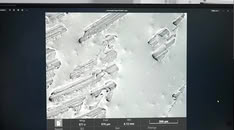
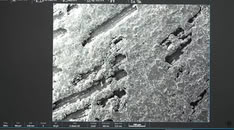
Moving onto the actual long-term testing and analysis, Der8auer analyzed a copper plug applied with Thermal Grizzly Conductonaut Extreme intermittently over a two-year period to see how the thermal interface material changed over time. While the liquid's surface is clearly visible under the electron microscope after the initial application, it changed significantly after just two weeks, with obvious crystallization and solid particulates forming in the TIM surface. These crystals continued to grow as the test sample sat in a de-oxygenated environment, losing any appearance of the liquid by the end of the second month after the initial application, with the surface then comprised exclusively of crystals. No further changes were observed in the liquid metal's surface between the two-month and two-year marks, suggesting that no major changes happened after the first 50-60 days, as predicted by Der8auer's initial explanation that peritectic deposition would occur at a rate of roughly 1 µm per day until it reached around 50 µm thick.