Tuesday, October 13th 2026

Intel B960 and Q970 Motherboards for "Nova Lake-S" Appear
Intel's upcoming "Nova Lake" desktop platform is drawing nearer, and today we have some intriguing details thanks to the Chinese electronics and motherboard maker Decenta. In leaked information about the motherboard SKU "M26-NVLS-ATX09," we see that it uses Intel's new LGA1954 socket and is listed with Q970 and B960 chipset options. The most notable difference between the two chipsets seems to be their expansion capabilities. Previously leaked specifications suggest that the Q970 provides a total of 44 PCIe lanes, including eight PCIe 5.0 lanes supplied by the chipset. In contrast, the B960 reportedly offers 34 lanes, with no additional PCIe 5.0 lanes from the chipset itself.
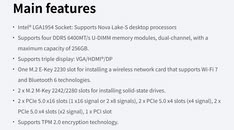
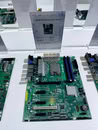
Both chipsets feature PCIe 4.0 connectivity, although the Q970 offers 12 chipset lanes compared to the B960's 14. Decenta's ATX motherboard supports four DDR5-6400 memory modules, with dual-channel operation and a maximum capacity of 256 GB. Its expansion layout includes PCIe 5.0 slots, two M.2 storage connectors, and a legacy PCI slot for older industrial hardware. For wireless connectivity, we see that Decanta's platform supports expansion through an M.2 E-Key socket that supports Wi-Fi 7 and Bluetooth 6.x modules. VGA, HDMI, and DisplayPort outputs allow up to three displays to operate simultaneously.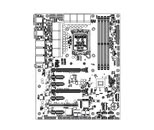
 The published chipset specifications also suggest different target markets. The Q970 reportedly supports Intel vPro management features but does not allow memory overclocking, while the B960 supports memory overclocking but lacks vPro. These differences could make the Q970 more appealing for managed business systems and industrial deployments, with the B960 serving a different segment of the desktop market. Decenta also advertises 138 TOPS of combined theoretical AI computing performance across the CPU, NPU, and integrated GPU. However, these figures have not been verified and may point to a specific processor configuration.
Sources:
@wxnod, Decanta China, via HardwareLuxx
Both chipsets feature PCIe 4.0 connectivity, although the Q970 offers 12 chipset lanes compared to the B960's 14. Decenta's ATX motherboard supports four DDR5-6400 memory modules, with dual-channel operation and a maximum capacity of 256 GB. Its expansion layout includes PCIe 5.0 slots, two M.2 storage connectors, and a legacy PCI slot for older industrial hardware. For wireless connectivity, we see that Decanta's platform supports expansion through an M.2 E-Key socket that supports Wi-Fi 7 and Bluetooth 6.x modules. VGA, HDMI, and DisplayPort outputs allow up to three displays to operate simultaneously.


11 Comments on Intel B960 and Q970 Motherboards for "Nova Lake-S" Appear
Judging by the serial ports, PCI, and multiple x4 lane expansion slots, we're looking at an Industrial or specialized Appliance board.
As usual intel obsoletes the current socket again.
But BIOS is usually completely unlocked, with all of the normally hidden options. And it's the good old school text based menu one, not some slow GUI abomination.
Also again Intel with dumb chipset shenanigans: Q970 have more PCIe lanes (and PCIe 5.0) but doesn't support even basic RAM OC that B960 does, but that lacks the PCIe lanes...
But Z990 version would be quite cool, if paired with proper VRM. Also if chipset have 44 lanes, that could allow MB with even plenty of x8 slots, not just x4!
I wish motherboard manufacturers were more open to trying new ideas and designs, current x8+x8+x1 situation is getting a bit stale...
(It's the DFI ADS630-R680E/Q670E, and the PCI bridge seems to be ITE too).
Anyways, is ITE in any way better, more compatible or more suitable to industrial applications, than the good old ASM1083?
And looking at LGA pin maps, one lane takes 12 pins. 4 for the signals, surrounded by 8 more for ground. Seems wasteful at first but pushing tens of GHz around is far from trivial.