Saturday, November 21st 2026

28-Core Intel "Nova Lake-S" Appears in Testing Running at 5.2 GHz
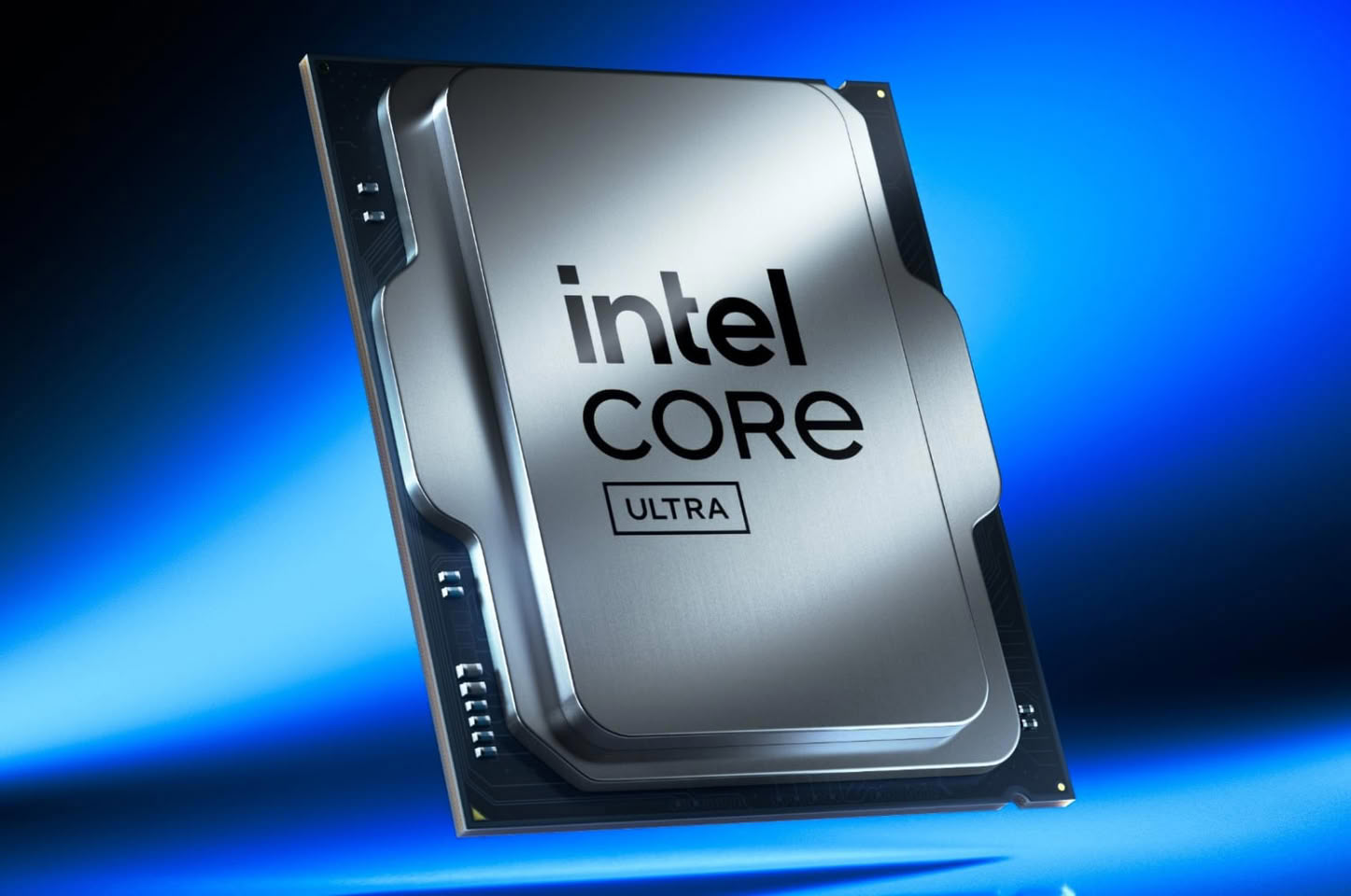
Intel's single-compute die "Nova Lake-S" variant has been spotted with a 28-core configuration and a boost frequency of 5.2 GHz, according to the OpenBenchmark testing suite. During the tests, a processor named Intel 0000 appeared with the "NVL" identifier, suggesting that a "Nova Lake-S" SKU with this configuration is indeed present. The processor's identification as Intel 0000 implies that the rumored four-number naming scheme is real, as confirmed by the benchmarks. This naming scheme could easily become standard, moving away from the three-digit SKU naming we've seen in the past.
Interestingly, the submission also identifies the integrated graphics as Intel NVL-S, indicating that the engineering platform is being tested beyond just CPU workloads. The tests include various graphics and compute applications, such as Quake II RTX, Unigine benchmarks, Hashcat, and multiple OpenCL workloads. While the 5.2 GHz figure is promising, it should not be taken as confirmation of the processor's final boost frequency. Engineering samples can operate with different firmware, power limits, and clock configurations than retail products. The listing also does not disclose whether the reported frequency represents a sustained operating clock or a maximum observed value.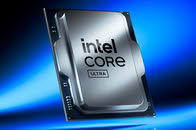
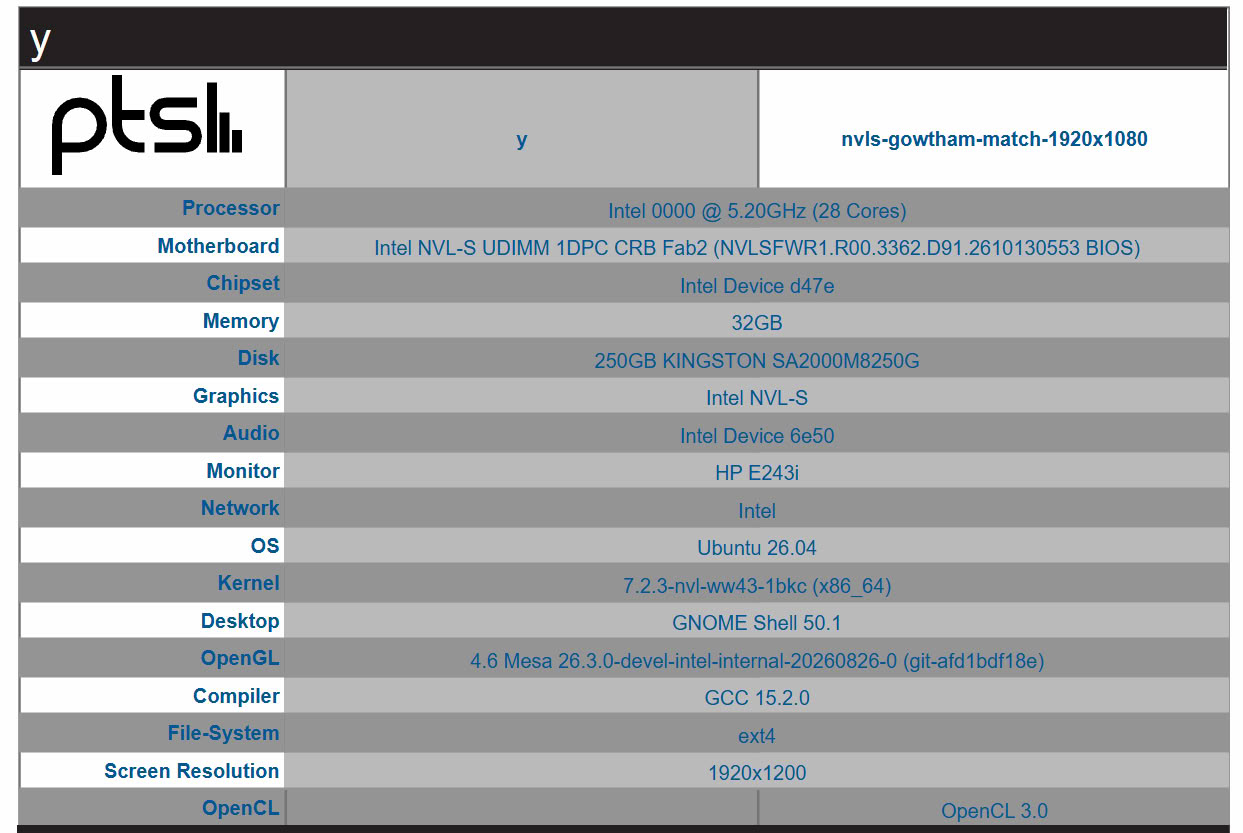
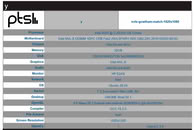 The system information lists 28 CPU cores, likely indicating a configuration with 8 P-Cores, 16 E-Cores, and 4 LPE-Cores, along with a reported operating frequency of 5.20 GHz. The motherboard is identified as an Intel "Nova Lake-S" reference platform, specifically an NVL-S UDIMM 1DPC CRB Fab2 configuration running an early BIOS build. The system was tested with 32 GB of memory under Ubuntu 26.04, suggesting that it could be Intel's internal engineering teams testing the system, or one of their OEM PC partners.
Source:
OpenBenchmark.org
Interestingly, the submission also identifies the integrated graphics as Intel NVL-S, indicating that the engineering platform is being tested beyond just CPU workloads. The tests include various graphics and compute applications, such as Quake II RTX, Unigine benchmarks, Hashcat, and multiple OpenCL workloads. While the 5.2 GHz figure is promising, it should not be taken as confirmation of the processor's final boost frequency. Engineering samples can operate with different firmware, power limits, and clock configurations than retail products. The listing also does not disclose whether the reported frequency represents a sustained operating clock or a maximum observed value.
46 Comments on 28-Core Intel "Nova Lake-S" Appears in Testing Running at 5.2 GHz
So I am expecting a response with the actual workloads?
Example I render
That response it not an actual answer to the question.I will be looking at the 12core Zen 6 X3D chip when its released and I want it for the additional 4 cores over my current 9800X3D.
Which will help with alot faster software compiles, Handbrake will also benefit as I use that alot for videos I create when I need to reduce the size, will also allow for better multitasking when I have the processor at full load.
Also want the additional instruct sets AMD is adding for AI workloads on Zen 6.
I don't really think so. According to tests, zen6 latency in 1-32MB increased by 17% compared to zen5. Overall though, adding more cache is a good thing.True. You can never have too much performance since demand is always there, and in theory nobody complains about a faster PC.
What I don't get is why people still complain about e core when intel gives 28 physical cores that seriously boost CPU performance, backed up by real-world tests showing clearly faster processing.
Why? I mean, yes, you outlined your reasoning, but what’s the point for Intel to basically nerf their desktop CPUs for… no reason? The amount of P-cores that will take up the space occupied currently by E-cores will absolutely not be enough to overcome the resulting MT performance deficit. You are essentially asking them to make worse CPUs just because. The software and OSs have caught up to the heterogeneous approach for the most part and will only improve with time. The approach WORKS. Denying it at this point is just being contrarian. Whatever issues Arrow Lake had at launch weren’t due to its hybrid nature. The refresh fixed what was left. The 270K is basically a 9950X at 2/3rds of the price. It’s a good CPU. Taking away its MT chops just to gain two more “muh real” cores is not a good idea. End of story.
They have improved quite abit since their first offering.
However I think if intels released a P core only chip with like 12-16 cores with BLLC that will be the big winner for most people.
Those claims are valid when tehy use a monitor from year 2017? Old Kernel, dated file system, etc.
check the line "gelistet seit" geizhals.at/hp-elitedisplay-e243i-1fh49aa-a1664713.html
last listed price was in year 2022 for that monitor
support.hp.com/gb-en/product/product-specs/hp-elitedisplay-e243i-24-inch-monitor/model/17210319
the gcc points to july 2025. I do install gcc later than the 16 branch.
the storage in question which intel uses wiht so much money is only pice 3.0
www.techpowerup.com/ssd-specs/kingston-a2000-250-gb.d282
Why not spoof all teh operating system parameters? That is not that hard! The usual software look only in a few locations.
When measured in 1T, it is fine. If there is contention it falls off more compared to cores with private L2. So even if Coyote Cove ends up with very similar IPC to Arctic Wolf it will likely be higher real world performance even at same clock rate.
All CPU core designs are balancing Power, Performance, and Area. Pretty much every CPU vendor has realized that the best solution for client is to have 3 different cores that are all optimized for one of these 3 attributes instead of making one core that tries to do it all.
Why are E cores bad for desktop? You think 4 P cores would be a better use of Intel's die space than 16 E cores? For what purpose? 8P+16E is already losing. 12P would get slaughtered.Intel's E cores are pretty much the only good design they have left.
You want to get rid of them to add more of their garbage tier P cores? Intel's P cores are massive cores designed to sacrifice efficiency and area to have amazing performance....and then don't have amazing performance.
14900Ks a bit less cores but turbo at 6.2Ghz
Intel 285 a bit more cores, but single Turbo at 5.6 Ghz
Now a bit (true P ) more cores but at max of 5.1 Ghz
its all the same wheel rooling, no CPU is faster than the one made more than 12 years ago, as for general purpose
And thats cause an Intel Pentium 4 with pure cooper, single core, two threads runs at 5 to 6 ghz. I did it. Now its only a matter of cores, with O.S. putting more processes that are ususally not necessary)
With the exception of youcrude and some video codecs (interframe) , the majority of apps runs as sequential, step by step, like the intra frame prores codec, so.. that no advancements for consumer..
Once you get into parallel compute workloads like comp/decomp and compiles they want cores over inter-die latency. This is where Intel's e cores come in and curb stomp AMD.
When it comes down to core to core Arrow Lake already meets or beats Zen5. Disable the e cores and a 270k easily still matches and beats that 9700x. Re-enable those e cores and Intel curb stomps it in multicore. AMD's only lead is thanks to X3D's cache for games.
Intel's fear is if AMD really can crack 6ghz and stay there. They both sit comfortably at 5.4-5.5 right now, but Intel can't hold 6ghz yet. AMD aren't hitting 7ghz so stop listening to Morons Law Is Dead. Early leaks still show it capped around 5.7 under load.
AMD's fear is Intel increasing core count again with e cores on a SINGLE DIE. That single die 7 will most likely stomp the 9950x in multicore. AMD HAS to increase core count per CCD so it's competitive with the 7, let alone the dual die 52core 9. They can't even rely on X3D for the win with gamers and enthusiasts anymore. X3D adds 96mb of 3rd layer cache. Intel's LLC is going to add 144mb of 3rd layer cache. Then when you look at architecture Intel's 18a is showing to be psychotically efficient with Panther Lake. TSMC's 2nm can clock high, but it eats power to hit those speeds. Probably why engineering samples have been in the mid 5ghz range.
AMD has everything to lose right now. Intel is about to cancel their X3D gamer card. They're also about to stomp all over the 16 core and most likely any 24 core in multi. AMD doesn't have a fat OEM following like Intel does. If Nova Lake is even half as good as I'm expecting and ALL the top chips have gobs of cache without a super special X3D moniker I worry about AMD in the long run.
GL with that awesome money saving you do there lol. There is a point where moar is just comical, and we're in that space for a while now with these Intel CPUs.Those also happen to be workloads that are either in realtime or mandatory to continue further work so its pretty neat that those scale on cache.
A rendering workload that isn't realtime, can last a few minutes longer just fine, as do most other consumer related workloads. The only time critical ones are the realtime ones.