News Posts matching #Core

Return to Keyword Browsing

Maxsun Readies Panther Lake and Wildcat Lake MoDT NAS Motherboards for November

Maxsun has shared full specifications for the SK-PTLNAS and SK-WCLAIO, two NAS-focused MoDT (Mobile on Desktop) motherboards built around Intel's Panther Lake and Wildcat Lake chips. Both were first shown at Computex 2026 and are expected to launch this month, though pricing is still unknown. The SK-PTLNAS now tops out at the Core Ultra 9 386H, a 16-core chip with four Xe3 GPU cores, a 25 W base power and up to 80 W of turbo power. The Computex listing mentioned options up to the Core Ultra X9 388H, which no longer seems to be on the table. It supports up to 128 GB of DDR5-7200 memory across two SO-DIMM slots, with five M.2 slots and three Mini SAS ports for storage. The board also gets a PCIe 5.0 x8 slot, 10GbE, 2.5GbE and two 1GbE ports, plus two Thunderbolt 4 ports. Maxsun lists Windows 11 and Ubuntu support.

The SK-WCLAIO measures just 90 x 165 mm, a big change from the mATX design shown in June. It runs the six-core Core 7 350 (2P + 4LPE) with two Xe3 cores, a single DDR5-6400 SO-DIMM slot for up to 48 GB, 1 TB of onboard UFS 3.1 storage and four M.2 slots. Wildcat Lake has very few PCIe lanes, so those drives probably won't each get full x4 bandwidth. Maxsun rates the system at 45 W when active and 16 W with drives on standby, which should suit an always-on home NAS. The power input is a bit unclear for now, since the listing mentions both a 12 V DC jack and USB-C PD.
Intel Nova Lake-S CPUs Reportedly Drop to 5.1 GHz Max Above 90°C

Intel's upcoming Core Ultra 4000 "Nova Lake-S" desktop processors will reportedly cap their maximum core frequency at 5.1 GHz whenever they run above 90°C, according to Intel leaker Jaykihn on X. He says the limit applies to the entire Nova Lake-S desktop lineup, works separately from regular TjMax throttling at 100°C, and can't be raised. He also notes that the information is still preliminary. In practice, it looks like a safety net that sits between normal boost behavior and full thermal throttling. Below 90°C, the chips should presumably boost as usual, and models that don't exceed 5.1 GHz in the first place wouldn't be affected at all.

Final Nova Lake clocks aren't official yet, though the current Core Ultra 9 285K already boosts up to 5.7 GHz, so a high-end Nova Lake chip that runs hot could lose a sizable chunk of its peak frequency. A 100°C TjMax would also be lower than Arrow Lake's 105°C, which can be manually raised to 115°C on the 285K. That puts more weight on cooling, since the 28-core Core Ultra 9 4970K BFC was reportedly set to pull up to 296 W at PL2 despite its 125 W rating, and staying under 90°C at that kind of power draw will probably take a really capable cooler. Nova Lake-S is currently expected to arrive in Q1 2027, and Intel hasn't confirmed any of this yet.

Intel Readies "Moon Lake" and "Wildcat Lake Refresh" Built on 18A Node

Intel is reportedly preparing two new processor SKUs focused on extremely low-power computing. The first, called "Moon Lake," is designed as a pure low-power efficiency (LPE) core SoC. The "Moon Lake" generation features no P-Cores and up to 4 "Darkmont" LPE-Cores on the Intel 18A die. Unlike "Wildcat Lake," which includes at least 2 P-Cores, "Moon Lake" is intended to be a much smaller design for embedded devices like NAS. The base power of "Moon Lake" is reportedly rated at 6 W, similar to an SoC typically used in smartphones. The number of Xe3 cores in this SKU is unknown, but since "Wildcat Lake" has up to 2 Xe3 cores, we expect "Moon Lake" to have half of that to maintain its 6 W TDP. Intel has manufactured "Moon Lake" on its 18A node and placed it on the BGA1516 package, the same platform used by "Wildcat Lake." The official moniker for "Moon Lake" is MNL, and it could be a successor to the N-Series, like the previous "Alder Lake-N" series of low-power processors.

Additionally, Intel is preparing an overhaul of "Wildcat Lake" with the new "Wildcat Lake Refresh." When Intel launched the Core 300 Series "Wildcat Lake" earlier this year, these processors came with up to 2 P-Cores, 4 E-Cores, and up to 2 Xe3 GPU cores, with a package reaching up to 35 W. However, the new "Wildcat Lake Refresh" is expected to increase the number of P-Cores to 4 while keeping the same base microarchitecture of "Cougar Cove" and maintaining 4 "Darkmont" LPE-Cores. The integrated graphics remain similar, with up to 2 Xe3 cores. Importantly, this refresh adds support for Intel's vPro technology, meaning that enterprise customers are in for a surprise with a new low-cost option for their PCs.

Intel Confirms "Nova Lake" Uses 18A-P Internal Node, More Details at CES

During the Q3 2026 earnings call, Intel CEO Lip-Bu Tan confirmed that the company's upcoming flagship client CPU, codenamed "Nova Lake," will be produced by Intel Foundry using its 18A-P node. Initially, Intel planned to outsource the main compute tile production for "Nova Lake" to TSMC, utilizing its 2 nm N2 node. TSMC was expected to handle about 60-70% of the production, with the remainder produced in-house by Intel Foundry on the 18A node. This meant Intel would dual-source production for its next-generation chip. However, later supply chain information suggested that the company intended to bring the majority of "Nova Lake" compute tile production in-house, with these compute tiles being made on the Intel 18A-P node. Today, we received confirmation directly from the Intel CEO:
Intel CEO Lip-Bu Tan"Nova Lake," our first Intel 18A-P client product, is tracking ahead of schedule, with design wins expected to be twice those of "Panther Lake" at launch. We look forward to sharing more at CES in January.

Biostar Introduces the EdgeComp MS-U320 Fanless Edge AI System

BIOSTAR, a leading manufacturer of edge AI solution, IPC systems, motherboards, graphics cards, and storage devices, today introduced the EdgeComp MS-U320, a compact fanless edge AI system powered by the Intel Core 5 320 processor (Wildcat Lake). Designed for equipment manufacturers and system integrators, the MS-U320 combines on-site data processing, light AI computing, and industrial connectivity for applications in industrial automation, smart manufacturing, industrial IoT, smart retail, and smart infrastructure.

The MS-U320 features an onboard Intel Core 5 320 processor with six cores, clock speeds of up to 4.6 GHz, a 15 W TDP, and integrated Intel graphics. A single DDR5-6400 SO-DIMM slot supports up to 64 GB of memory, while the integrated CPU, GPU and NPU deliver up to 40 TOPS of AI performance. This combination supports local data processing and light AI workloads without requiring a separate accelerator.

28-Core Intel Nova Lake-S CPU Shows Promising Performance Boost in Leaked Benchmark

It looks as though the upcoming Intel Nova Lake-S CPU family will launch soon, headed-up by a 28-core Core Ultra 9 CPU. A new PassMark benchmark spotted by VideoCardz now purports to show expected performance of that 28-core Nova Lake-S CPU in two separate benchmark runs. The CPU, which is listed as "Nova Lake Client Platform," with the motherboard model giving it away as "NVL-S Embedded CRB 1 Fab2 Board," appears alongside an eight-core NVL-S CPU, and both CPUs achieve decent scores in the single-threaded performance benchmarks.

According to the PassMark database scores, the eight-core NVL-S scores up to 5,085 points, while the 24-core variant tops out at 5,210 points. Meanwhile, the 28-core—ostensibly the Core Ultra 9 4970K BFC—scores as high as 61,509 points in the multithreaded CPU test, and the eight-core variant, likely a Core Ultra 3 or 5 CPU, scores 23,478 points. If these PassMark scores are accurate, this puts the Core Ultra 9 4970K BFC at around 85% of the performance of an AMD Ryzen 9 9950X3D in multicore performance, while the CPU beats out the Intel Core Ultra 9 285K on single-threaded performance but misses out on matching the outgoing Intel chip by 5,721 points or around 8.5%.

AMD EPYC 9996 Geekbench Listing Offers First Look at Zen 6 Single-Core Gains

AMD's Zen 6 just got one of its first rough per-clock comparisons against Zen 5, and the early numbers look good. Leaker HXL spotted a Geekbench 7.1.0 listing for the 256-core EPYC 9996, the flagship "Venice" chip AMD launched in July, scoring 2,847 points in single-core on a Dell PowerEdge R9815 server running Linux. User three twenty six on X then locked a Ryzen 7 9700X to 4.1 GHz, matching the EPYC 9996's maximum boost, and got 2,444 points on the same Geekbench version. That works out to roughly 16.5% higher single-core performance for Zen 6 at the same frequency. Apparently, Zen 6 came out ahead in all 15 single-core subtests, with gains ranging from 8.2% in File Compression to 25.7% in HTML5 Browser.

Of course, these scores only give us a general idea about the gains. The EPYC 9996 uses the dense Zen 6c cores, not the full Zen 6 cores expected in desktop Ryzen chips, so it's hard to say how closely these numbers will carry over. The two systems are also wildly different, with a server platform on one side and a 9700X running DDR5-6000 CL34 under CachyOS Linux on the other, and the EPYC listing has since been pulled from the Geekbench database. Still, a double-digit per-clock gain from the dense core variant is quite encouraging. AMD has already confirmed that "Olympic Ridge" desktop CPUs will stay on AM5, though they reportedly won't arrive until 2027, so we can expect more comprehensive performance leaks well before then.

Xiaomi Redmi Book 14 2027 With Intel Wildcat Lake CPU and 2.8K Display Confirmed

Xiaomi has officially spilled the beans on the 2027 update to its Redmi Book laptop series, detailing both a launch date and what to expect from the laptops in terms of performance and battery life. The information comes courtesy of the Xiaomi Redmi account on Weibo, and the announcement reveals an October 27 release date for the Redmi Book 14 and likely the 16, alongside it. It's so far unclear if and when the new Redmi Book laptops will launch internationally or what the pricing will be, but the outgoing Redmi Book 14 starts at 6,499 CNY with 16 GB of RAM and 512 GB of storage.

With the post, Xiaomi also confirms that the Redmi Book 14 and 16 will be using Intel's Wildcat Lake Core Series 3 processors, with previous leaks having tipped the Core 5 320 for the Redmi Book 16, and the fine print on the marketing images now confirming the Core 5 320 for the Redmi Book 14. The Redmi Book 14 2027 has also been confirmed to ship with a 72 Wh battery, which Xiaomi claims will deliver over 20 hours of office use, with a claimed 1.26 days of local video playback. It will also use LPDDR5X-7467 RAM, although capacities are unclear at the time of writing, aside from the confirmation that there will be a 16 GB version available. The fine print also confirms that the display will be 2.8K, however the panel tech isn't mentioned.

AMD Readies Official Ryzen Overclocking Driver for Linux

AMD is reportedly working on official Ryzen overclocking controls for Linux. Per Phoronix, AMD engineer Shyam Sundar S K has posted a three-patch series for a new driver called AOD, short for AMD Overclocking Driver, to the platform-driver-x86 mailing list. It is a WMI driver that talks to the same firmware interface Ryzen Master uses on Windows, with all of its controls exposed through sysfs. For now, that covers PPT, TDC, and EDC limits along with their supported ranges, a platform-level SMT toggle, and a read-only memory clock readout. Notably, Ryzen Master itself isn't coming to Linux with this. AMD seems to be following the same approach it took with its amdgpu graphics driver, handling the kernel side and leaving the GUI to third-party tools such as CoreCtrl and to desktop environments.

There are a few catches, however. Power limit changes are stored in firmware and only kick in after a reboot. AMD's existing HSMP interface works the other way around, applying limits instantly but losing them on restart. The PPT, TDC, and EDC attributes are also write-only, since the firmware doesn't report the currently active values. The SMT switch, meanwhile, behaves more like a BIOS option than the kernel's nosmt boot parameter. Apparently, the firmware supports many more commands than the initial patches wire up, so more controls could arrive later. The patches are still under review, and there is no word yet on which kernel release will pick them up, so a proper Linux app for this is probably still a while away.

Leak: Intel Core Ultra 9 4995HX Leads Nova Lake Laptop Lineup

Intel's Core Ultra 9 4995HX looks set to be the fastest Nova Lake chip for laptops. Leaker Jaykihn on X has confirmed that the 4995HX uses an 8+16+4+2 layout, meaning 8 P-cores, 16 E-cores, 4 LPE cores, and 2 Xe3 GPU cores. That adds up to 28 CPU cores, four more than Intel's current Arrow Lake-HX chips, with the extra cores coming from the LPE cluster Arrow Lake-HX lacked. The overall layout matches the 8P+16E+4LP ceiling earlier reports pointed to, and the name itself fits the Core Ultra 4000 branding said to be extending to HX parts. Intel hasn't confirmed any of this, and clocks, cache, and power figures are still unknown.

The same post lists the Core Ultra 9 4970H as 4+8+4+12, so 16 CPU cores and a 12-core Xe3P iGPU. That is the same core count as Panther Lake's flagship Core Ultra X9 388H, so any gains here should come from the new Coyote Cove P-cores, Arctic Wolf E-cores, and Xe3P graphics rather than extra cores. The tiny iGPU on the 4995HX is less of a concern, since HX chips almost always end up paired with a discrete GPU anyway. Jaykihn also put the final 8+16 HX compute tile, built on TSMC N2P, at 14.8 x 6.6 mm, or roughly 98 mm², shortly after die shots of both chips surfaced. Current reports point to the first Nova Lake-H and HX laptops showing up around CES 2027, though that timing should be treated as tentative for now.

Intel Core i5-4670K Gets a New Cinebench R11.5 Record, 13 Years After Launch

Overclocker Luumi has taken the top spot in HWBot's Cinebench R11.5 rankings for the Intel Core i5-4670K, beating a record that had stood for around 12 years. Running the 2013 Haswell quad-core at 6,301 MHz under liquid nitrogen, Luumi scored 10.8 cb, just edging out Strat's previous 10.76 cb at 6,249 MHz. That's roughly 66% above the chip's 3.8 GHz boost clock, which is quite a lot for a four-core, four-thread part built on Intel's 22 nm process. The top of the leaderboard is tight as well, with Moose83 sitting third at 10.74 cb out of 187 submissions. Of course, this is a record for the i5-4670K category, not an overall Cinebench R11.5 world record. Luumi also has a history with Cinebench, having set an 8-core world record on an EVGA Z390 Dark back in 2018.

The test bench was period-correct too. Luumi used an ASRock Z97 OC Formula, the same board that pushed a Core i7-4790K past 7 GHz back in 2014, along with 4 GB of XPG DDR3 running at 2,708 MT/s with 8-12-7-28 timings and a Corsair AXi 1600 power supply. The run was done on Windows 7, as HWBot's R11.5 rules apparently don't allow pre-Skylake Intel chips on newer versions of Windows without BenchMate. Haswell is no stranger to extreme clocks, as the Core i7-4770K was overclocked to 7 GHz before it even launched in 2013. A modern 12-core laptop reportedly scores around four times higher in R11.5 while running in quiet mode, so the achievement here is about squeezing every last megahertz out of 13-year-old silicon.

GIGABYTE BIOS Update Points to New DDR4 Intel Processors Coming Next Year

GIGABYTE has released BIOS updates that prepare its entire Intel B760 and H610 motherboard lineup for upcoming LGA1700 processors, which the company says are "expected to launch in early 2027." As reported by Videocardz, the update covers DDR4 and DDR5 boards alike, so owners only need to flash the new firmware and drop in the new CPU once it arrives. GIGABYTE doesn't name the processors in its press release, and Intel has yet to announce anything new for the socket. However, the timing lines up what we've been reporting for months. Intel is said to be readying "Raptor Lake Next" chips for LGA1700 in 2027, based on the original Raptor Lake silicon.

That makes GIGABYTE's BIOS the closest thing to a confirmation of new DDR4-compatible Intel processors for 2027, and it comes before Intel has announced them. It looks like the firmware was rolling out quietly even before the press release. The B760 Gaming X AX, for example, received its F18 BIOS on September 29, with a changelog that lists a CPU microcode update and "preparation for upcoming processor support." GIGABYTE also claims to be the first vendor to cover every B760 and H610 model. The press release makes no mention of Z790, Z690, or B660 boards, and there's no word on whether those will follow.

AMD Shares Its Progress with Agentic PCs

AMD held a press briefing to share how its "Agentic PC" push is going, and it brought a fair number of figures along. Apparently, the company has shipped over half a million Agentic PCs across more than 50 designs, alongside tens of millions of AI PCs across more than 250 designs. Of course, the term "Agentic PC" is AMD's own. It covers any PC whose CPU, GPU, and NPU can run AI agents locally, and AMD says Ryzen AI Max+ systems with 64 GB of memory or more give the best experience. The Ryzen AI Max 400 series is pitched as the "next-gen Agentic PC" for 2026, and most of the briefing focused on its flagship, the Ryzen AI Max+ PRO 495 "Gorgon Halo" with 192 GB of memory.

Intel Reportedly Limits "Nova Lake DS" Samples, Rollout Starts in December

Intel is reportedly limiting access to some of its most interesting "Nova Lake" processors during the early development stages. According to leaker Jaykihn, chips with the internal "DS" designation are being distributed to a much smaller group of testers compared to the rest of the "Nova Lake" lineup. This "DS" designation reportedly includes parts built around two compute tiles, which are expected to be among the first to be released. These SKUs are currently known to carry the "BFC" suffix, which has appeared on several leaked Core Ultra 4000 desktop processors and is linked to Intel's larger big last-level cache (bLLC) implementation. For example, the leaked Core Ultra 9 4970K BFC is a 28-core processor combining eight P-cores, 16 E-cores, and four LPE cores.

The scarcity of BFC hardware in public leaks may be more related to Intel's sampling policy than to availability. The leaker claims these processors are being kept within a restricted testing group, preventing them from appearing through the standard qualification-sample pipeline that usually produces early benchmarks and hardware detections. This way, no public benchmark scores are surfacing, leaving us in complete dark before the official launch happens.
Intel Nova Lake

Intel Core Ultra 4000 "Nova Lake-S" Lineup Leaks With 28-Core 4970K BFC

A new leak by @laurentschoice lists seven desktop Nova Lake-S processors under what looks like Intel's new four-digit Core Ultra 4000 naming, led by a Core Ultra 9 4970K BFC. It apparently has 8 P-cores, 16 E-cores, and 4 LPE cores for 28 in total, plus bLLC (big last-level cache), a 125 W rating, and a 32 EU iGPU. That puts it above the Core Ultra 9 4950K, which first surfaced in a CPU-Z leak in August as a 28-core chip. This list shows the 4950K with 24 cores (8 P-cores and 16 E-cores), without LPE cores or bLLC.

The rest of the list follows a similar pattern. The Core Ultra 7 4870K BFC has 24 cores and bLLC, while the 4850K gets 20 cores without it. There is also a Core Ultra 9 4900 BFC with 22 cores, bLLC, and a 65 W rating. We currently don't know what BFC stands for, although the models carrying it appear to be the ones with bLLC, which Intel is introducing as its answer to AMD's 3D V-Cache. Intel hasn't confirmed any of these names, so they may well change before Nova Lake's official launch.

AMD Publishes Full EPYC 9006 "Venice" Specs and Pricing: 8-Core at $700, 256-Core at $14,904

AMD has published the full EPYC 9006 "Venice" lineup on its product page, listing specifications and 1,000-unit pricing for all 31 Zen 6 server processors across the SP7 and SP8 platforms. Prices start at $700 for the 8-core EPYC 9016 and top out at $14,904 for the 256-core EPYC 9996. AMD says the specifications are subject to change. The EPYC 9996 is the flagship, with 256 Zen 6c cores and 512 threads, a 2.55 GHz base clock, up to 4.1 GHz boost, 1 GB of L3 cache, and a default CPU power of 600 W (configurable from 400 W to 600 W). That works out to roughly $58 per core, and it costs about the same as the 192-core EPYC 9965 did at launch, which was around $14,800.

The SP7 platform covers nine chips, from the 64-core EPYC 9556 at $8,008 up to the 9996. The 22 chips on the SP8 platform run from 8 cores up to the 128-core EPYC 9746 at $11,679. AMD has also retired TDP as its power label for this generation, using "Default CPU Power" instead. SP7 systems are expected in Q4 2026, with SP8 following in the first half of 2027. These are 1Ku prices, so what OEMs charge for complete systems will probably look quite different. Nevertheless, it looks like the EPYC 9996 is the one to watch for this generation, especially after AMD's claims of beating NVIDIA's Vera CPUs by a significant margin.

ASRock Industrial Expands Mainstream Edge Computing With Intel Core Series 3 Platforms

ASRock Industrial proudly presents its latest lineup of industrial edge computing platform powered by Intel Core Series 3 processors (Wildcat Lake-U), designed to bring power-efficient computing and integrated AI acceleration to mainstream industrial and embedded edge applications. Featuring integrated CPU, GPU, and NPU compute engines with up to 40 platform TOPS, the new platforms support up to 64 GB DDR5 6400 MHz memory, high-speed expansion and storage, rich I/O connectivity, and multi-display capabilities. Spanning industrial motherboards, NUC motherboards, and compact NUC BOX systems, ASRock Industrial's Intel Core Series 3 portfolio provides right-sized computing options for industrial control, HMI, intelligent gateways, smart retail, digital signage, and other mainstream edge applications.

NUC Core 300 BOX Series: Compact, Power-Efficient Edge Computing
The NUC BOX-320 and NUC BOX-304 integrate Intel Core Series 3 processors into compact fanned embedded BOX PCs, powered by the Intel Core 5 processor 320 and Intel Core 3 processor 304, respectively. The systems support up to 64 GB of single-channel DDR5 6400 MHz memory with In-Band ECC. For expansion, the systems provide one M.2 Key E (2230) slot with Wi-Fi 6E and Bluetooth 5.3 for wireless connectivity. Networking includes one Intel 2.5 Gigabit LAN and one Realtek 2.5 Gigabit LAN. Storage configuration includes one M.2 Key M (2242) slot with PCIe Gen 4 x1 and one M.2 Key M (2242/2280) slot with PCIe Gen 4 x2 for SSDs. I/O connectivity includes two USB 3.2 Gen2x2 Type-C and three USB 3.2 Gen 1 Type-A ports. The series supports triple-display output up to 4K through two HDMI 2.1 and DisplayPort 1.4a outputs from Type-C. Intel PTT and a 19 V/90 W power adapter further support secure, ready-to-deploy system integration. Built in a compact 117.5 x 110 x 49 mm fanned chassis with VESA mounting support, the NUC Core 300 BOX Series provides a space-efficient computing platform for smart retail, digital signage, kiosks, HMI, and other mainstream edge applications.

CD Projekt Red Unveils Detailed PC Requirements for The Witcher 3: Wild Hunt Remastered

CD Projekt RED has published the full and updated PC requirements for The Witcher 3: Wild Hunt Remastered, which launches tomorrow, September 29, as a free upgrade for existing owners. Only the minimum and recommended specs were public until now, but the new detailed requirements are broken down by categories and even include separate Ray Tracing and Path Tracing requirements. The updated table covers six tiers: Minimum, Recommended, Ultra, RT Minimum, RT Recommended, and Path Tracing.

The Minimum tier targets 1080p at 30 FPS with the Low preset, and requires a Core i5-8400 or Ryzen 5 2600 CPU, 12 GB of RAM, and a GTX 1660, RX 5500 XT, or Arc A580 graphics card. CDPR says the GTX 1660 can reach 60 FPS or higher there. Recommended (1080p, 60 FPS, High) asks for a Core i7-8700K or Ryzen 5 3600X CPU, 16 GB of RAM, and an RTX 2060 Super, RX 6600 XT, or Arc B580 GPU. If you want to play at Ultra (1440p, 60 FPS), it calls for a Core i7-13700K or Ryzen 7 7700X CPU, 24 GB of RAM, and an RTX 3070 Ti, RX 6800 XT, or Arc B580 graphics card with XeSS.

Wici Wireless eGPU Promises RTX 5060 Ti and 5090 Performance Over Wi-Fi 7

There has been a lot of development in the eGPU scene lately, with Thunderbolt 5, OCuLink, and MCIO 8i providing serious gains in bandwidth and throughput for eGPU use cases. However, Wici has just launched the Wici One, a new wireless eGPU solution that relies on Wi-Fi 7 for data transfer instead of a cable connection, available with both an NVIDIA GeForce RTX 5060 Ti or an NVIDIA GeForce RTX 5090, the latter of which does not yet have a listed price.

While Wi-Fi 7 is capable of theoretical maximum speeds of around 46.1 Gbps, as VideoCardz points out, the 4×4 radio inside the Wici One, running at 320 MHz and 4096-QAM, would top out at just 11.5 Gbps. To add to this limitation, those speeds are likely only possible over very short distances, with very little interference. Still, Wici promises high-framerate gaming over the network-connected device, with Cyberpunk 2077 reaching 80 FPS at 4K Ultra with DLSS 4 on the RTX 5060 Ti version and Black Myth: Wukong hitting 60 FPS in the 4K Cinematic preset. No latency claims are made, however, but, gaming, a latency-sensitive workload, isn't Wici's main selling point. The true focus for Wici is as a workstation machine, since it contains not only a GPU. The Wici One is actually a full platform, replete with a CPU and storage—presumably, the platform relies entirely on VRAM, since there are no RAM specs or quantities listed.

Intel Reportedly Preparing 8P+8E ''Raptor Lake Next" Chip to Replace Core i5-14600K

Intel is reportedly preparing to retire the Core i5-14600K in favor of a new "Raptor Lake Next" chip with eight P-cores and eight E-cores. According to leaker Jaykihn on X (spotted by VideoCardz), the successor will have two more Performance cores than the current 14600K, putting it on par with the Core i7-14700K in P-core count, though not necessarily in cache or clocks. Raptor Lake Next is the codename for Intel's plan to extend the LGA 1700 platform with fresh silicon based on the original Raptor Lake design rather than the newer Raptor Lake Refresh. The chips are expected to launch alongside new LGA 1700 motherboards from Intel's partners in early 2027.

Intel seems to be using the lineup to fill gaps in the 14th Gen stack instead of replacing it outright, and it's reportedly also working on more 125W and 65W desktop SKUs alongside mobile variants. DDR4 support is apparently part of the pitch, which would help buyers sidestep today's DDR5 pricing crisis. More P-cores should help in games that lean on core count, and it looks like this could put the chip ahead of the Core Ultra 5 250K Plus, since the current 14600K already trades blows with Arrow Lake Refresh in several titles. That said, this is a single-source claim for now, so treat the exact configuration and timing as rumor until Intel or its partners confirm anything.

Mobile Intel 12 Xe "Nova Lake" May Support Upgradeable DDR5-8000 Memory

Intel's next-generation Nova Lake mobile chips with 12 Xe-core graphics may support DDR5-8000 memory through CSODIMM modules, according to leaker Golden Pig Upgrade Pack on Weibo. If that pans out, it would be the first mobile Nova Lake variant to officially support DDR5, a notable departure from the soldered LPDDR memory that dominates thin-and-light laptops right now. Current Panther Lake systems with 12 Xe cores, like the Core Ultra X7 358H, don't officially list DDR5 support, though ASRock Industrial already ships mini PCs with two DDR5 SO-DIMM slots running at DDR5-7200 on that platform, and Intel itself includes this configuration among its Core Ultra Series 3 developer systems.

Nova Lake-S, the desktop version, has already been tied to DDR5-8000 through leaked B960 chipset details and platform documents, so Intel appears to be pushing that same memory ceiling down into at least part of the mobile lineup too. Unlike soldered LPDDR5X, CSODIMM support would let OEMs offer upgradable RAM again in these systems, an option that's grown rare in slimmer laptop designs built around battery life and board space. Despite the leaker's solid track record, this is still a single leak rather than anything Intel has confirmed, so I'd hold off treating the exact speeds as final. If it checks out, it suggests Intel is willing to give at least some mobile Nova Lake configurations more memory flexibility, even as most of the market keeps drifting toward soldered memory for efficiency.

Intel Set to Raise CPU Prices by Another 10% in October

Intel is reportedly planning another 10% price increase on PC CPUs in October, according to DIGITIMES. This would be the latest in a string of price hikes made in stages over the past year. The report doesn't specify whether this price increase will affect only desktop CPUs or whether mobile CPUs will also be included. Industry sources cited by the outlet say the goal is to improve gross margin rather than growing market share. That would be especially important, since global PC shipments are expected to dip slightly from 260 million to about 250 million units in 2027, even as prices continue to climb. If Intel can push CPU shipments back up toward 200 million units, DIGITIMES estimates its market share could recover to roughly 78%.

The report also claims Intel is considering ending its low-margin Small Core product line entirely, which could open the door for Qualcomm and MediaTek to expand further into the industrial PC and IoT chip markets that Intel currently leads. On staffing, sources suggest another 5% to 10% of the workforce could be cut, following Intel's trim of its Data Center and AI group in July. Headcount reportedly sits around 75,000 now, though the same sources say Intel plans to keep hiring alongside any cuts, and that its current size is already reasonable.

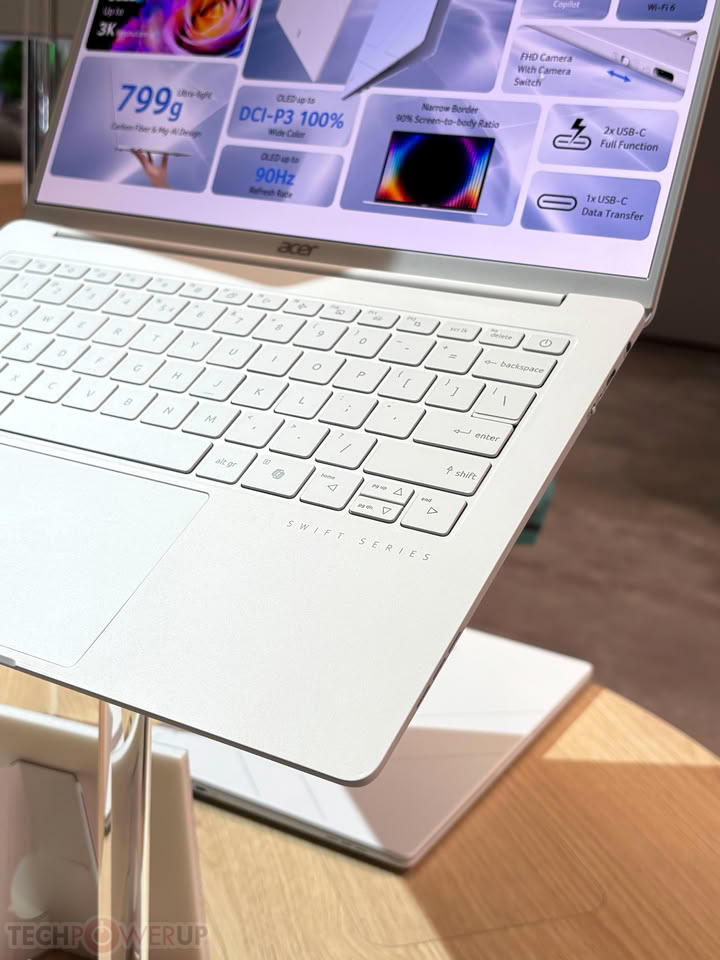
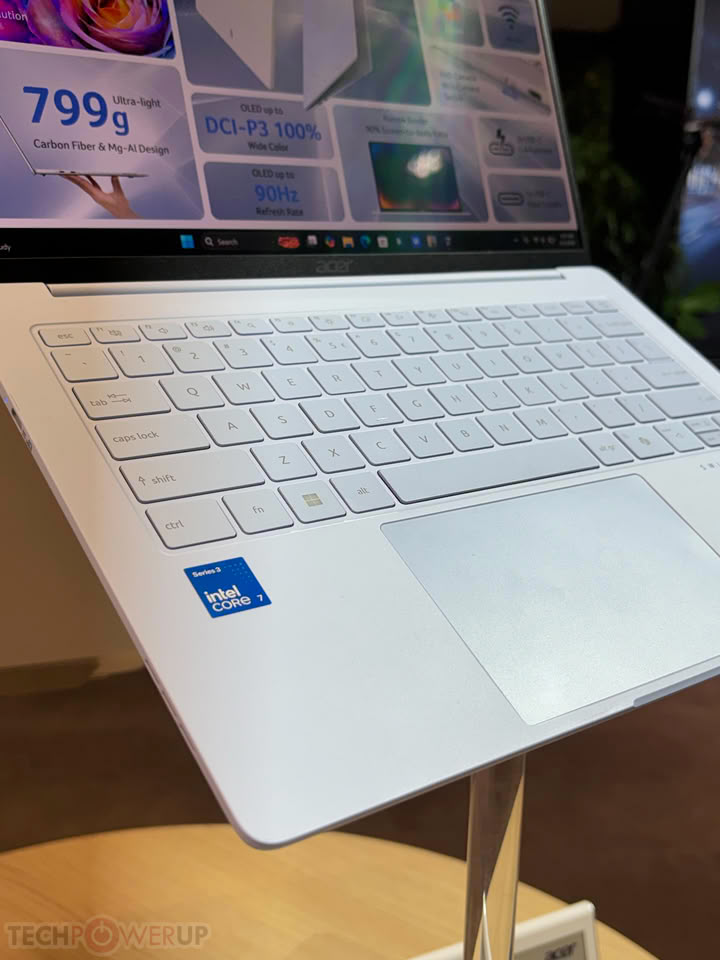
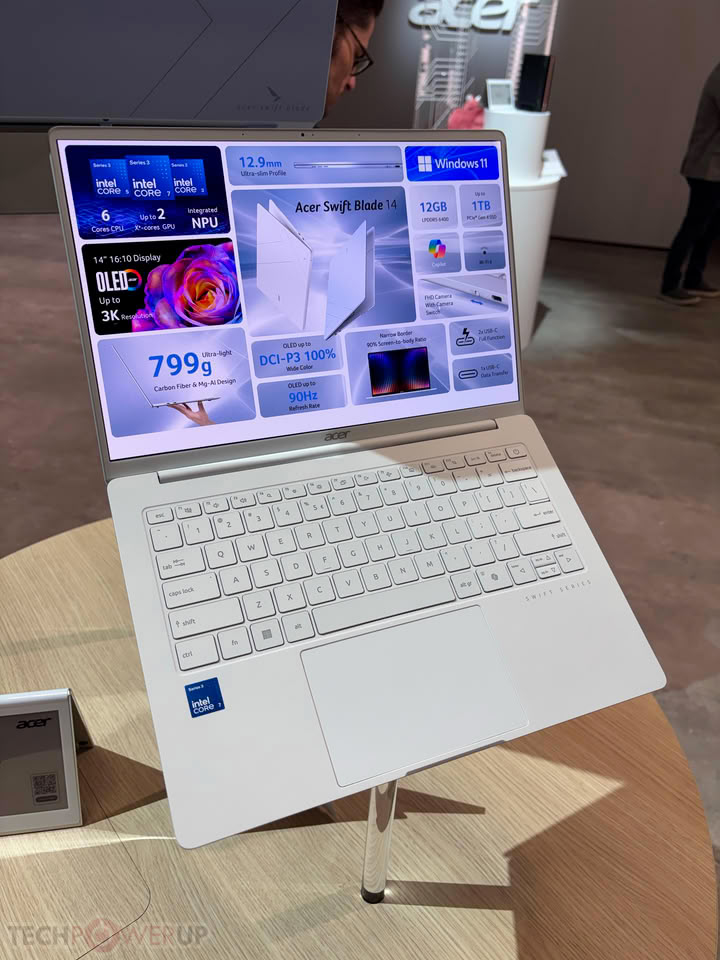
Acer Shows Off the 799g Swift Blade 14 at IFA

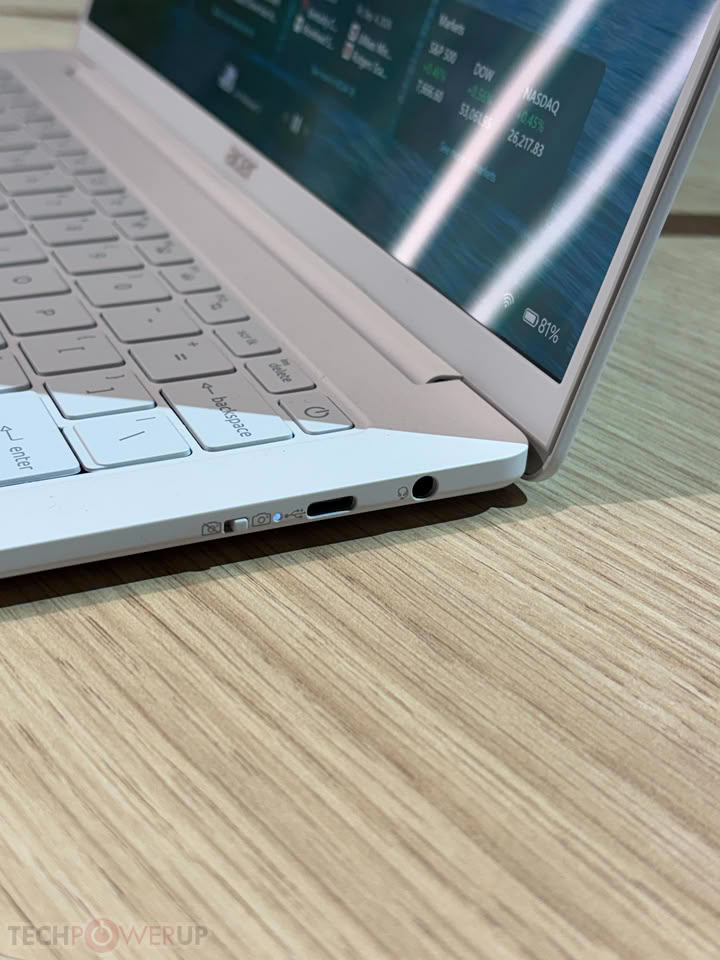
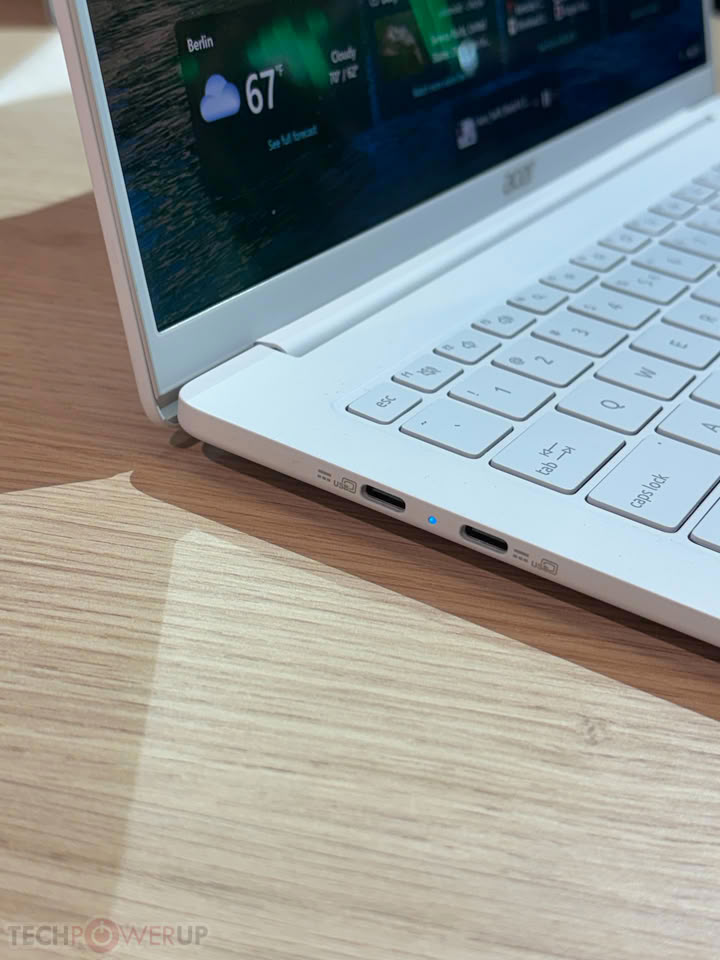
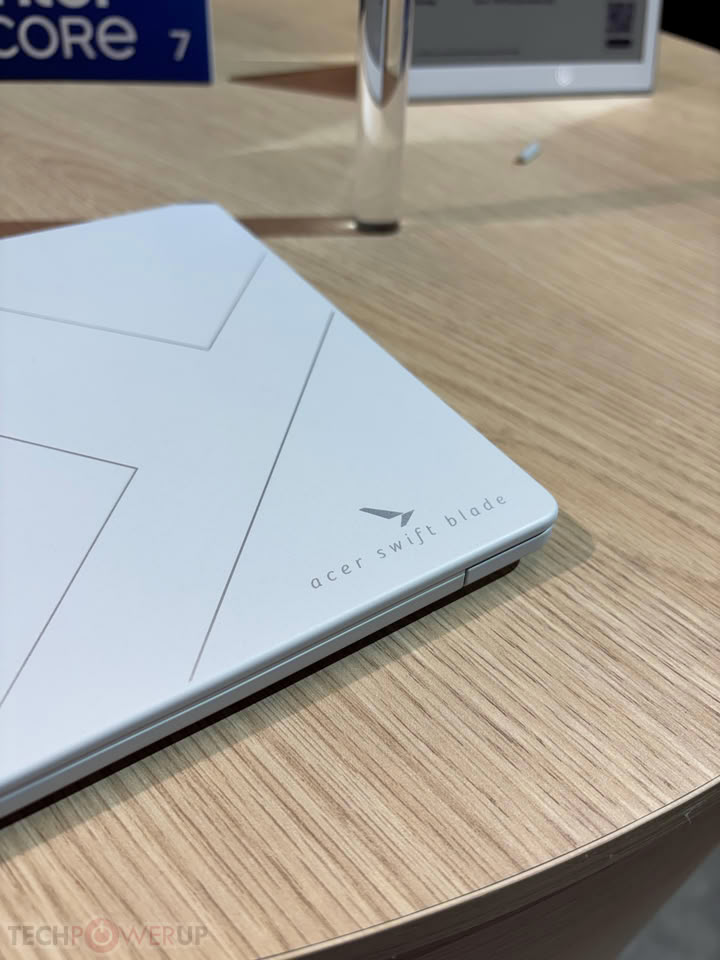
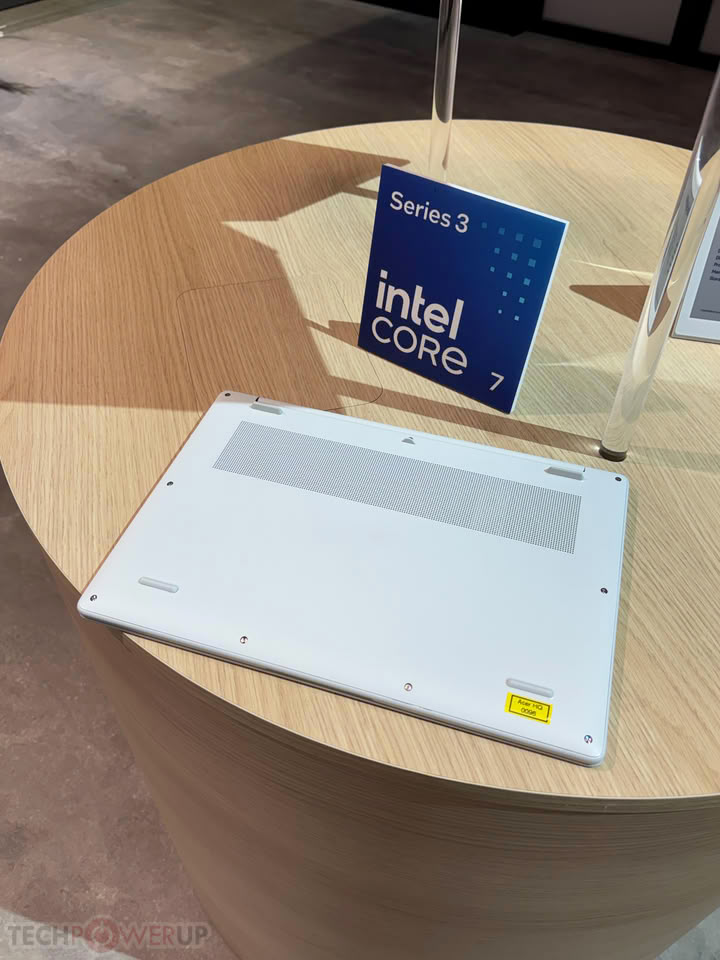
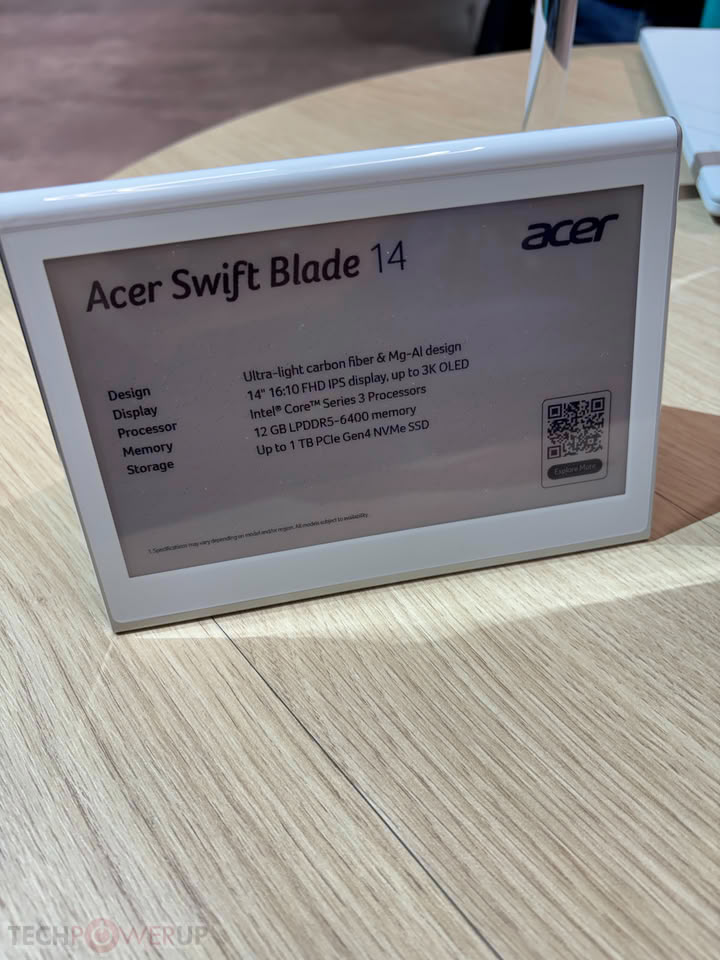
We're on the ground at IFA in Berlin this week, and one of the more interesting machines we walked past on the show floor was the Acer Swift Blade 14. It's a new sub-brand under Acer's Swift lineup, and the first thing you notice picking it up is just how little of it there is to hold. Acer built the Swift Blade 14 to weigh just 799 grams (1.76 pounds), making it one of the lightest 14-inch Windows laptops we've come across. The chassis pairs carbon fiber on the top and bottom covers with a magnesium-aluminum alloy keyboard deck, keeping the weight down without the machine feeling flimsy in hand. It measures 12.9mm thin on the base configuration and 13.5mm on OLED models. That's not quite as thin as a 13-inch MacBook Air, but it is significantly lighter.

Inside, the laptop runs on Intel's Wildcat Lake platform, scaling up to a Core 7 350 CPU alongside 12GB of onboard LPDDR5-6400 memory and up to 1TB of PCIe Gen 4 NVMe storage. The display comes in three tiers, topping out at a 3K OLED WQXGA+ panel running at 90Hz with 400 nits and full DCI-P3 coverage, packed into a 90% screen-to-body ratio with 4.3mm bezels. A 50Wh battery, three USB Type-C ports, Wi-Fi 6, and Bluetooth 5.3 round out the spec sheet. Of course, thermal performance will be a concern in a chassis this thin, so we'll have to wait for independent testing to comment on that. Acer confirmed the Swift Blade 14 launches across EMEA in December, though pricing hasn't been announced yet.

Acer Focuses on Repairability and AI-powered Performance With New Vero 16 Laptop

Acer today announced the Acer Vero 16 (V16-I71 / V16-I71T), a premium laptop that incorporates purposefully sourced materials and significant repairability without compromising performance. Its design makes the device easier to repair and upgrade, while the chassis leverages recycled materials and low-carbon aluminium. Powered by Intel Core Ultra Series 3 processors, the Acer Vero 16 is a Copilot+ PC that delivers responsive performance and advanced on-device AI features for productivity, content creation, and entertainment. Combined with a stunning 16-inch OLED display and modern connectivity, the Acer Vero 16 delivers top-notch capabilities in a purposefully designed package.

"Sustainability should be built into every stage of a product's lifecycle—from raw materials all the way to packaging," said James Lin, General Manager, Notebooks, Acer Inc. "The Acer Vero 16 embodies this philosophy through its thoughtfully sourced materials and repairability-driven design, while delivering the AI-powered performance consumers expect from a modern PC."

Intel Confirms LGA1954 as the Socket for "Nova Lake-S" Processors Through Internal Tools

The upcoming Nova Lake-S lineup of Intel desktop CPUs has been the subject of strong rumors for a while, and one of them concerned the socket itself. Intel is moving away from LGA1851 and will have a brand-new socket for its upcoming Core Ultra 400 series processors, namely LGA1954. We already know about LGA1954 as its records appeared in shipping manifests months ago, and we even know what the socket looks like. Nova Lake-S will debut on this new socket, and Intel has now officially confirmed this, though not in the usual way.

Intel has just published an internal test tool on its website that connects the LGA1954 socket to Nova Lake-S processors. This listing is for validation hardware and provides some engineering and technical enablement equipment. Nevertheless, the important part is that this is the first time Intel itself has mentioned Nova Lake-S alongside LGA1954 in any sort of official capacity. This is confirmation that Nova Lake-S will indeed launch alongside the LGA1954 socket and Intel 900-series motherboards. Nova Lake is currently expected to launch in Q1 2027.
Return to Keyword Browsing
Nov 11th, 2026 03:58 CST change timezone

New Forum Posts

Popular Reviews

TPU on YouTube

Controversial News Posts