News Posts matching #GPU

Return to Keyword Browsing

Intel's Reference "Wildcat Lake" Laptop Mimics Apple MacBook Neo with Aluminium Body

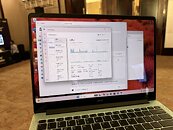
One of the first Intel "Wildcat Lake" laptops has been revealed, showcasing a design language that closely resembles Apple's highly popular $599 MacBook Neo model. Intel's own reference design model features a standard 6-core "Wildcat Lake" configuration with two Xe3 cores and a 17 TOPS NPU, all housed in an aluminium chassis with a bright color theme, similar to Apple's MacBook Neo. The Intel reference design "Wildcat Lake" laptop operates with a 17 W PL1 mode, which measures the base TDP, and a 35 W PL2 for running the new WCL chip at maximum turbo frequency. There is also a high-performance mode for maximizing core performance with a 22 W PL1 base TDP, as well as a mode for fanless operation. In the PL1 power mode at 11 W, WCL chips can function in fanless environments, making them very versatile.

When Intel launched the "Wildcat Lake" Core 300 series of processors, the company aimed to satisfy value-oriented buyers seeking good CPU performance and basic GPU output in small form-factor commercial and edge AI PCs. The platform's hybrid core configuration, combining two "Cougar Cove" P-cores with four LPE "Darkmont" cores, should provide sufficient CPU power for basic tasks in the entry-level segment. Especially when paired with the NPU 5, Xe display and media engine, and a GPU that includes up to two Xe3 cores, this SoC should handle tasks with ease, along with some very light entry-level gaming.


System76 Redefines Linux Platform with Redesign of Thelio Desktop and Workstation

Today, System76, the leading Linux-first computing platform, introduced significant updates to its Thelio product family with the new Thelio Mira desktop and Thelio Major workstation. The two systems - designed, engineered, and manufactured in Denver - deliver a complete range of professional and mission-critical capabilities for organizations that demand sustained performance, open architecture, and hardware built to last.

Engineered for Linux from the hardware up, both systems ship with Pop!_OS 24.04 LTS or Ubuntu. This full-stack approach distinguishes System76 from any other desktop manufacturer in the market.

Bolt Graphics Completes Tape-Out of Test Chip for Its Zeus GPU

Bolt Graphics today announced the successful tape-out of its test chip, marking a key milestone in the development of its Zeus GPU. Zeus is a next-generation compute platform designed to reduce the total cost of compute by up to 17 times across high-performance computing (HPC), rendering, and emerging compute-intensive applications.

Global demand for compute capacity continues to accelerate to support capabilities such as simulations, real-time graphics, and artificial intelligence across a wide range of industries. To address the need, companies optimized existing compute architectures for peak performance rather than cost efficiency, causing infrastructure cost to become a primary constraint. As the majority of workloads remain dependent on these architectures, large segments of the available market remain economically unviable.

Gigabyte Collaborates with NVIDIA on GeForce RTX 50 Series and Pragmata Bundle

Gigabyte, the world's leading computer brand, announces the collaboration with NVIDIA for the PRAGMATA GeForce RTX 50 Series game bundle across eligible graphics cards, desktops, and laptops powered by NVIDIA GeForce RTX 5070 or above GPUs and Laptop GPUs. Powered by NVIDIA Blackwell architecture, the GeForce RTX 50 Series GPUs bring game-changing capabilities to gamers. Equipped with a massive level of AI horsepower, the RTX 50 Series enables new experiences and next-level graphics fidelity. Combined with Gigabyte's cutting-edge cooling designs, the bundle aims to unleash smoother gameplay and a more immersive PRAGMATA gaming experience.

The GeForce RTX 50 Series GPUs leverage a trio of key technologies to elevate gameplay. Path tracing simulates the physical behavior of light to deliver photorealistic and real-time 3D graphics. Alongside NVIDIA's suite of neural rendering technologies, NVIDIA DLSS 4 leverages AI technologies to boost FPS, reduce latency, and enhance image quality, while NVIDIA Reflex further reduces system latency for more responsive control.

Xbox VP Confirms 1st-Party Xbox Helix, Opens Door to Speculation of 3rd-Party Variants

We've known for a while now that the upcoming Xbox Project Helix game console will be a hybrid game console, able to play both PC and Xbox games, but recently news broke that the Xbox Helix would be using an off-the-shelf AMD APU, followed by a leak from KeplerL2 on the NeoGAF forums that it would be a third-party console. The latter rumor claimed that the Xbox Helix would not be available directly to consumers from Microsoft itself, instead adopting something of a Steam Machine model—the original Steam Machine, not the 2026 reboot—and making the hardware design available to hardware partners similarly to how AMD and NVIDIA sell their GPUs to board partners who package them in their own way.

Xbox Vice President, Jason Ronald, chimed in with a response on X, saying simply that "Project Helix will be available as a 1st party Xbox console," and nothing more. While this somewhat debunks the rumor started by KeplerL2, it also leaves the door open to the possibility of third-party Helix consoles. This idea somewhat holds water, given the context of the previous rumor about the off-the-shelf APU. If Microsoft did not license the Xbox Helix design, and brands could simply buy the APU directly from AMD to make their own hardware platforms, similarly to what's been happening with other Radeon 780M-powered APUs that have been popping up in Windows gaming handheld devices since the Ryzen Z1 Extreme handhelds launched.

Framework Laptop 13 Pro Brings Core Ultra Series 3 CPUs, LPCAMM2 Memory, and Improved Battery Life

Today, we're happy to introduce Framework Laptop 13 Pro, a complete ground up redesign that brings a massive leap in battery life with Intel's Core Ultra Series 3 Processors, a 74 Wh battery, and LPCAMM2 memory, a new full CNC aluminium chassis, our first purpose-built power-optimized display with touch support, an excellent feeling haptic touchpad, an option for pre-loaded Ubuntu, and much more.

In many ways, this product has been six years in the making. We've taken all of the feedback you've given us on the first seven generations of Framework Laptop 13 to make this the ultimate portable developer and power user machine. With all of this, it's still a Framework Laptop, meaning it's repairable, upgradeable, customizable, and entirely yours to do what you want with. Framework Laptop 13 Pro is available to pre-order today, starting at $1,199 USD for DIY Edition and $1,499 USD for pre-built configurations, with first shipments in June.

End of an Era: macOS 27 Drops Support for Intel-Based Macs

Apple is making its latest macOS 26 release the last official operating system that will run on Intel-powered Macs. This means that starting with next year's macOS 27 release, new operating system updates will be available only on the M-Series of Apple Silicon. For macOS 26, codenamed "Tahoe," several Intel-based Macs will still support this latest release. These include the 2019 Mac Pro, 2019 MacBook Pro 16-inch, 2020 MacBook Pro 13-inch, and the 2020 release of the 27-inch iMac. These models will receive the latest macOS "Tahoe" operating system support this year, while next year's macOS 27 will officially end the rollout for Intel-based Macs. This marks the end of an era for Intel-based Macs and represents the Hackintosh community's final efforts to get this operating system on non-Apple PCs.

The transition to Apple Silicon officially began in late 2020 with the introduction of the M1 SoC—Apple's first custom silicon processor that features an in-house developed CPU, GPU, and much of the surrounding IP that make up an SoC. This initiated a series of M-Series designs over the years, with the current latest being the M5 generation, led by the M5 Pro and M5 Max. The Cupertino giant has been creating custom silicon for years with its A-Series of smartphone SoCs, but only recently started a special line for Macs. The company even offers the A18 Pro-based MacBook Neo, incorporating some smartphone silicon into a $599 Mac computer for basic PC work.

Recent Linux VRAM Management Improvements Resurrect 4 GB AMD Radeon RX 6500 XT for Some Games

Natalie Vock, a well-known Valve contractor and Linux graphics driver developer, recently debuted a new patch that enabled better VRAM management on Linux for GPUs with low VRAM. When we originally covered the set of kernel patches, we noted that it could cut VRAM usage in half in some applications, potentially making certain aging graphics hardware viable for gaming where it may not have been before the patches. Aside from some early tests by Vock herself, not much other data was available at the time to draw any conclusions about the potential performance improvements. Now, thanks to NJ Tech on YouTube, we have some idea of how the patch could improve performance on a GPU like the AMD Radeon RX 6500 XT, which has a mere 4 GB of VRAM. The YouTuber tested the GPU across nine games, including some heavy hitters, like Crimson Desert, Hogwarts Legacy, and Cyberpunk 2077 in CachyOS, which was the first Linux distribution to package and release Vock's kernel patches in what it calls GPU Booster. In the current GPU market, it would be nice to have a silver bullet to make low VRAM GPUs viable, but the results are far more varied than that, with some games seeing no improvement and others seeing up to 100% increases in FPS.

In Alan Wake II, VRAM use is actually increased, but there's a more than 2× increase in FPS, going from 14 FPS to a very playable 42 FPS average. In Resident Evil: Requiem, VRAM use is identical, but there's a 16% FPS increase, and in Silent Hill f, the story is similar, with identical VRAM utilization but marginal performance increases. Crimson Desert saw a decrease in VRAM usage, but there was no measurable performance increase as a result, as was the case with Hogwarts Legacy and Cyberpunk 2077, both of which saw reduced VRAM usage but an increase of 1 FPS average in the former and identical performance in the latter. The Last of Us Part 2 actually saw a 1 FPS drop in both average and 1% low FPS, but it seems as though there was just too much graphics memory pressure for Vock's VRAM patches to mitigate the issue. Death Stranding 2 and Marvel's Spider-Man 2 also saw little to no improvement despite reduced VRAM utilization in the former. The full video by NJ Tech follows.

NVIDIA Develops 2-3x Faster Real-Time Path Tracing with Better Image Quality

NVIDIA has developed a new algorithm for path tracing that will make it 2-3 times faster, deliver better visual quality, and improve the robustness of real-time path tracing. Scheduled for a technology demo at the ACM conference on Computer Graphics and Interactive Techniques in May, NVIDIA has found a way to make real-time path tracing a fully realistic rendering process, moving beyond the usual emulation, software denoising, upscaling, and other techniques we use today. Since real-time path tracing is extremely compute-intensive, modern GPUs are still not powerful enough to execute the full path tracing technology in all its potential. Instead, we currently rely on emulations in modern games, implemented across many titles to address this computational demand. Below is the abstract described on NVIDIA's paper page, though the paper itself is not yet available as its publication is scheduled for May. However, note that the technology is still in development, and we have to wait more for it to hit commercial games.
NVIDAAlgorithms leveraging ReSTIR-style spatiotemporal reuse have recently proliferated, hugely increasing effective sample count for light transport in real-time ray and path tracers. Many papers have explored novel theoretical improvements, but algorithmic improvements and engineering insights toward optimal implementation have largely been neglected. We demonstrate enhancements to ReSTIR PT that make it 2-3x faster, decrease both visual and numerical error, and improve its robustness, making it closer to production-ready. We halve the spatial reuse cost by reciprocal neighbor selection, robustify shift mappings with new footprint-based reconnection criteria, and reduce spatiotemporal correlation with duplication maps. We further improve both performance and quality by extensive optimization, unifying direct and global illumination into the same reservoirs, and utilizing existing techniques for color noise and disocclusion noise reduction.

NVIDIA GeForce RTX 3060 12 GB Returns in June, RTX 5050 9 GB Edition on Pause

NVIDIA's GeForce RTX 3060 12 GB "Ampere" GPU, which is two generations old, is expected to make a comeback in June this year. Meanwhile, the rumored RTX 5050 9 GB edition is reportedly on hold. According to well-known hardware leaker MEGAsizeGPU on X, NVIDIA is pausing the transition from its 8 GB RTX 5050 "Blackwell" version to a 9 GB model due to the reintroduction of the GeForce RTX 3060 12 GB "Ampere" GPU. Since both of these GPUs compete in the budget segment, the company will reportedly only release the older GeForce RTX 3060 12 GB SKU with a 192-bit wide memory bus. For this, NVIDIA will once again use Samsung's 8 nm DUV node, as it has in the past. The entire NVIDIA "Ampere" architecture lineup was produced on the 8 nm DUV node, and its return after several years was unexpected. However, since NVIDIA has transitioned to TSMC for manufacturing its "Ada Lovelace" and latest "Blackwell" GPUs, becoming TSMC's largest customer using the 5 nm node, this move is intriguing.

The NVIDIA GeForce RTX 3060 features 3,584 CUDA cores and 12 GB of GDDR6 memory. In contrast, the GeForce RTX 5050 has newer CUDA cores on a smaller node with 2,560 cores on the GB207 die, but it has less memory, with only 9 GB of the rumored GDDR7. Since the resurrected GeForce RTX 3060 will use the older GDDR6 memory, sourcing GDDR6 may have been easier for NVIDIA, leaving the more expensive GDDR7 for its other GPUs.

Intel Arc GPU Graphics Drivers 101.8724 WHQL Released

Intel today released its latest Arc GPU graphics drivers with the version 101.8724 WHQL bringing support for new hardware and new games. Yesterday, the company launched its Core Series 3 "Wildcat Lake" processors with up to six CPU cores and two Xe3 GPU cores. Expected to land in over 70 different laptop designs, Intel today enabled full gaming support with the Arc GPU driver update. In addition to new hardware, the new driver release adds game-ready support for Pragmata and fixes a lot of the old issues that persisted with the previous releases. These include fixes for flickering in Crimson Desert running DirectX 12, No Man's Sky experiencing corruptions on certain terrains, and importantly issues with Adobe Premier Pro crashing when exporting media based on HEVC codec has been fixed. For a complete picture of fixes and remaining issues, we have posted the changelog below.
DOWNLOAD: Intel Arc Graphics Driver 101.8724 WHQL

Panasonic Connect Launches the TOUGHBOOK 56

Panasonic Connect North America, Division of Panasonic Corporation of North America, today launched the TOUGHBOOK 56, a powerful, modular rugged laptop purposefully built to empower mobile workers in sectors including public safety, utilities, enterprise and federal. TOUGHBOOK 56 delivers high performance computing, expanded connectivity speeds options, enhanced thermal management, and advanced security. Backed by new warranty options, it provides customers with greater flexibility and long-term peace of mind.

Frontline and field professionals must work with increased efficiency to deliver fast, high-quality service, while navigating unpredictability and resource constraints that make getting the job done infinitely challenging. TOUGHBOOK 56 is engineered with these professionals in mind, bringing advanced performance, security, innovation, and design to the edge, in a rugged, reliable, and dependable package. For IT teams, TOUGHBOOK 56's modular architecture, updated admin management software and expanded support simplify upgrades and extends device lifecycles as operational needs evolve.

Intel "Crescent Island" Xe3P to Skip Arc Gaming GPUs, Focus on Workstations

Intel's upcoming "Crescent Island" series of GPUs, based on the newly developed Xe3P graphics IP, will be hitting the market this year. However, it seems this IP won't be featured in the desktop Arc gaming series of discrete GPUs. According to a reliable leaker, Jaykihn, Intel will not release this GPU generation as dedicated Arc gaming graphics cards. Instead, Xe3P-based GPUs will power "Crescent Island" data center and workstation GPUs, similar to the current Arc Pro series for professional users. This leaves Arc gamers without a clear indication of when, or even if, they will receive a new gaming Arc GPU based on the Xe3 or Xe4 IP in the coming months.

Intel recently announced the Arc Pro B70 and Arc Pro B65 graphics cards, which maximize the BMG-G31 "Battlemage" Xe2 silicon but are intended for professional users only. A recent driver update added the ability to play games on these cards, but they are still primarily designed for AI workloads and professional visualization. Gamers are still seeking clarity about future updates, and the lack of recent rumors regarding an additional Arc gaming discrete GPU is concerning. Even the higher-end Arc B770, which has been rumored for some time, seems to be on hold. Upcoming events like Computex might offer Intel a chance to at least provide a teaser of what the desktop Arc GPU family will look like or if there will be any updates soon.

NVIDIA To Pause RTX 5060 Ti 8 GB Supply in Late April

A leak from early 2026 claimed that NVIDIA would be pausing production of the GeForce RTX 5060 and RTX 5060 Ti for as long as six months starting in the beginning of 2026, with the leaker predicting that supply would start to worsen in the beginning of 2026 and relief only coming in Q4. While it seems as though this may not have come to pass as predicted, a new rumor claims that supply for the NVIDIA GeForce RTX 5060 Ti 8 GB may be halted for two weeks at the end of April 2026. As Gazlog reports, the alleged production halt is as a result of oversupply of the entry-level GPUs.

This production and supply pause means that third-party GPU vendors will not receive 5060 Ti GPUs during this pause, although production is slated to resume in May. The running theory is that the oversupply is causing prices of the 5060 to decline, and the production pause would create artificial scarcity and return the prices to previous levels. Curiously, this news comes hot on the heels of news that NVIDIA may be launching a new 9 GB variant of the RTX 5060 and 5060 Ti near Computex around May or June. It should be pointed out that this is merely a rumor and may not come to pass at all, although leaks that come out of Board Channels generally do carry a decent amount of weight.

NVIDIA Launches Ising Open AI Models to Accelerate the Path to Useful Quantum Computers

NVIDIA today announced the world's first family of open source quantum AI models, NVIDIA Ising, designed to help researchers and enterprises build quantum processors capable of running useful applications. To achieve useful quantum applications at scale, significant breakthroughs are needed in quantum processor calibration and quantum error correction. AI is key for turning today's quantum processors into large-scale, reliable computers. Open models empower developers to build high-performance AI while maintaining total control over their data and infrastructure.

Named after a landmark mathematical model that dramatically simplified the understanding of complex physical systems, the NVIDIA Ising family provides high-performance, scalable AI tools for quantum error correction and calibration — two of the most critical challenges in building hybrid-quantum classical systems. Ising models run the world's best quantum processor calibration and enable researchers to tackle much larger, more complex problems with quantum computers by delivering up to 2.5x faster performance and 3x higher accuracy for the decoding process needed for quantum error correction.

Thermal Grizzly Introduces New DeltaMate GPU Block for ROG Astral 5080

With the DeltaMate GPU Block Astral - ROG 5080, Thermal Grizzly introduces a GPU water block with a viewing window made of Schott BOROFLOAT glass. Borosilicate glass refracts the light of the integrated RGB lighting differently than acrylic glass, making the new GPU block a visual highlight. In addition, the glass is less susceptible to alcohol-based cleaners.

The design of the DeltaMate GPU Block Astral - ROG 5080 water block is otherwise identical to other water blocks in the DeltaMate series and therefore shares their features:
  • Ultra-High-Performance microfins with 0.2 mm structure width
  • Full-metal construction with RGB-illuminated viewing window
  • Targeted cooling of all VRAM and VRM components
  • Configurable with Through Terminal (4-port) or Direct Terminal (2-port) made of brass
  • Thermal paste, thermal pads, and putty included in the scope of delivery

MSI Unveils New Raider and Crosshair Gaming Laptops with Up to 300W Combined Power

MSI, a global leader in gaming, content creation, and business & productivity laptops, proudly introduced the redesigned Raider and Crosshair gaming laptop series, built for gamers seeking high-performance 16-inch laptops with the latest Intel Core Ultra 200HX Plus processors and NVIDIA GeForce RTX 50 Series Laptop GPUs. The new lineup delivers up to 300 W combined CPU and GPU power on select Raider models and up to 200 W on select Crosshair models, alongside upgraded cooling, OLED display options, and rear I/O for cleaner cable management. These models set a new benchmark as the most powerful gaming laptops in the industry.

MSI has also upgraded its existing 18-inch gaming lineup, including the Titan 18, Raider 18 Max, and Stealth 18. In addition to featuring the Intel Core Ultra 200HX Plus processors, users can experience ultra-smooth visuals through top-tier specifications such as a 4K 240 Hz Mini LED display.

NVIDIA GeForce RTX 5060 and 5060 Ti Planned With 9 GB VRAM

It was recently revealed that NVIDIA plans to launch a version of the RTX 5050 GPU with 9 GB of VRAM—three 3 GB modules of GDDR7 over a 96-bit bus and 336 GB/s total memory bandwidth. Now, according to a new leak by Hakuitado on the Board Channels forum (via Gazlog), NVIDIA is planning to make the same move with the RTX 5060 and 5060 Ti in order to cater to budget consumers while avoiding high DRAM and BOM costs.

DRAM quantity aside, the move would also see NVIDIA decrease the bus width of the respective cards, going from 128-bit to 96-bit by using new 24 Gbit memory chips, resulting in an overall decrease in bandwidth and reduced memory performance. According to @harakuze5719 on X, the new 9 GB NVIDIA GeForce RTX 5060 and 5060 Ti GPUs are slated to launch sometime between May and June, with a Computex launch seemingly likely.

NVIDIA DLSS Comes To Cthulhu: The Cosmic Abyss, MONGIL: STAR DIVE, PRAGMATA and Windrose

Each week, new games and apps integrating NVIDIA DLSS, NVIDIA Reflex, and advanced ray-traced effects are released or announced, delivering the definitive PC experience for GeForce RTX players. This week, PRAGMATA launches with path-traced effects, DLSS Multi Frame Generation and DLSS Ray Reconstruction, giving GeForce RTX gamers the definitive experience. Additionally, DLSS comes to Cthulhu: The Cosmic Abyss, MONGIL: STAR DIVE, and Windrose this week. And INDUSTRIA 2 launches with DLSS 4.5 this month. And a new sci-fi first-person shooter called Fragmentary Order has been announced, which will launch with DLSS 4.5.

PRAGMATA GeForce RTX 50 Series Bundle Available Now, Ahead Of April 17th Launch, Featuring Path Tracing & DLSS
Set in the near future, CAPCOM's PRAGMATA transports players to a lunar research station. In the years since the discovery of Lunam Ore, humanity has developed Lunafilament, a material capable of replicating almost anything. One day without warning, Earth lost contact with the station dedicated to this Lunafilament, as all signals went dark.

NVIDIA Says It Is Not in Talks to Acquire a PC Maker

Yesterday, SemiAccurate posted a rumor that NVIDIA was planning to acquire a large PC maker, which would have reshaped its position within the PC space. However, it turns out the rumor is not true. NVIDIA issued a statement to CNBC saying, "The media report is false; NVIDIA is not engaged in discussions to acquire any PC maker." This brief statement effectively shuts down the rumors, suggesting that NVIDIA does not plan to go through with such an acquisition, even if it might have been considered in the past. Large corporations, especially with NVIDIA's $4.6 trillion market capitalization, are always looking to expand their business in areas where they are dominant and enter new markets where they could capture a significant share. NVIDIA holds a strong position in the dedicated GPU market, with about 94% market share among AIB GPU shipments.

The company is also looking to enter the laptop space with the upcoming N1/N1X SoCs, which would allow NVIDIA to tap into a completely new segment among PC users. In this context, acquiring a PC company would be a logical move, but it would present significant regulatory hurdles, as the company might not get approval from market regulators in the United States, European Union, and other regions. Now that we know the rumor is not true, we are waiting to see if any more rumors emerge about which company might have been the potential target. For now, we are refraining from making definitive claims or pointing fingers at any specific company.

Intel Prepares "Nova Lake" Desktop APU with 12 Xe3P Cores

Intel's upcoming Core Ultra 400 Series "Nova Lake-S" desktop processors are set to launch in the second half of this year, marking what seems to be the company's most ambitious lineup yet. Recently, new rumors have emerged suggesting that Intel is also working on a "Nova Lake-S" desktop APU featuring 12 Xe3P graphics cores. This configuration is expected to deliver graphics performance similar to the Arc B390 integrated GPU found in "Panther Lake," albeit with a slight twist in the overall GPU core design. We've already covered a recent leak detailing the entire Core Ultra 400 Series "Nova Lake-S" desktop lineup, but it seems Intel is developing and testing more in its labs than initially anticipated. Readers may recall brief rumors about a variant called "Nova Lake-AX," which was rumored to feature a single compute tile with eight "Coyote Cove" P-cores and 16 "Arctic Wolf" E-cores, along with a four-core LPE island, totaling 28 cores. The iGPU configuration for this variant was said to include 48 Xe3 cores, potentially making it one of the most powerful APUs ever.

However, since the "Nova Lake-AX" appears to be on hold, Intel is preparing other solutions with less powerful GPU configurations. According to a post by Jaykihn on X, the new desktop APU would feature four "Coyote Cove" P-cores, eight "Arctic Wolf" E-cores, and four LPE-cores. This 4+8+4 configuration would be paired with 12 Xe3P cores, which are slightly different from the regular Xe3 cores used in the standard "Nova Lake-S" desktop processors. Intel's lineup is becoming somewhat confusing, but it seems the main lineup will consist of standard desktop series split into several SKUs with high core counts and bLLC, or the newly rumored SKU with more Xe3P cores and fewer CPU cores, similar to AMD's Ryzen G-Series of desktop APUs. Do note that the image below is just an illustration, and not the actual render.

Valve Engineer Improves Linux Memory Management for GPUs with 8 GB VRAM or Less

Valve's Linux developer, Natalie Vock, has introduced a new method for handling memory management on GPUs with 8 GB or less VRAM. Since a large part of the gaming community uses systems with limited resources, improving performance and VRAM allocation is an excellent way to maximize frames per second. According to Vock's solution, GPUs with 8 GB of VRAM or less on Linux will now benefit from better background VRAM management, allowing more free space for games. Several Linux kernel patches have been submitted to guide how Linux manages resources when a game is loaded. Previously, when a game used too much VRAM on a low-VRAM GPU, the Linux Graphics Translation Table (GTT) would move data to system RAM to prevent the game from crashing. Since Linux doesn't prioritize programs, it could sometimes move the actual game from VRAM to system RAM to make space for something like a browser or another third-party app.

In Vock's testing before these new patches, running Cyberpunk 2077 resulted in the system using only 6 GB of the 8 GB of available GPU VRAM, with about 1.37 GB spilling over to GTT and being allocated in system RAM. This could lead to game stuttering and frame-pacing issues. Now, Vock has developed a real-time dmemcg-booster, which stands for Device Memory Control Groups, to inform Linux when a program running on the GPU VRAM needs to stay there without being moved to GTT and then to system RAM. With the new patch, running Cyberpunk 2077 now uses almost the entire available system VRAM, reaching 7.4 GB, while GTT allocation has been reduced to 650 MB, cutting usage by more than half. In the picture below, you can check the "GameThread" behavior before and after the patch is applied.

ASUS Introduces ROG Equalizer 12V-2x6 Cable for GPU Power Stability

ASUS has introduced the ROG Equalizer, a new 12V-2×6 PCIe power cable designed to improve power delivery stability for modern GPUs. The cable is compliant with ATX 3.1 and PCIe 5.1 standards and will be bundled with the company's upcoming ROG Thor III and ROG Strix Platinum power supplies. The ROG Equalizer targets ongoing reliability issues around 16-pin GPU power connectors by focusing on load balancing across all pins. According to ASUS, the cable is designed to distribute power more evenly across all the wires, this reducing the risk of hotspots caused by uneven load. The cable supports up to 17 A per wire, compared to standard 12V-2x6 cables, which are rated at 9.2 A per wire (per pin).

ASUS also claims the design keeps operating temperatures around 73°C even when some wires aren't under full load, a situation where standard cables can run noticeably hotter due to uneven current distribution across the conductors. The exact internal engineering hasn't been provided by ASUS, but the likely approach is equalizing the impedance across all conductors (wires) to spread the load more evenly. The cable itself is 750 mm long, braided in a dual-tone finish, and ships with cable combs for tidier routing. It follows a GPU-first wiring layout and is built with high-power delivery in mind. No information regarding pricing yet.

NVIDIA N1 Gaming SoC Surfaces on Laptop Motherboard with 128 GB LPDDR5X Memory

NVIDIA's upcoming N1 SoC, designed for gaming laptops, has officially appeared for the first time alongside its motherboard intended for a laptop. Featuring 128 GB of LPDDR5X memory running at 8,533 MT/s, the SoC is paired with SK hynix modules. NVIDIA's OEM partners for this launch, including Dell and Lenovo, have confirmed that the new NVIDIA laptop platform will be available this year, and we have seen early benchmark submissions of the N1 SoC. As NVIDIA prepares to enter the gaming laptop market, the company initially released its GB10 SoC for the DGX Spark mini workstation. This chip allowed NVIDIA to test its collaboration with MediaTek on developing new low-power SoCs that offer unusually high-performance graphics for AI applications, as well as very high RAM capacity.

In the latest images that appeared on Goofish, we see a laptop motherboard equipped with the NVIDIA N1 SoC and 128 GB of LPDDR5X memory closely packed in a specialized PCB area. This area might be designated for the cooler, which could potentially also cool the LPDDR5X memory modules. NVIDIA plans to introduce its N1/N1X SoCs with Arm-based CPU cores around Computex 2026. These will offer consumers 20 CPU cores, consisting of 10 Cortex-X925 and 10 Cortex-A725 CPU cores based on the Armv9.2 ISA, along with a "Blackwell" GPU optimized for low power settings with up to 6,144 CUDA cores in the higher-end form. You can also see the port selection on the side of the PCB, which seems to be USB-C or Thunderbolt 4/5, USB-A, and an HDMI connection. Since we don't know which laptop model this is, we have to wait a bit more before getting final details.

MSI Reveals The MAG Infinite S AI 2nd Gaming PC

MSI, a world leader in gaming hardware, today unveiled the MAG Infinite S AI 2nd, a gaming desktop built for players who want dependable performance, smart cooling, and clear upgrade paths. Featuring processors up to Intel Core Ultra 7 265 and graphics up to NVIDIA GeForce RTX 5070 Ti. The new MAG Infinite S AI 2nd pairs DDR5 memory and M.2 Gen 5 SSD storage slots to deliver fast load times, smooth gameplay, and headroom for future gaming titles.

Uncompromising Performance: Intel Core Ultra 7 & NVIDIA GeForce RTX 5070 Ti
The MAG Infinite S AI 2nd is meticulously engineered to push gaming performance to its limits, powered by the Intel Core Ultra processor and NVIDIA GeForce RTX 50 series graphics. Intel's advanced hybrid architecture delivers the raw processing muscle required for the most demanding modern titles, while the Blackwell GPU architecture of the RTX 50 series graphics unlocks unprecedented frame rates and visual fidelity that were previously out of reach.
Return to Keyword Browsing
Nov 22nd, 2026 16:54 CST change timezone

New Forum Posts

Popular Reviews

TPU on YouTube

Controversial News Posts